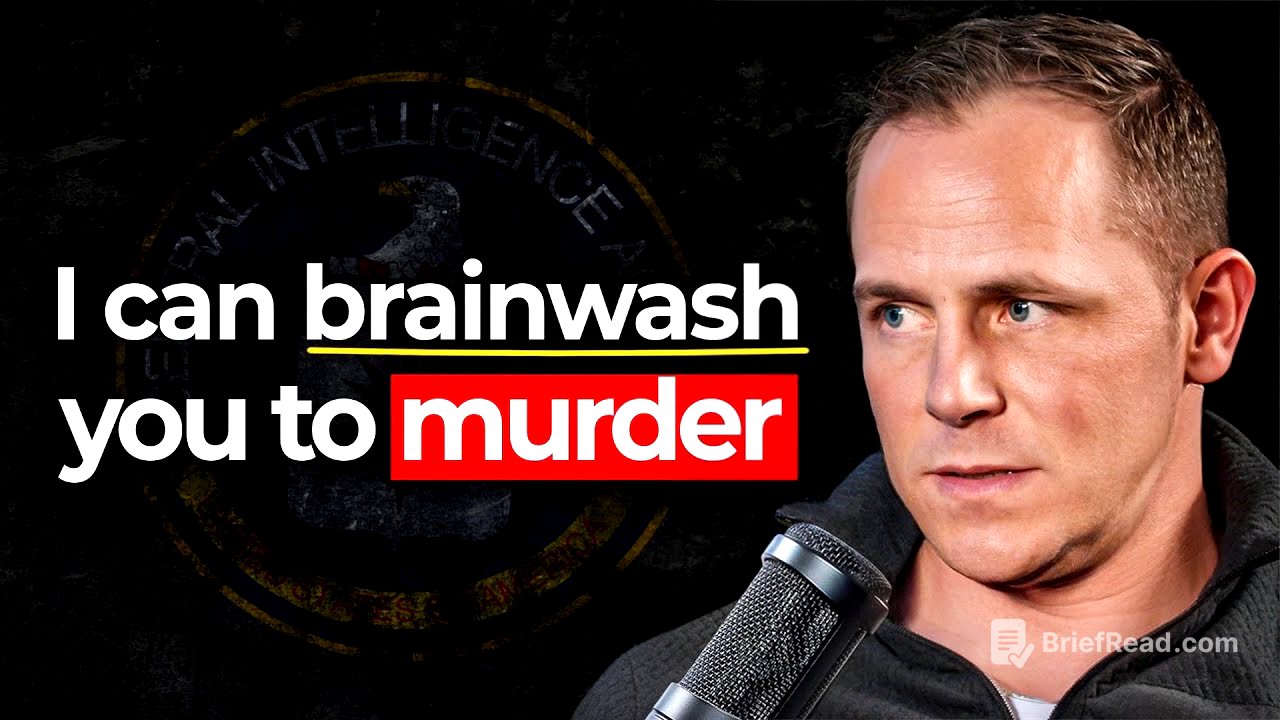
TLDR;
This YouTube video features an interview with Chase Hughes, a leading expert in human behavior, covering a wide range of topics from facial cues and body language to influence and interrogation techniques. Hughes shares insights on how to read people, influence their behavior, and understand the underlying psychological principles at play. Key takeaways include the importance of confidence, understanding social needs, and the power of non-verbal communication.
- Reading facial cues and body language to understand a person's state of mind.
- Techniques for influencing people through language, gestures, and understanding their social needs.
- The importance of confidence and self-mastery in persuasion and influence.
- Ethical considerations in interrogation and the dangers of false confessions.
Intro [0:00]
Jack Neel introduces Chase Hughes, a human behavior expert with a background in the U.S. Navy, who has trained Secret Service and military leaders in behavior profiling, interrogation, and psychological warfare. Hughes is known for educating people on the science of influence and working with CEOs and FBI agents. The episode promises to explore strategies for controlling conversations, how government elites manipulate the masses, and hidden cues that reveal what someone is thinking.
Chase Writes Down Some Predictions About Jack [1:03]
Chase Hughes makes three predictions about Jack Neel's insecurities based on their brief interaction. These predictions will be revealed at the end of the podcast to test Hughes's ability to read people. Hughes notes that much can be discerned about a person through observation, setting the stage for a discussion on human behavior and body language.
What Can You Tell About a Person Just By Looking at Their Face? [2:32]
Hughes explains that facial lines etched from repeated expressions reveal a person's dominant emotions. Smile lines indicate happiness, while lines between the eyebrows (glabella) suggest anger. Forehead lines are linked to social communication. Raising eyebrows during greetings can elicit a reflexive eyebrow raise in others. Skeptical expressions, which wrinkle the lower eyelids, can indicate a tendency to distrust. Smooth lower eyelids may correlate with higher suggestibility, a trait comedy hypnotists exploit.
How You Can Tell Almost Everything About a Person By How They Blink [6:18]
Blink rate, or blinks per minute, is a powerful indicator of stress and focus. The average blink rate is 15-17 per minute. Increased blink rate signals stress, while a decreased rate indicates focus. In high-stress situations, blink rate can exceed 80 per minute, whereas intense focus can lower it to 3-4 per minute. Changes in blink rate are more significant than the rate itself, signaling shifts in attention or stress levels. Public speakers can monitor audience blink rates to gauge engagement and adjust their presentation accordingly. Shutter speed, the speed of eyelid closure, increases with fear and decreases with comfort.
Chase Some Helpful Tips About Spotting Small Facial Cues [11:30]
Lip compression, squeezing lips together, indicates withheld opinions. Lip retraction, when the lip moves past the teeth, suggests a need for reassurance. These cues are valuable in business negotiations and social interactions, helping to understand underlying emotions and intentions. Recognizing these signs can improve communication and inform how to respond to others.
Is Physiognomy Accurate? [14:14]
Hughes dismisses physiognomy, the practice of assessing character from facial features, as largely discredited. While acknowledging its historical roots, he finds it unreliable. He emphasizes that human behavior is an art and a science, with individual differences shaped by background, culture, and personal history. Hughes likens behavior profiling to meteorology, dealing in likelihoods rather than certainties, using multiple data points to form a comprehensive assessment.
What’s the Easiest Way To Make Someone Comfortable Around You? [16:55]
To make someone comfortable, predictability and reliability are key. Approaching someone head-on can trigger an adversarial response, so a non-confrontational posture is better. The mammalian brain relies heavily on non-verbal cues, making them more important than language. Confidence is contagious and transferable, helping others feel at ease. Open palms communicate honesty and trustworthiness. Genuine confidence, not ego-driven, makes others feel more confident as well.
Chase Shares His Thought on The Trump/Zelensky Fight in the Oval Office [24:00]
Hughes discusses the importance of observing changes in body language rather than focusing on static poses. He references an interview between Trump and Zelensky, noting that genital-covering behavior in men indicates vulnerability, threat, or insecurity, while women tend to cover their abdomen. The key is to identify when these behaviors occur and what triggers them, rather than interpreting isolated gestures.
How Do You Get The Most Out of a Negotiation? [27:24]
To get the most out of a negotiation, define the desired outcome and encourage identity agreements, where the other person affirms a specific identity. This can be achieved by contrasting them with a less desirable type of person. Identity is a stronger influence than mere agreement on ideas. Asking someone how they achieved a certain positive trait can also reinforce that identity.
Chase Shares Some Secret Methods to Sneakily Influence People [32:50]
Hughes explains how to influence someone by using negative dissociation, talking negatively about a group of people to make the other person want to distance themselves from those traits. Priming involves setting the stage by planting small seeds of thoughts in the person's head. These techniques are more effective when combined with authority and confidence.
Chase Talks About Some Linguistic Methods to Gain Influence [39:20]
Linguistics play a role in influence by directing a person's attention and focus. Milton statements, or presumptive statements, can help the brain picture and imagine certain scenarios. Vivid communication translates into the mammalian brain, capturing attention. Embedded commands, hidden within language, can influence behavior. Ambiguity in speech, such as blurring the lines between phrases, can also be used to influence.
Why Confidence is Key When Influencing Others & What “Confidence” Actually Means [49:40]
Confidence is crucial for influence and has nothing to do with hierarchy or status. It involves treating everyone the same and not comparing oneself to others. Developing a comfort with social injury, being willing to be embarrassed, and believing things will generally work out are key to building confidence. Unlimited self-forgiveness helps eliminate shame and fear of judgment.
Chase Shows Some Gestures Hacks To Easily Influence People [57:06]
Gestures can be used to associate ideas with oneself or create a connection with others. Pointing at oneself while saying "fascinating" can generate focus. Using gestures to emphasize connection can also be effective. These techniques are more effective when combined with confidence and authority.
What Are Some Habits That Make People Dislike You? [1:00:55]
Habits that make people dislike you include not being interested in others and trying to be on top. People have social needs for significance, acceptance, and approval, and taking these away can create negative feelings. Understanding and meeting these social needs is crucial for persuasion and building rapport.
How Do You Compliment Powerful People? [1:05:45]
When dealing with people who have high egos and reject compliments, ask for their advice. Use what they say about themselves to explain why they are perfect to answer a question. By giving advice, they are agreeing not to be the person you are asking about.
When Is The Right Time to Mirror Someone’s Body Language? [1:10:55]
Mirroring is a symptom of liking each other, not a cause. It happens after trust is developed. It's more important to match someone emotionally and cognitively than to mimic their physical posture. Focus on mirroring the mammal, not just the body.
What Is the Best Way To Reveal Someone’s Inner Thoughts? [1:19:10]
To reveal someone's inner thoughts, use statements instead of questions. Summarize what they say and then make provocative statements to trigger a need to correct the record. This elicits more information without making them feel questioned.
When is the Best Time to Ask Someone a Question? [1:24:15]
Use 90% statements and 10% questions, especially when dealing with sensitive topics. Paint vivid pictures with sensory-rich information to engage the mammalian brain. Describe scenarios and emotions in detail to translate experiences into the mammalian brain.
Is Torture Better Than Kindness For Interrogators? [1:31:10]
Kindness is more effective than torture in interrogations. Torture pushes people to the bottom of Maslow's hierarchy of needs, where they will say anything to survive. Kindness, on the other hand, builds rapport and elicits more truthful information.
Chase Shares Some Key Questions Police Officers Use During Interrogations [1:33:50]
Key questions in police interrogations include the bait question, which places the suspect at the scene, and the punishment question, which gauges their perception of the crime. After these questions, the interrogation transitions into a monologue designed to offload guilt. The monologue involves socializing, minimizing, rationalizing, projecting, and asking an alternative question.
Chase Talks About Why People Sometimes Give False Confessions [1:45:45]
False confessions can occur when interrogators prioritize confession over truth. Sleep deprivation and manipulation can increase suggestibility and lead to false memories. The intent of the interrogator is crucial; ethical interrogators prioritize truth and avoid coercive tactics.
What’s the CIA’s Most Disturbing Experiment? [1:49:35]
The CIA's most disturbing experiment, according to Hughes, involved psychic driving in Canada, where people were given massive doses of LSD and forced to watch videos. Another experiment, Project Midnight Climax, involved drugging people with LSD in a brothel and observing their behavior.
Chase Talks About The Science and History of Hypnosis [1:54:30]
Hypnosis involves getting the brain into a Theta brain wave state, relaxing the body, and obtaining focus. It is not about forcing someone to do something against their will but about modifying context and perception. Factors that determine success with hypnosis include focus, openness, connection, suggestibility, compliance, and expectancy.
Chase Talks About The Manson Family [1:55:00]
Cult leaders like Charles Manson use mammalian brain control and the six elements of human brain control to influence their followers. By capturing the mammalian brain and manipulating emotions, they can get people to do anything.
Chase Hypnotises Jack Live in Studio. [2:07:23]
Chase hypnotizes Jack live in the studio, guiding him through a relaxation process and implanting a suggestion for increased focus.
Jack Shares With the Audience the Uncanny Accurate Predictions Chase Made at the Beginning of the Show. [2:12:00]
Jack reveals the predictions Chase made at the beginning of the show, confirming their accuracy.
What’s the Best Piece of Advice You’ve Ever Received? [2:13:30]
The best piece of advice Chase ever received was "do not fear," which is repeated in ancient religious texts. Fear is the opposite of love, and a good life involves getting out of fear and being more openhearted.