TLDR;
This YouTube video features a series of presentations and discussions from Bitcoin Magazine's "Bitcoin for Corporations" conference. The main topics covered include Bitcoin adoption trends, corporate treasury strategies, the role of digital credit, and the future of Bitcoin in wealth management. Key takeaways include:
- Institutional adoption of Bitcoin is accelerating, with businesses, funds, and governments becoming net accumulators.
- Digital credit instruments, like Stretch, are emerging as a way to generate yield and attract more investors to Bitcoin.
- The regulatory landscape is evolving, with the potential for greater clarity and integration of Bitcoin into traditional financial systems.
- Education and clear communication about the risks and benefits of Bitcoin are crucial for wider adoption.
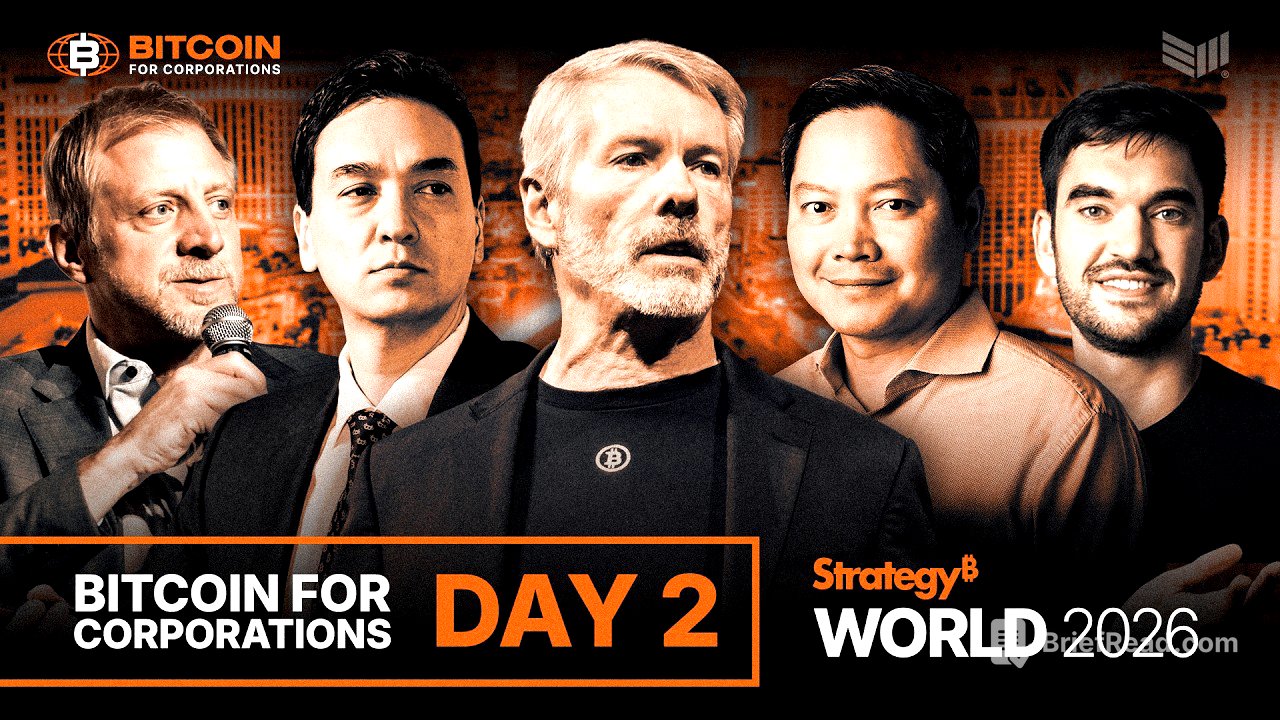
Welcome to Bitcoin for Corporations Day 2 [8:46]
Natalie Brunell welcomes attendees to the second day of the Bitcoin for Corporations conference, highlighting Bitcoin's morning price increase and thanking the room host, Laam and Watkins. She encourages attendees to submit questions for Michael Sailor and Fong Lee's interactive Q&A session later in the afternoon. The first session will feature Alex Leechman, CEO of River, discussing Bitcoin adoption trends, followed by George McCale, Managing Director of Bitcoin for Corporations, providing an adoption update.
Bitcoin Adoption Trends with Alex Leechman [9:28]
Alex Leechman presents data on Bitcoin adoption trends from 2025 through early 2026, noting that despite the current bear market, institutional adoption is accelerating. Institutions, businesses, funds, and governments have been net accumulators of Bitcoin, purchasing it from individuals. He shows a chart extrapolating Bitcoin ownership, suggesting that by 2035, half of Bitcoin might be owned by institutions. This trend is driven by the popularity of Bitcoin on Wall Street, with over 60% of top US banks building Bitcoin products and over half of the top US hedge funds having Bitcoin allocations. He notes that while registered investment advisors (RAAs) are increasing their Bitcoin holdings, it still represents a tiny fraction (0.006%) of their managed assets. Businesses have also been major contributors to capital inflows, with record inflows in 2025, particularly from treasury companies and conventional businesses. He also notes the steady growth in merchants accepting Bitcoin payments, especially since Square unlocked Bitcoin payments in their merchant product. River's business client base more than doubled last year, serving various mainstream businesses. A survey of these business owners revealed that 63% plan to hold Bitcoin indefinitely. He concludes that the market downturn is temporary and the next market cycle will be driven by institutional adoption.
Bitcoin for Corporations Adoption Update with George McCale [17:53]
George McCale discusses the events of 2025, emphasizing the mission of Bitcoin for Corporations to accelerate corporate Bitcoin adoption. He references the BFC's first annual report on corporate Bitcoin adoption, highlighting that the number of public companies holding Bitcoin on their balance sheets grew from 90 to approximately 167, with corporate holdings increasing by 73% year-over-year, adding about half a million Bitcoin to balance sheets. He notes the emergence of numerous Bitcoin Treasury companies. Despite the growth, some companies ceased or pivoted away from their Bitcoin strategy, and some were forced sellers. He shares the story of Prenetics, a healthcare company backed by David Beckham, which pivoted away from its Bitcoin strategy due to shareholder demands to reinvest in the core business. He notes that Bitcoin was the worst-performing major asset in 2025, but corporations continued to add Bitcoin to their balance sheets, indicating deep conviction. The Bitcoin for Corporations network grew from 13 to over 41 members in 15 countries. He mentions mergers and acquisitions in the space, including BTC, Inc.'s acquisition by Nakamoto. He emphasizes that the "conviction class" of executives continues to show up and resource each other, driven by strong financial incentives and a duty to execute their strategies. He also highlights the emergence of digital credit as a new market class, with a $6 billion market cap and $370 million in dividends. McCale mentions MSCI's proposed rule to reclassify Bitcoin Treasury companies, which was ultimately withdrawn after community advocacy. He discusses the scaling of the Bitcoin for Corporations network, including the addition of vendors, providers, and capital allocators. He promotes upcoming events, including Bitcoin 2026 in Las Vegas and symposiums in various locations around the world.
Bitcoin Treasury Company Leaders Panel [31:03]
Natalie Brunell introduces a panel of four leaders from Bitcoin treasury companies around the globe: Simon Gerovich, CEO of Metaplanet; Ging Gomez, founder and CEO of Orange BTC; Alexander Lzay, director of Bitcoin strategy at Capital B; and Andrew Webbley, CEO of the Smarter Web Company.
Metaplanet's Bitcoin Standard in Japan with Simon Gerovich [31:13]
Simon Gerovich discusses Metaplanet's strategy to build Japan's Bitcoin standard, despite Bitcoin's price being down almost 50% from its all-time high. He frames Bitcoin as an absolute constant with a fixed supply, while human opinion and sentiment are volatile. He highlights Japan's high debt-to-GDP ratio, inflation, and large amount of household assets sitting in cash, creating a debasement risk. He suggests that financial repression is the most likely path forward for Japan, leading to a tidal wave of capital venturing into alternative monetary assets like Bitcoin. Metaplanet's strategy involves acquiring Bitcoin through the issuance of long-dated yen liabilities, utilizing Japan's global capital cost advantage. He notes that real rates in Japan remain negative, and the spread between their cost of capital and Bitcoin's historical returns remains significant. He contrasts market cap with realized cap, noting that realized cap drawdown is only 2%, indicating the underlying economic reality of the network is at all-time highs. He shows that Metaplanet's Bitcoin per share is up 5,000% since adopting the Bitcoin standard, while Bitcoin's price has been roughly flat. He details Metaplanet's capital formation, raising $130 million in 2024 and $3.25 billion in 2025. He explains how Metaplanet uses its Bitcoin as a long-term reserve, dynamic collateral, and for Bitcoin income generation. He highlights how Metaplanet turns its stock volatility into an advantage, using moving strike warrants and stock plus warrants structures. Metaplanet holds approximately 85% of all publicly held Bitcoin in the Japanese market and ranks among Japan's industrial giants by net cash position. He notes that Metaplanet's shareholder base has grown to over 216,000, representing roughly one in every 600 people in Japan. He discusses Metaplanet's preferred equity program, including Mars and Mercury securities, targeting a variable cost of capital under 8%. He outlines the regulatory timeline in Japan, with Bitcoin becoming a regulated financial instrument by 2028. He concludes that Metaplanet is building for a market that exists in 2028, aiming to become a template for Asia and the world.
Orange BTC's Bitcoin Champion Strategy in Latin America with Gigis [47:34]
Gigis discusses Orange BTC's mission to accelerate Bitcoin adoption in Brazil and Latin America. He contrasts the deep integration of Bitcoin into US capital markets with the grassroots, retail-driven adoption in Latin America, where institutional adoption is lacking. He emphasizes that Brazil is a large economy with a structural need for Bitcoin due to inflation and currency debasement. Orange BTC aims to be a public champion for Bitcoin in Latin America, accumulating 3,722 Bitcoin and ranking among the top public companies holding Bitcoin globally. The company is designed to grow Bitcoin per share with a clean, equity-focused capital structure. Orange BTC utilizes shares in treasury to capitalize the company and buy more Bitcoin, and can also buy back shares if trading below NAV. The company focuses on principal investments, education and marketing, and financial products and access. Principal investments aim to generate returns to cover operating costs and buy more Bitcoin, with a goal to be profitable by year-end. Orange BTC has adopted stretch as part of its corporate strategy. Education efforts include a blog with best-in-class content in Portuguese and English, corporate events, and a strong online presence, including taking over bitcoin.com.br for content and education. Financial products and access initiatives include capital advisory, asset management, and credit solutions. Despite being a young company, Orange BTC has seen significant growth in its shareholder count and liquidity, driven by local market demand for Bitcoin exposure. Gigis concludes that Brazil has all the conditions for Bitcoin adoption but lacked a champion, which Orange BTC aims to be.
Capital B's Bitcoin Strategy in Europe with Alexander Lzay [1:01:27]
Alexander Lzay presents Capital B as Europe's first Bitcoin treasury company, listed on Euronext Growth Paris. He highlights Europe's 500 million individuals increasingly needing Bitcoin exposure due to rising taxes, security threats, and low deposit rates. He emphasizes Europe's mature capital markets and France's leading position in the credit market as a strong foundation for Capital B. He notes that Capital B has outperformed global benchmarks since adopting the Bitcoin standard, despite the recent downturn. He argues that digital capital is better than traditional capital, absorbing value creation and gravitating towards Bitcoin. He states that digital capital treasuries are transforming the $30 trillion market of Bitcoin into a $300 trillion market of Bitcoin credit markets. Capital B is the number one issuer in the world in terms of Bitcoin-denominated convertible notes, raising amplification to over 40% with zero fiat leverage. He mentions the potential for listed digital credit like stretch. He explains that Bitcoin-denominated convertible notes allow investors for a minus 50% drawdown reduction and a two to 3x amplification upside increase. Capital B has increased the number of Bitcoin on its balance sheet by 6,000% and the number of sats per fully diluted share by 1,600%. He emphasizes the strategy playbook at European scale, accumulating Bitcoin consistently and relentlessly, with a focus on increasing Bitcoin per share. He notes that Capital B is part of life insurance flows from asset managers and global equity flows from firms like Bitwise. Capital B has 1.4 billion of liquidity in the market, with 3 to 5 million euros of average daily volumes. He states the ambition to raise over 100 billion euros of capital over the next eight years to accumulate 1% of the total BTC supply. The objective is to continue to grow the balance sheet, grow the Bitcoin per share, and lead the integration of Bitcoin in digital capital markets for Europe.
Smarter Web Company's Bitcoin Treasury Strategy in the UK with Andrew Webley and Jesse Meyers [1:11:32]
Andrew Webley and Jesse Meyers discuss the Smarter Web Company's Bitcoin treasury strategy in the UK. Andrew Webley recounts his "Bitcoin moment" upon discovering Michael Sailor's strategy and his subsequent decision to list his business on the stock market in 2025 to build a balance sheet on digital capital. He notes that the Smarter Web Company was the best-performing equity in the UK last year. The company uplisted to the London Stock Exchange and has the largest Bitcoin treasury of any company in the UK. He highlights the company's experienced team, high standards of governance, and growth through the indexes. He shares statistics, including 2689 Bitcoin on the balance sheet, almost a quarter of a billion pounds raised, and a 1,200% share price increase last year. Jesse Meyers discusses the global asset landscape, noting that Bitcoin is still just 0.2% of global asset value. He focuses on the UK, which commands 6% of global asset value and has a financialized economy. He explains that the Smarter Web Company amplifies Bitcoin's volatility, bringing it to London public markets, which historically lack volatility. The company is the clear leader in the UK as a Bitcoin treasury company, with 4.3 times as much Bitcoin as the next closest UK Bitcoin treasury company. Andrew Webley outlines the company's goal to be one of the largest companies in the UK, progressing through the indexes to eventually become a Footsie 100 company. He discusses the company's structural properties, investor base, community support, and Bitcoin per share growth. He emphasizes the importance of transparency, honesty, and free speech in running the company. He outlines the company's pathway to success, including structural properties, investor base, community support, Bitcoin per share growth, capital tools, and global investor base.
Coffee Break [1:25:12]
A 15-minute coffee break is announced before the afternoon sessions begin.
Fireside Chat with Amy Oldenberg and Fong Lee [2:00:46]
Fong Lee interviews Amy Oldenberg, head of digital asset strategy at Morgan Stanley. Amy discusses Morgan Stanley's expertise in investment banking, investment management, and wealth management, noting that it has the largest wealth management business in the US with eight trillion dollars of assets under management. She highlights that Morgan Stanley does not have retail banking or corresponding banking business. She mentions Morgan Stanley's acquisition of Erade, providing a spectrum of wealth management options. Fong notes Morgan Stanley's long-term history as a banker for MicroStrategy, including leading their first Dutch tender auction and the Stretch IPO. Amy explains that the decision to distribute Stretch to Morgan Stanley's wealth clients was influenced by the evolving regulatory environment and risk management considerations. She highlights the unique features of Stretch, including stability, yield, and tax efficiency. Amy discusses the education needed for clients to understand preferred securities and the importance of focusing on the high-level benefits of stability and yield. She notes that Morgan Stanley has been working in the digital asset space for a long time, focusing on blockchain technology and now exploring spot crypto on the Erade platform, wallet technology, crypto ETPs, tokenization of equities and structured notes, and opportunities within their FX business. Amy explains that her role is to coordinate digital asset initiatives across the organization and build the infrastructure to support them. She emphasizes the importance of client-led initiatives and addressing client questions about allocations, tokenization, and stable coins. She confirms that Morgan Stanley will offer the ability to custody and buy and sell crypto, including Bitcoin, and is exploring yield and lending services. She notes that a considerable number of clients have crypto assets off-platform and that Morgan Stanley will allow in-kind Bitcoin deposits into ETPs. Amy discusses the potential for tokenization to democratize access to privates and strip down administrative burdens. She states that Morgan Stanley will be a player in the stable coin space if digital money happens. She discusses the role of corporations in holding Bitcoin and the potential for Stretch to be an interesting instrument for corporate treasuries. She references Denny Galindo's research recommending a 2 to 4% allocation to Bitcoin for the right types of customers. Amy concludes that the products are still pretty basic and that there is a need for more active management and sophisticated products in the cryptocurrency space.
Bitcoin Linked Convertibles with Ranga Canthadai [2:27:50]
Ranga Canthadai discusses Bitcoin-linked convertibles. Jaywood Capital is an independent capital markets advisory platform focused on equity-linked products. They partner with issuer clients, largely public companies, to help them understand and execute convertible bond transactions. Since its inception, Jaywood Capital has done over $225 billion of overall deal volume. They advise clients on structure, legal, tax, and accounting aspects of convertibles. They also consider investor composition and work with banking partners to achieve the best execution. The deal sizes vary, from $100 million to $2.7 billion, with a variety of use of proceeds, including buying Bitcoin or building AI data centers. The convertible market is smaller than the investment grade, equity, and high-yield markets. In 2025, the convertible market was the best-performing asset class, driven by volatility and credit tightening. In 2025, over $112 billion was raised in the convertible market, with half coming from technology and 15% from healthcare. The terms of recent convertible deals show investors are willing to accept low or zero interest rates and high conversion premiums due to continued volatility. The average maturity for convertibles is around five years. A convertible bond is roughly 70% bond and 30% equity call option. Strategy has revolutionized the market, raising over $9 billion in convertibles and convertible preps dedicated to buying Bitcoin. The weighted average coupon is under 50 basis points. The liability profile is largely stacked year-over-year, minimizing overlapping risk. The cost of capital for convertibles is cheaper than equity on the upside and breaks even with debt at around a 15% compound annual growth rate. Convertibles make sense for Bitcoin-related issuers due to volatility, which allows for better terms. Investors are willing to accept low coupons due to the option component and the potential for equity upside. The market is comprised of hedge funds and fundamental investors. The target market is publicly listed companies with a minimum market cap of $400 to $500 million, stock borrow availability, and trading volume.
Derivatives and Bitcoin with Gordon Grant [2:45:38]
Gordon Grant discusses the use of derivatives to create uncorrelated return streams on top of Bitcoin. He categorizes derivatives into risk management, capital efficiency, and diversification. He notes that derivatives can be a piece of financial machinery that can be a cog in your machine. He explains that while holding Bitcoin provides a one-for-one payoff profile, derivatives can generate alpha. He presents a chart showing the quarterly returns of an SMA he has managed, demonstrating that the derivative strategy continues to accrete value despite the vicissitudes of price. He notes that the Bitcoin derivatives market has limited data compared to traditional markets, requiring careful consideration of data usage. He mentions Derabit, CME, OKX, and Binance as key players in the market. He explains that digital capital treasuries are transforming the $30 trillion market of Bitcoin into a $300 trillion market of Bitcoin credit markets. He emphasizes the importance of a Bitcoin treasury company to amplify Bitcoin's volatility. He notes that the Smarter Web Company brings volatility to London public markets. He discusses the structural properties, investor base, community support, and Bitcoin per share growth of Bitcoin treasury companies. He explains that the Smarter Web Company is working on different capital tools to continue growing the company. He emphasizes the importance of Bitcoin yield and compound Bitcoin. He notes that the Smarter Web Company aims to have a global investor base with multi-index inclusion and a range of different capital tools.
Generating Bitcoin Income with Alex Bloom [2:58:37]
Alex Bloom discusses the challenges and realities of generating Bitcoin income. He argues that the narrative that Bitcoin can generate yield safely, predictably, and without trade-offs is false. He emphasizes that Bitcoin does not pay coupons and does not produce yield by default. Any return on Bitcoin is compensation for risk. He notes that the common understanding of yield implies predictability and a high expectation of principal return, which is not the case with Bitcoin. He states that to earn a return on Bitcoin, you are inherently short something, some kind of risk. He highlights the dangers of answers marketed as low risk, which are actually tail risk dressed up as yield. He notes that Bitcoin has a lot of tail risk that is severely mispriced. He explains that the goal is not to generate yield, but to generate Bitcoin-denominated income by taking noble, defined risks. He emphasizes the importance of transparency and understanding the risks involved in various strategies, such as lending, leveraging, trading, and writing options. He notes that many strategies work most of the time but are not yield strategies; they are risk capital strategies optimized for sharp or total return. He highlights the importance of principal protection and the challenges of achieving it while also generating a return. He recounts the implosion of various crypto lenders in the early 2020s, where investors lost their Bitcoin due to counterparty risk and risky lending practices. He also discusses the risks of covered calls, where a single month can erase years of returns. He notes that the market structure has shifted, with basis trades getting compressed and implied volatility decreasing. He emphasizes that there is no risk-free return and that the best you can do is know when you are going to lose and manage those risks. He advocates for changing the questions you ask, focusing on what you are risking rather than what you can make. He concludes that the future is not yield, but clarity about what Bitcoin is, what Bitcoin yield is not, and what trade-offs you are actually making.
Coffee Break [3:17:37]
Another coffee break is announced.
Fireside Chat with Brett Teesp and Fong Lee [4:46:28]
Fong Lee interviews Brett Teesp, co-CEO of Coinbase Institutional. Brett discusses his background in traditional finance, including roles at JP Morgan and Barclays, and his current role at Coinbase Institutional. He highlights the three pillars of Coinbase Institutional: exchanges, the prime platform, and asset management. The exchanges include the US spot exchange, a CFTC-regulated futures exchange, a Bermudian-regulated international swap exchange, and Darabit. The prime platform allows institutions to buy, sell, store, finance, and stake crypto. The asset management business manages third-party capital for high-net-worth individuals and pensions. Brett notes that the Genius Act was a pivotal moment for the industry, leading to increased interest from banks in stable coins and international payments. He mentions partnerships with PayPal, Revolute, SoFi, PNC, and JP Morgan. He emphasizes that Coinbase is focused on building infrastructure and providing crypto as a service. Fong asks about the potential competitive threat from banks building their own custody and exchange platforms. Brett responds that it will expand the ecosystem and that Coinbase will continue to be a major infrastructure provider. He discusses the benefits of Stretch, including its yield, tax deferral, and stability. He notes that Coinbase Asset Management has purchased Stretch in client accounts. Fong asks about tokenization and stable coins. Brett states that Coinbase is working on tokenization of stocks and is committed to 24/7 trading. He mentions Coinbase's participation in tokenization projects with Apollo and Mubadala. He highlights the potential for tokenization to democratize access to new assets. He concludes that the next big thing for Coinbase Institutional is the growth of the Cass business and the continued expansion of stable coin payments.
Interactive Q&A with Michael Sailor and Fong Lee [7:37:40]
Fong Lee and Michael Sailor answer questions from the audience, with assistance from James Lavish. The first question concerns the impact of AI on the economy and the role of digital credit. Michael Sailor responds that AI will lead to a deflationary shock by demonetizing human capital, but that digital credit, like Stretch, will serve as a bridge to this new reality. He suggests that individuals may be better off investing in Bitcoin or digital credit rather than traditional education. He emphasizes that Capital B is focused on digital credit for the future in a listed way and for the present as well in the most convex way both for investors and the company. The second question concerns the regulatory landscape for digital credit. Michael Sailor responds that he does not anticipate significant regulatory hurdles, as digital credit is not competing with sovereign credit but rather with private credit. He believes that regulators will ultimately support digital credit as a way to improve the economic system and provide opportunities for individuals. He emphasizes the importance of protecting the layer one Bitcoin protocol.