TLDR;
This video explains the concept of limiting reagents in chemical reactions, emphasizing how one reactant limits the reaction based on stoichiometric calculations. It also discusses the concept of theoretical and actual yields and how to calculate the percent yield of a reaction.
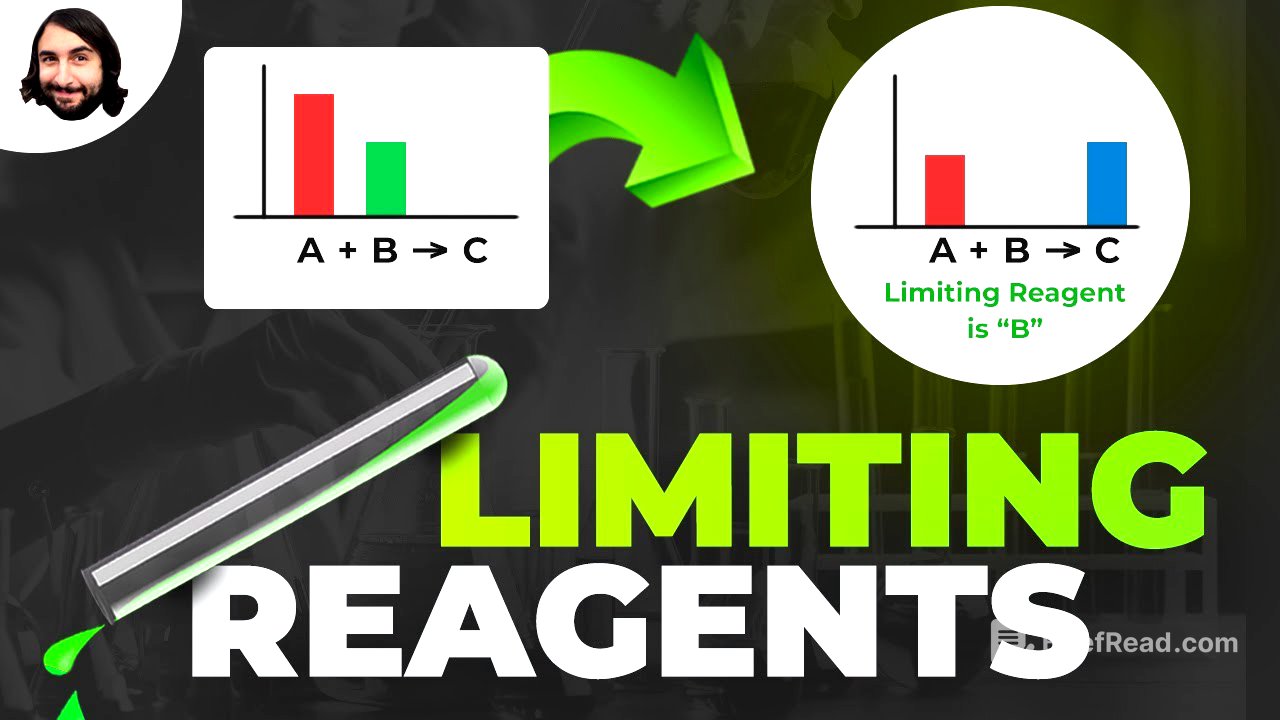
- The limiting reagent is the substance that runs out first and stops the reaction.
- Percent yield is calculated as actual yield divided by theoretical yield, multiplied by 100.
Understanding Limiting Reagents [0:00]
Professor Dave introduces the topic of limiting reagents, explaining that in chemical reactions, it is rare to have reactants in the exact amounts required for complete reactions. One reagent will be in excess while the other will be the limiting reagent, which is the one that will run out first, halting the reaction.
Identifying the Limiting Reagent [0:09]
When determining which reactant is limiting, it isn’t always the one present in the smaller amount. For example, in the analogy of making bologna sandwiches, having seven slices of bologna and ten slices of bread shows that bread is the limiting reagent as it is needed in larger quantities per sandwich.
Real-World Reaction Example [1:25]
In a practical example involving urea production, Dave uses mass to identify the limiting reagent. He converts the mass of each reactant into moles, pointing out that one reactant, carbon dioxide (CO2), cannot produce as much product as ammonia, thus CO2 is the limiting reagent.
Calculating Theoretical and Actual Yields [2:45]
The discussion moves to the concept of theoretical yield, which represents the expected amount of product if the reaction occurs perfectly. In reality, reactions yield less than the theoretical yield, leading to the calculation of percent yield as (actual yield/theoretical yield) × 100. For example, if 10 grams of product were expected but only 8.4 grams were obtained, the percent yield would be 84%.
Importance of Percent Yield [3:30]
Percent yield is a vital measurement of a chemical reaction's efficiency and proves invaluable in planning organic compound syntheses. Professor Dave wraps up by reinforcing the concept of limiting reagents and the significance of understanding yields in chemistry.