TLDR;
This lecture note covers chapters 6 to 15, discussing agrarian disputes, the rise of Filipino nationalism, Rizal's vision of the Filipino nation, and the continuing relevance of his novels "Noli Me Tangere" and "El Filibusterismo." It also explores Rizal's views on Philippine history, indolence, and the destiny of the Filipino people, emphasizing the importance of education, moral character, and unity for national progress.
- Agrarian disputes and personal experiences shaped Rizal's early life and worldview, leading him to advocate for social reform through education and awareness.
- Rizal and his contemporaries envisioned a Filipino nation based on shared values, freedom, and dignity, as reflected in his novels.
- "Noli Me Tangere" and "El Filibusterismo" expose the injustices and corruption of Spanish colonial society, with themes that remain relevant today.
- Rizal believed that studying the past objectively and critically was essential for understanding the nation's present and future.
- He argued that indolence was a result of oppression and advocated for education, infrastructure, and equal opportunities to restore Filipino diligence.
- Rizal emphasized that the destiny of the Filipino people depended on education, moral character, and unity, warning against freedom without virtue.
Chapter 6: Agrarian Disputes [0:29]
This chapter examines how agrarian unrest shaped Jose Rizal's early life and worldview. During Rizal's time, much of the land in Calamba was controlled by friar estates, leading to constant insecurity for tenant farmers due to high rents and the threat of eviction. Rizal's family experienced this injustice firsthand when they joined other tenants in refusing to pay excessive rents, resulting in retaliation from the friars, including eviction and the burning of their homes. This exposed Rizal to the harsh realities of colonial abuse and economic exploitation, highlighting the system of oppression that forced the poor toward resistance and leading Rizal to realize that social reform was necessary through education, civic virtue, and awareness, a message consistent throughout his writings.
Chapter 7: Emerging Nationalism [2:30]
This chapter explores the birth of Filipino nationalism in the late 19th century, a period of major changes in the Philippines, including a growing middle class, the rise of print media, and exposure to liberal ideas from Europe. Rizal and his contemporaries, such as Marcelo Del Pilar and Graciano Lopez Jaena, began to articulate a shared sense of national identity. Education and travel opened their eyes to the concept of a Filipino nation that could stand equal among others. Formal education, economic mobility, and global exposure created a more critical and united generation. Rizal fueled this by writing, engaging in reformist movements, and using his pen as a tool for awakening.
Chapter 8: Imagining a Nation [4:24]
This chapter explores how Jose Rizal and his contemporaries envisioned the Filipino nation before it existed. They debated what it meant to be Filipino, with some emphasizing cultural pride, others shared suffering, and still others equality before the law and civic virtue. Rizal's novels, "Noli Me Tangere" and "El Filibusterismo," vividly paint this imagined community. Through his characters and social critique, he invited readers to see themselves as part of a nation capable of progress. Rizal and his contemporaries imagined the Filipino nation as a moral and civic community defined by shared values and aspirations for freedom and dignity, rather than by blood.
Chapter 9: Noli Me Tangere - Context and Content [5:42]
This chapter discusses the context and content of "Noli Me Tangere," emphasizing that it was not just a novel but a mirror reflecting Spanish colonial society. Rizal exposed the injustices, corruption, and hypocrisy of Spanish rule. Characters like Father Damaso, Maria Clara, and Ibarra represent different sectors of society. Crisostomo Ibarra symbolizes the reformist vision, an educated patriot trapped by an unjust system. His struggles demonstrate that reform in a corrupt society can lead to tragedy. Ibarra's downfall exposes the futility of justice under tyranny. Rizal used fiction to awaken the conscience and provoke reformist thought.
Chapter 10: Continuing Relevance of Noli Me Tangere [7:36]
This chapter explores the continuing relevance of "Noli Me Tangere," noting that its themes of corruption, social inequality, and moral hypocrisy remain part of the Philippines' reality today. Rizal's critique of religious manipulation resonates in today's political climate, where faith can be used for control. His portrayal of education as liberation reminds us that critical thinking and civic responsibility are key to progress. Corruption in governance and the misuse of power mirror the novel's themes. Rizal teaches that freedom demands moral courage and vigilance against abuse.
Chapter 11: Looking at the Filipino Past [9:50]
This chapter examines Rizal as a historian and thinker, emphasizing his belief that studying the past was essential to understanding the nation's present. In his essay "The Philippines a Century Hence," he reflects a disciplined historical method, examining sources, questioning colonial narratives, and applying critical reasoning. For Rizal, history was not about memorizing dates but about awakening national consciousness. He promoted the use of primary sources, contextual analysis, and fair critique, principles that shape modern Filipino historiography. Rizal promoted objectivity, critical inquiry, and purpose in studying the past, emphasizing that history must serve the truth and the people.
Chapter 12: Indolence or Industry [11:41]
This chapter discusses Rizal's essay "The Indolence of the Filipinos," in which he dismantled the racist idea that Filipinos were lazy. He argued that indolence was a symptom of oppression, not a natural trait. Centuries of forced labor, lack of motivation under tyranny, and environmental conditions discouraged productivity. Rizal called for reforms in education, infrastructure, and equal opportunities to restore Filipino diligence. Colonial misrule breeds apathy, and education and self-determination are the cures. Rizal believed that true industry arises when people are free and respected.
Chapter 13: El Filibusterismo - The Dark Twin [13:36]
This chapter introduces "El Filibusterismo," considered by some scholars as the dark twin of "Noli Me Tangere." While "Noli Me Tangere" is about hope through reform, "El Filibusterismo" is about despair and revolution. Written during a time of deepening repression, it reflects Rizal's frustration with slow reforms. The main character, Simon, is Ibarra from "Noli Me Tangere," returning for vengeance and revolution. Simon's transformation symbolizes the anger boiling within colonial society. The dark satire of "El Filibusterismo" mirrors Rizal's disillusionment and the rising radicalism among Filipinos, serving as a warning of what unchecked injustice can cost.
Chapter 14: Continuing Relevance of El Filibusterismo [15:26]
This chapter discusses the continuing relevance of "El Filibusterismo," noting that its critique of institutions like the education system and government exposes greed and moral decay. Modern bureaucracy often mirrors the corruption and incompetence Rizal condemned. "El Filibusterismo" reminds us that without integrity and accountability, progress collapses. The metaphors in "El Filibusterismo" still speak to our time, with power without conscience breeding decay. Rizal's work remains a call for moral and civic renewal.
Chapter 15: The Destiny of the Filipino People [16:59]
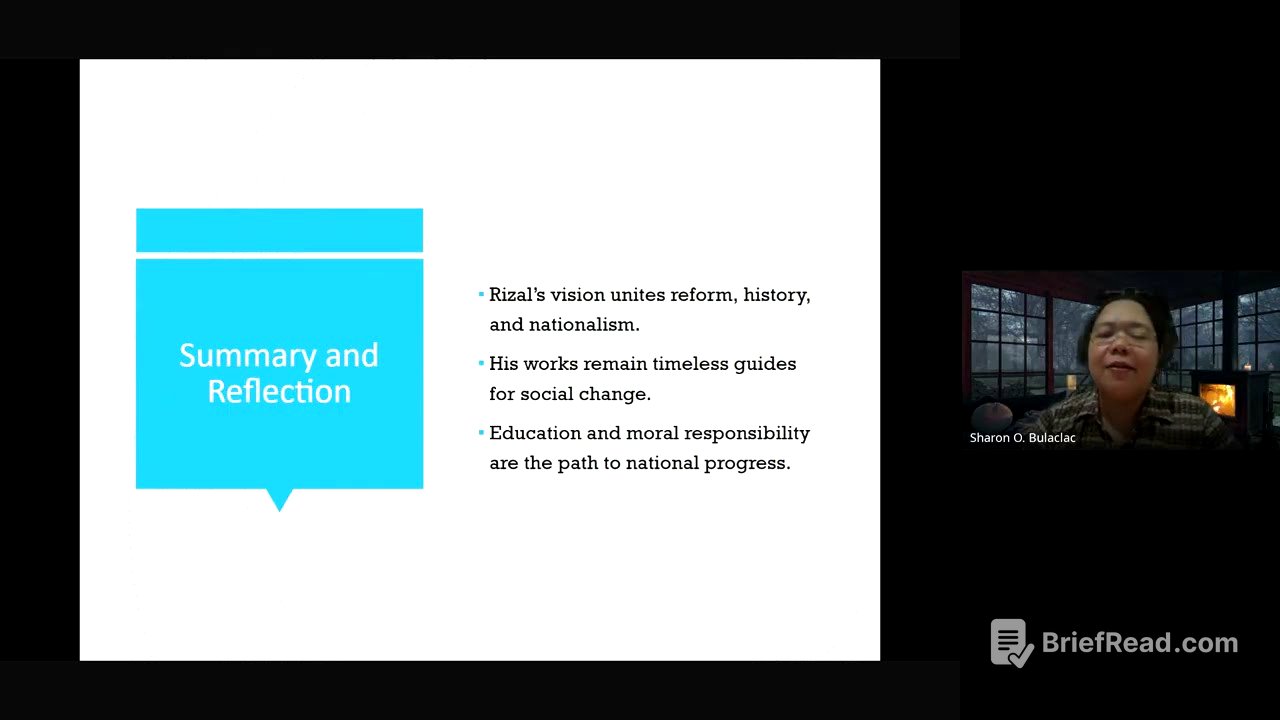
This final chapter ties Rizal's vision together, stating that the destiny of the Filipino people depended on education, moral character, and unity. Rizal believed in gradual and peaceful reform, uplifting minds before seizing power. He warned that freedom without virtue would only repeat the mistakes of the past. Rizal's martyrdom became the seed of national awakening, showing that the pen can indeed move nations. Rizal saw education, moral integrity, and civic consciousness as necessary conditions for national progress, remaining the pillars of nation-building. His messages were adopted by Bonifacio's Katipunan.



![[Digimon Podcast] LiT Episode 94 - DigiEgg is Not On Crash](https://wm-img.halpindev.com/p-briefread_c-10_b-10/urlb/aHR0cDovL2ltZy55b3V0dWJlLmNvbS92aS9VYnBDbUdhbEJoVS9ocWRlZmF1bHQuanBn.jpg)