TLDR;
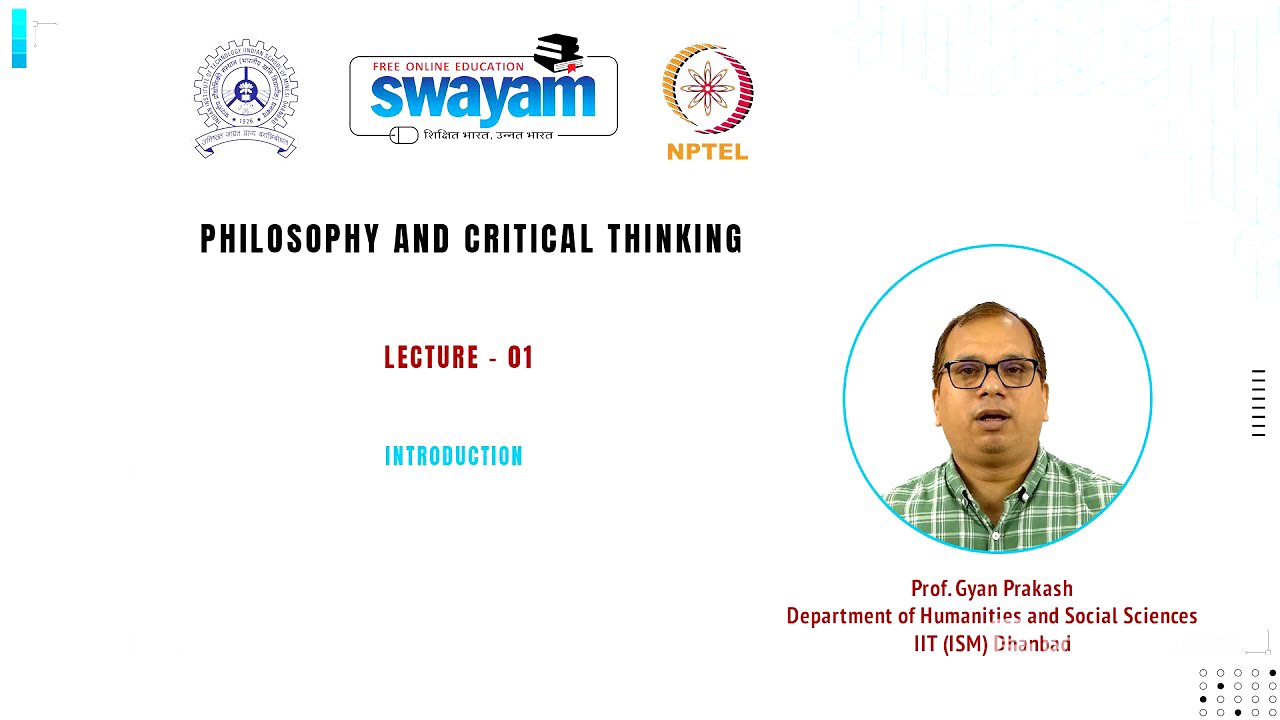
This video introduces the NPTEL course on Philosophy and Critical Thinking, emphasizing its relevance to understanding oneself and the world. It covers both Western and Indian philosophical concepts, including pre-Socratic philosophers, Socrates, Plato, Aristotle, René Descartes, Spinoza, Locke, Hume, ethics, Sankhya, Vedanta, Buddhism, and Jainism. The course aims to teach how to think critically rather than what to think, exploring questions about free will, the existence and nature of God, the reality of dreams, the meaning of life and death, and the nature of the soul.
- Philosophy is defined as the love of wisdom, involving both practical and theoretical understanding.
- Indian philosophy, or "Darsana," focuses on achieving liberation and ultimate reality.
- Philosophy encourages critical thinking and the formation of strong arguments based on personal perspectives.
Introduction to Philosophy and Critical Thinking [0:21]
Gyan Prakash introduces the NPTEL course on Philosophy and Critical Thinking, highlighting its importance for understanding oneself and the world. The course will explore philosophical concepts from both Western and Indian traditions. Philosophy offers a unique perspective compared to other disciplines like science and social sciences. The course will cover pre-Socratic philosophers, Socrates, Plato, Aristotle, René Descartes, Spinoza, Locke, Hume, ethics, and Indian philosophical systems like Sankhya, Vedanta, Buddhism, and Jainism. The course is designed as an introductory level, focusing on understanding basic philosophical concepts.
What is Philosophy? [2:56]
Philosophy is etymologically defined as "love of wisdom," combining "Philo" (love) and "Sophia" (wisdom). This love of wisdom is a serious academic inquiry involving the discussion of various philosophical concepts. Wisdom is understood in two ways: practically, as the knowledge of how to live the best possible life, acknowledging that the best life may vary for different individuals; and theoretically, as the knowledge of the ultimate cause of things, related to understanding reality. Practical wisdom requires theoretical wisdom and vice versa.
Indian Perspective on Philosophy [6:39]
In the Indian knowledge system, philosophy is known as "Darsana," which means "to see" or "to have a vision." It involves looking at the world and forming one's own view. Having a view constitutes philosophy, while thinking about why one holds that view is doing philosophy. Philosophy teaches how to think, not what to think, presenting different explanations of the same concept from various philosophers. Indian philosophy is more focused on practical wisdom, with the ultimate goal of achieving liberation or final happiness, viewing other concepts as stepping stones to this ultimate reality.
Why Philosophy is Important [9:15]
Philosophy is important because it addresses the subjective, focusing on individual perspectives and arguments rather than objective truths. Using the example of traffic signals, the presenter illustrates how individuals may perceive reality differently, emphasizing that philosophy values personal viewpoints supported by strong arguments. In philosophy, one can challenge prevailing opinions by presenting well-reasoned arguments based on their own understanding and reality.
Philosophical Questions and Problems [14:10]
Philosophy explores fundamental questions, such as "Do I have free will?" Free will involves having multiple choices in a situation and consciously deciding among them. The presenter discusses the concept of weak and strong wills, questioning whether our will is truly free or determined by external factors like training and values. The karma theory from the Indian perspective is introduced, suggesting that our actions are influenced by past karma, stored in three "tanks" representing past impressions and present actions. The presenter also raises questions about the existence and nature of God, the reality of dreams, the meaning of death and life, and the nature of the soul.
More Philosophical Questions and Summary [23:44]
The lecture continues to explore philosophical questions, such as "Am I dreaming right now?" and "Who am I?" These questions often cannot be answered by other disciplines, highlighting philosophy's role in addressing unanswered questions about life and existence. Philosophy seeks to provide answers from various perspectives, encouraging a comprehensive understanding of complex concepts. Philosophy is defined as a set of views or beliefs about life, requiring both having and doing philosophy through reflection and analysis. It involves critically examining deeply held concepts and beliefs, attempting to understand the world as a whole, logically analyzing language, and inquiring into the deepest problems of human existence.