TLDR;
In this discussion, Jim Acosta and Scott provide insights into the shift towards independent media, the challenges within legacy corporate media, and the critical role of enterprise reporting in informing public discourse. They address the whitewashing of January 6th, the importance of fact-checking, and the dangers of media consolidation. They emphasize the need for respectful dialogue, the fight for truth, and the significance of supporting independent media to maintain a healthy democracy.
- Shift towards independent media due to disappointment with legacy corporate media.
- The whitewashing of January 6th and the importance of accountability.
- Dangers of media consolidation and the need for diverse voices.
- Importance of fact-checking and respectful dialogue in journalism.
- Supporting independent media to maintain a healthy democracy.
Scott's Transition to Independent Media [0:00]
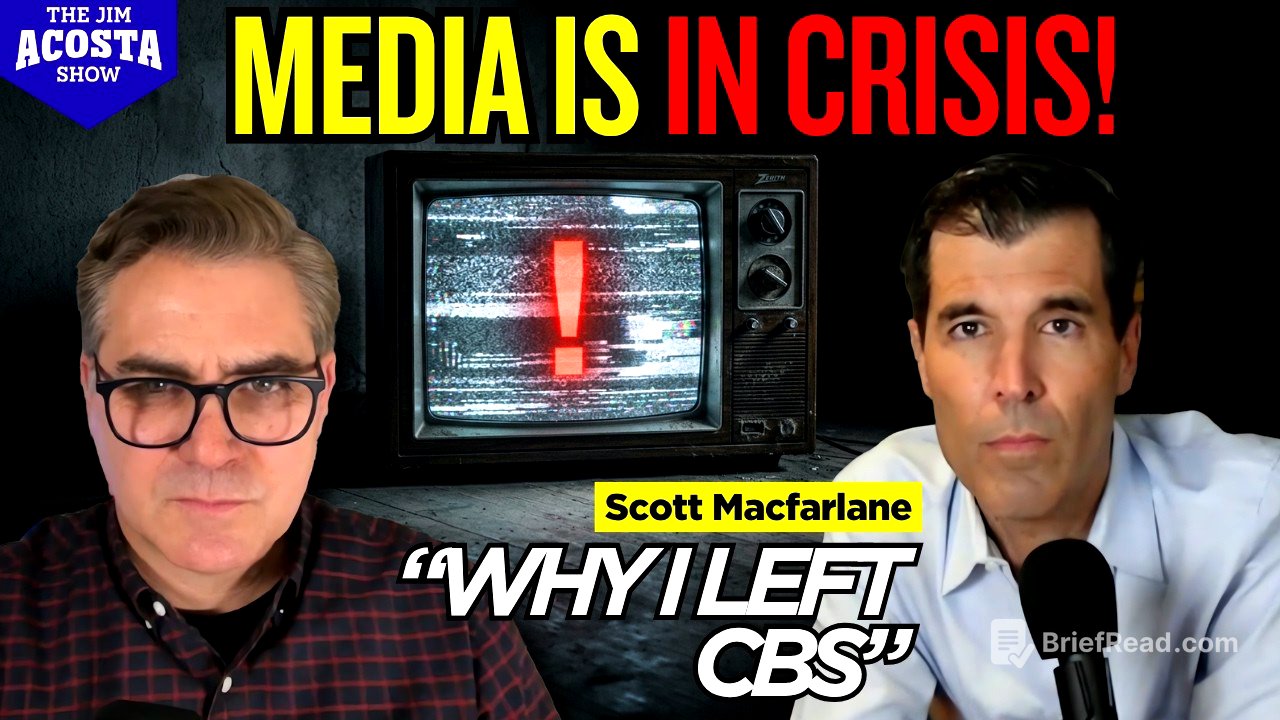
Scott explains his decision to transition to independent media, driven by data showing that his reports on social media garnered significant viewership, surpassing that of linear television. He expresses frustration with the constraints of traditional news formats, where stories can be delayed or cut due to editorial decisions. Scott emphasizes that independent media offers a better avenue for continuously breaking news and enterprise reporting.
Disappointment with Legacy Corporate Media [0:24]
Jim Acosta notes the disappointment people feel towards legacy corporate media, citing instances of bending the knee and specific incidents at CBS. He highlights Scott's move to Midas Touch, praising the team and their focus on enterprise reporting to drive broader conversations. The goal is to present facts and challenge opinions, avoiding the whitewashing of events like January 6th.
The Whitewashing of January 6th [2:02]
Scott stresses the importance of not whitewashing the events of January 6th, emphasizing the need to hold the insurrectionists accountable for their actions. He points out that even now, members of the January 6th select committee face threats and harassment for their investigation. Scott describes the whitewashing as a cancer in American politics that will persist until accountability is achieved.
Fact-Checking and Respectful Dialogue [3:27]
Jim Acosta praises Scott for his hard-charging journalism and commitment to calling things as he sees them. They discuss the White House's reactions to their reporting, including name-calling, and Scott's response, emphasizing the importance of fact-checking. Scott shares his opinion on the need for decorum, honesty, and authenticity in public dialogue, advocating for respectful interactions and an end to name-calling.
The Justice Department and Political Interference [7:35]
They discuss the politicization of the Justice Department, noting the presence of Donald Trump's banners, which signals a departure from the department's traditional role of impartiality. Scott recalls how covering Donald Trump required a more pugnacious approach due to the constant battle over facts and truth. He also notes the banner is a political problem for the Republican party, especially in light of the Epstein files controversy.
Media Consolidation and Its Dangers [10:34]
Jim Acosta expresses concern about the consolidation of media and its potential impact on the country. Scott describes the merger of major media companies as a crisis, pointing to the collapse of the radio industry following consolidation in the 1990s and early 2000s. He worries about the future of local news organizations and the loss of enterprise and investigative reporters, which weakens the watchdog role of the media.
The Erosion of Trust in Media [12:54]
They address the declining public trust in the media, attributing it to propaganda and attacks on legacy and independent media. Scott notes that when a large segment of the population is constantly told they won't get a fair shake from the press, negative attitudes are inevitable. He warns that media consolidation makes the industry more vulnerable to political interference.
The Need for Independent Media [14:12]
Scott recounts a moment at the Toner Journalism Awards where Cara Swisser highlighted how major media companies cozy up to politicians, indicating a vulnerability to changing political winds. He emphasizes that independent journalists do not root for a side but rather uphold democracy. Jim Acosta thanks viewers for supporting independent media, stressing its importance and the unique reporting it provides.