TLDR;
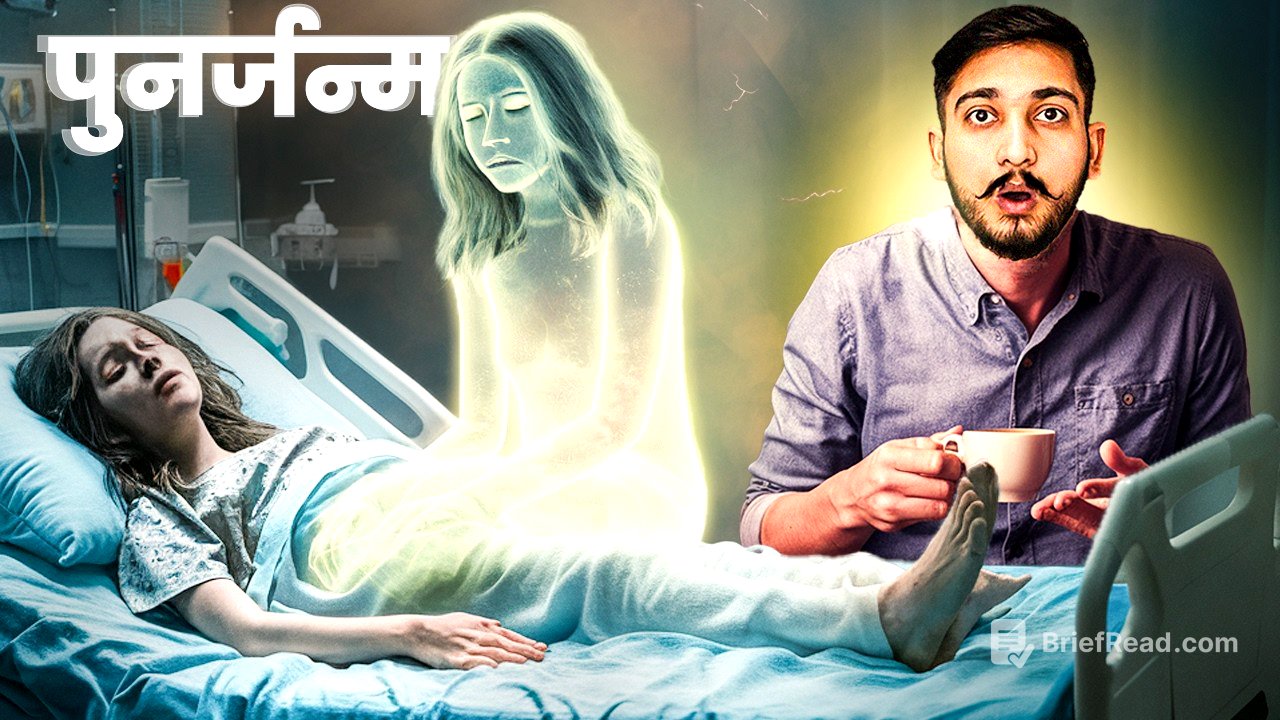
This video explores the concept of reincarnation through the lens of science and various religions, presenting compelling cases and differing perspectives. It examines the Titu Singh case, the Shanti Devi case, and the Sumitra-Shiva case, highlighting the evidence and investigations surrounding these instances of claimed past-life recall. The video also discusses the scientific skepticism towards reincarnation, the religious beliefs that support it, and the potential explanations for past-life memories.
- Explores the concept of reincarnation through compelling cases.
- Examines scientific skepticism and religious beliefs surrounding reincarnation.
- Discusses potential explanations for past-life memories.
Introduction to Reincarnation [0:00]
The video introduces the concept of reincarnation, comparing it to scenarios in movies where characters are reborn. It sets the stage to explore whether reincarnation is real, examining scientific perspectives and religious beliefs about the concept of rebirth.
The Case of Titu Singh [2:00]
The video presents the case of Titu Singh, born in 1983 in a village near Agra, who claimed to remember a past life as Suresh Verma, a 30-year-old man who was murdered. Titu provided details about Suresh's life, including his parents' names, his wife, children, his business, and a white Fiat car. As Titu grew older, he expressed dissatisfaction with his family's poverty and insisted on having the possessions he remembered from his past life.
Investigation of Titu's Claims [4:05]
Titu's brother, Ashok, investigated Titu's claims by visiting Agra and finding Suresh Radio, the shop Titu mentioned. He met Suresh's widow, Uma, who confirmed the details Titu had provided. Suresh died on August 28, 1983, just a little over a month before Titu was born on December 12, 1983. Ashok shared the information with Uma, who was shocked and wanted to meet Titu.
Meeting with Suresh's Family [6:11]
Uma, Suresh's parents, and Suresh's brother traveled to meet Titu. Titu recognized them and asked about his children, Ronu and Sonu. He also questioned why they didn't arrive in their Fiat car. Titu accurately described the events of Suresh's murder, including the location of the gunshot wound. Uma confirmed specific details about their life together, such as a trip to a fair and eating jalebi on the car's bonnet the day before Suresh's death.
Scientific Investigation of Titu's Case [8:49]
Researchers, including Dr. Satwant Pasricha, Dr. N.K. Chadha, and Dr. Ian Stevenson, studied Titu's case. Dr. Stevenson, who had investigated around 3,000 reincarnation cases, enlisted Dr. Antonia Mills to conduct a detailed study. Dr. Mills' research involved interviews and observations, and her findings were published in the Journal of Scientific Exploration.
Tests Conducted on Titu [10:33]
Several tests were conducted to verify Titu's claims. Titu was taken to Suresh's shop and accurately identified it, even pointing out changes made after Suresh's death. He correctly located the cash drawer where Suresh kept his money. In a test where Titu was asked to identify his children from a group of 20 children, he immediately picked out Ronu and Sonu. Titu had a birthmark on his right temple, corresponding to the location of the gunshot wound Suresh sustained.
Analysis of Titu's Case [12:39]
Researchers found no evidence of fraud or ulterior motives in Titu's case. Science does not generally accept reincarnation, but researchers could not find any loopholes to disprove the case.
The Case of Shanti Devi [13:05]
The video shifts to the case of Shanti Devi, born in Delhi in 1926. At the age of four, Shanti claimed to remember a past life in Mathura, where she died giving birth to a child. She identified herself as Lugdi Devi and provided details about her husband, Kedarnath Chaube. Shanti's claims led to an investigation involving Mahatma Gandhi.
Investigation of Shanti Devi's Claims [14:30]
Shanti's headmaster, Lala Chand, wrote a letter to Kedarnath Chaube, who confirmed that his wife, Lugdi Devi, had died in 1925 while giving birth. Kedarnath traveled to Delhi to meet Shanti. Shanti recognized him and her son, Navneet Lal. She provided specific details about their life, including the presence of a well in their courtyard.
Further Verification and Committee Investigation [16:55]
Mahatma Gandhi formed a committee of 15 prominent individuals to investigate Shanti's case. The committee traveled with Shanti to Mathura, where she accurately identified family members, her bedroom, and a hidden stash of money. She also used specific words unique to the Chaube family. The committee published a 26-page booklet in 1936, concluding that Shanti Devi was the reincarnation of Lugdi Devi.
Scientific Skepticism vs. Belief in Reincarnation [20:16]
The video discusses the two groups divided on the issue of reincarnation: skeptics and believers. Skeptics require solid scientific proof and suggest that past-life memories could be due to psychological phenomena like cryptomnesia. Believers rely on religious or spiritual teachings and interpret experiences like déjà vu as evidence of past lives.
Religious Perspectives on Reincarnation [21:33]
The video explores the role of religion in reincarnation, dividing the world into the Religion of the East and the Religion of the West. Hinduism, Jainism, and Buddhism support the concept of reincarnation, while Christianity and Islam do not. In Hinduism, reincarnation depends on karma, and the soul takes on a new body. Jainism also bases reincarnation on karma. Buddhism believes that consciousness connects one life to another.
Reincarnation, Transmigration, and Rebirth [22:41]
The video clarifies the differences between reincarnation, transmigration, and rebirth. Reincarnation involves a soul taking on a new body and continuing its journey. Transmigration involves a soul moving from one body to another, sometimes changing form. Rebirth focuses on the continuous cycle of birth, death, and rebirth, where the life force continues without the same soul or personal identity.
Birthmarks and Reincarnation [24:56]
The video discusses Dr. Ian Stevenson's concept of birthmarks as potential indicators of reincarnation. Birthmarks are areas of altered skin color that appear at birth or shortly after. Stevenson suggests that birthmarks related to reincarnation are often 3D in form, meaning they are raised, depressed, or puckered, and are larger than normal birthmarks.
Alternative Explanations and the Case of Sumitra [26:12]
The video explores alternative explanations for reincarnation claims, such as multiple personality disorder (DID) and past-life regressions. However, these explanations did not fit the cases of Titu and others. The video then presents the case of Sumitra, who died and then revived, claiming to be Shiva Tripathi.
The Case of Sumitra and Shiva [27:55]
Sumitra, born in 1968, lived a difficult life and died in 1985. After her death, she revived and claimed to be Shiva Tripathi, providing details about Shiva's life and family. Shiva's father, Ram Siya Tripathi, visited Sumitra and confirmed her identity as his deceased daughter. Sumitra recognized family members and identified her sister-in-law as the one who killed her.
Analysis of the Sumitra-Shiva Case [31:31]
Unlike other reincarnation cases, Sumitra had no memory of her current life after claiming to be Shiva. Researchers Stevenson and Pasricha independently investigated the case and found supporting evidence. James Matlock coined the term "replacement reincarnation" to describe cases like Sumitra's, where another soul enters a body.
Geographical Proximity and Conclusion [32:37]
The video notes that in the cases of Titu Singh, Shanti Devi, and Sumitra, the reincarnated individuals were reborn in the same or connected geographical locations. The video concludes by stating that science cannot prove or accept reincarnation, leaving the question open to interpretation.