TLDR;
This video provides an introduction to essay writing, focusing on methods of development. It outlines a seven-step pyramid for crafting effective essays, starting from foundational understanding to final proofreading. The video also discusses various methods of development such as narration, description, process analysis, comparison and contrast, cause and effect, and argumentation and persuasion, explaining how each can be used to enhance essay writing.
- Seven steps to writing an essay
- Methods of essay development
- Techniques for writing effective introductions
Introduction to Essay Writing [0:00]
The video introduces essay writing as a skill that can be learned through understanding the characteristics and methods involved in creating a well-structured and accurate academic paper. The core focus is on methods of development, which are the steps and techniques used to write a correct and high-quality essay.
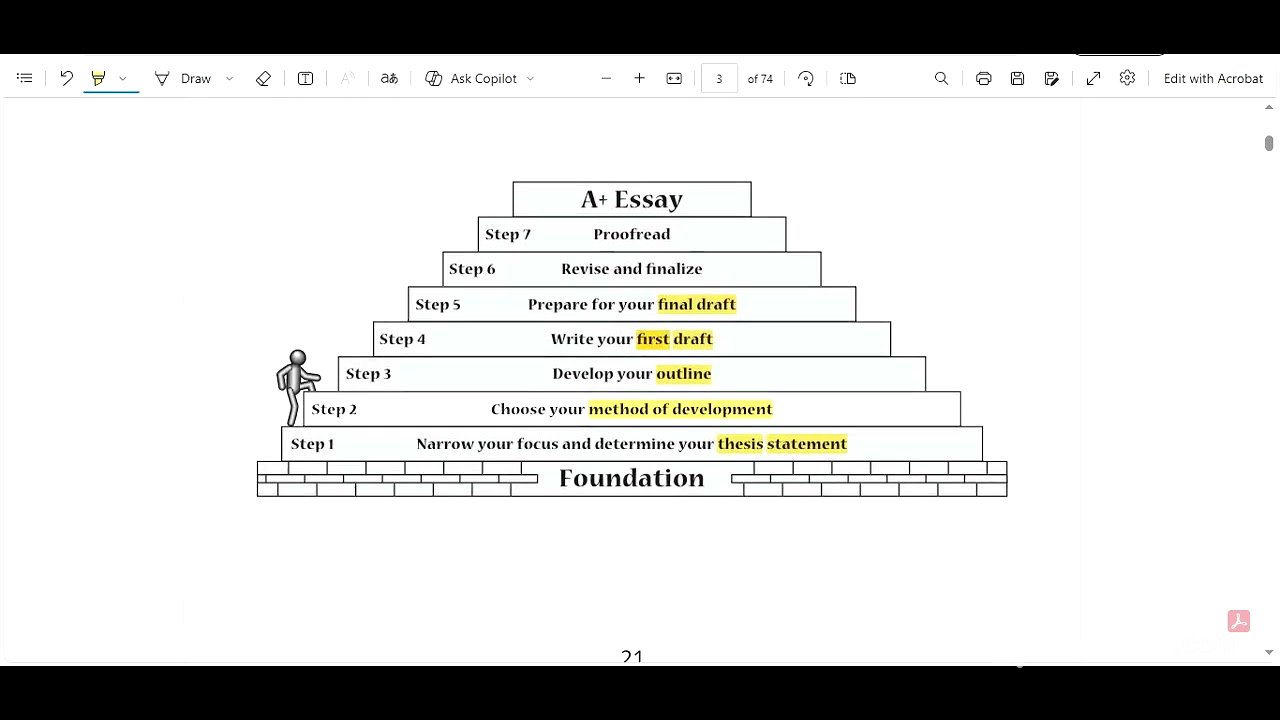
The Seven Steps to Essay Writing [1:21]
The video introduces a hierarchical model consisting of seven steps necessary to write a successful essay. These steps include:
- Foundation: This involves understanding the topic thoroughly.
- Narrow Your Focus: Refine your thinking to identify the main points and formulate a thesis statement, which is the central argument of the essay.
- Choose a Method of Development: Select the approach to present your ideas, such as comparison, cause-and-effect, or storytelling.
- Develop Your Outline: Create a structure that organizes the main points to be discussed in each paragraph.
- Write Your First Draft: Put all your ideas on paper, expanding on the outline.
- Revise and Finalize: Review the content for accuracy, strength, and appropriate academic style, checking the sources and quotations used.
- Proofread: Correct any spelling, punctuation, and grammatical errors to ensure a polished final product.
Methods of Development [11:06]
After choosing a topic and writing a thesis statement, the next step is to select a method of development to structure the essay. This involves choosing how to arrange and present ideas to achieve the desired outcome. The video will cover common methods of development, which are techniques for presenting and organizing the essay's ideas, depending on the essay's objective.
Common Methods of Development: Narration and Description [14:11]
The video outlines several common methods of development:
- Narration: Telling a story or recounting events, usually in chronological order, to make a specific point.
- Description: Using words to paint a picture and create a vivid mental image for the reader.
- Process: Explaining how something is done or how something works, often involving a series of steps.
- Comparison and Contrast: Showing the similarities and differences between two or more subjects.
- Cause and Effect: Explaining how certain events or actions lead to specific outcomes.
- Argumentation and Persuasion: Presenting arguments and evidence to convince the reader of a particular viewpoint.
Additionally, the video touches on the importance of transitions to connect ideas and avoid logical fallacies.
Narration: Telling a Story to Make a Point [39:31]
Narration involves telling a story or recounting events to support a specific point. While many people enjoy a good story, narrative essays use storytelling to convey a message or insight. The point of the story often represents the main idea, which should be reflected in the thesis statement.
Example of Narration in an Introductory Paragraph [43:21]
The video provides an example of using narration in an introductory paragraph about environmental awareness. The author shares a personal story about not caring about recycling until meeting volunteers who inspired them to participate in a beach cleanup. This experience opened their eyes to what individuals can do to improve the environment. The video emphasizes that while chronological order is important in narration, adding action, conflict, and personal feelings can make the story more engaging and help the reader connect with the narrative.