TLDR;
This video explains the concept of ideal gases, focusing on their properties and the relationships between key variables like pressure, temperature, volume, and moles. It highlights the simplifications made for ideal gases and describes laws governing their behavior.
- Ideal gases are simplified models where particles are dimensionless points in random motion.
- Key variables that define gas behavior include pressure, temperature, volume, and moles, with established laws to describe their interrelations.
Introduction to Ideal Gases [0:00]
Professor Dave introduces the topic of ideal gases, defining a gas as a phase of matter where atoms are in motion and fill their container. He outlines two assumptions about gases: first, that particles are dimensionless points in random motion and that they do not interact except for elastic collisions.
Key Variables of Gases [0:09]
The four main variables of gases are explained: pressure (the force exerted by gas particles on the container walls), temperature (the heat energy related to the kinetic energy of particles), volume (the size of the container), and moles (the number of gas particles). These variables are interdependent, forming the foundation for understanding gas behavior.
Boyle's Law [0:33]
The relationship between pressure and volume is discussed, stating that they are inversely proportional, leading to Boyle's Law (P1V1 = P2V2). If the volume decreases, the pressure increases due to the particles hitting the walls more frequently.
Charles's Law [1:33]
Next, the relationship between volume and temperature is introduced, showing they are directly proportional according to Charles's Law. When gas is heated, its particles move more quickly, requiring the volume to expand to maintain constant pressure.
Temperature and Kelvin Scale [2:05]
The importance of the Kelvin scale is highlighted for gas calculations, as it avoids issues with negative temperatures. Converting Celsius to Kelvin involves adding 273.
Combined Gas Law and Avogadro's Law [2:33]
The combined gas law, which integrates Boyle's and Charles's Law, is discussed. Avogadro's Law is also mentioned, stating that equal volumes of gas at the same temperature and pressure contain the same number of molecules, specifically indicating that one mole of an ideal gas occupies 22.4 liters at standard conditions.
Ideal Gas Law [3:05]
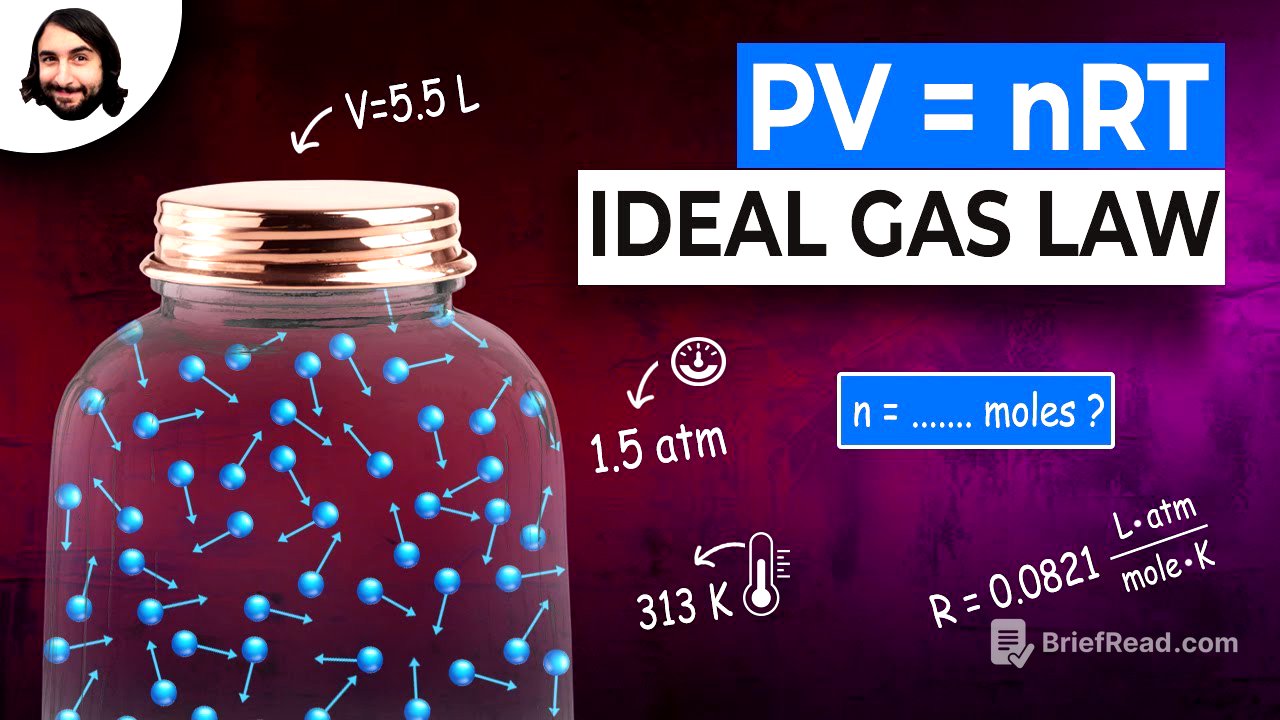
The ideal gas law (PV = nRT) is presented as a comprehensive equation connecting all four gas variables, where R is the gas constant. This law allows calculations of one variable when the others are known, providing a simple method to evaluate gas behavior under different conditions.
Application and Conclusion [3:33]
The video concludes with a summary of how to apply the ideal gas law, including examples of calculating unknown variables using given conditions. The overall message emphasizes understanding these gas laws is key to mastering gas behavior and related calculations.