TLDR;
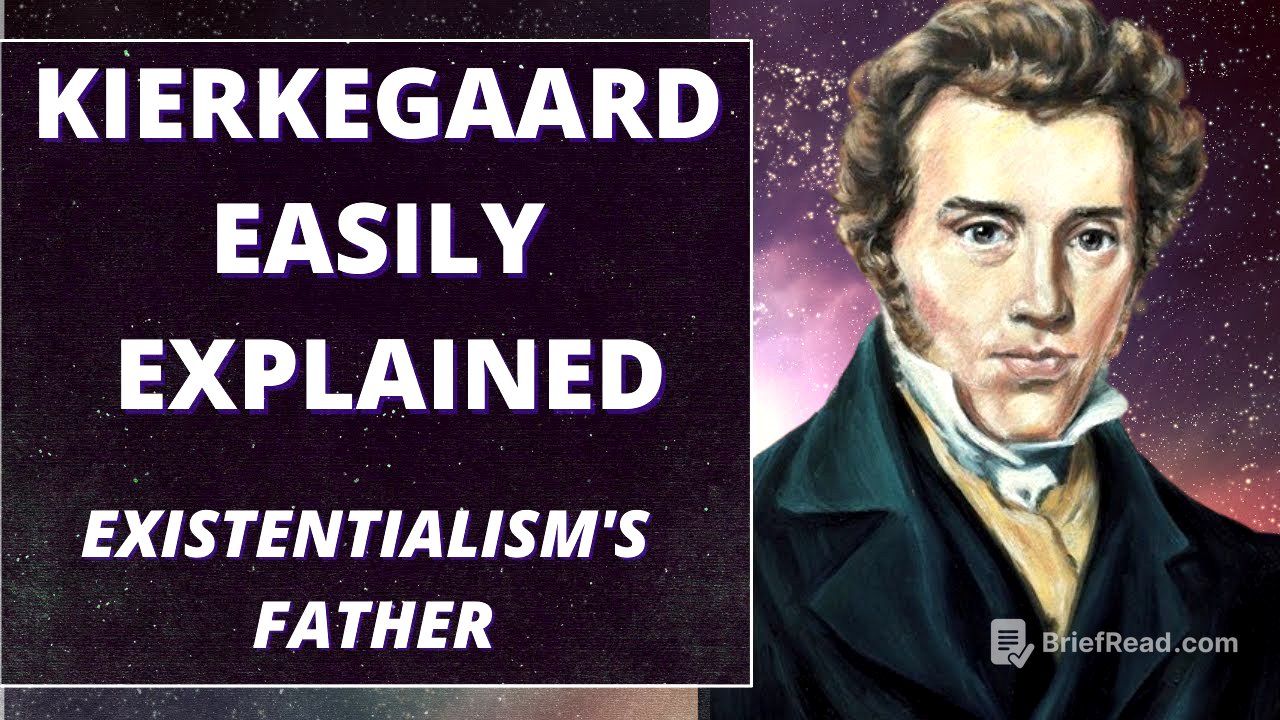
This video introduces Søren Kierkegaard, a Danish philosopher and theologian considered the father of existentialism. It explores his emphasis on subjective truth, the importance of individual responsibility, and his three stages of individual existence: aesthetic, ethical, and religious. The video also touches on key concepts like angst, death, and the teleological suspension of the ethical, providing a comprehensive overview of Kierkegaard's complex philosophical ideas.
- Kierkegaard emphasized subjective truth and individual experience over objective facts.
- He outlined three stages of existence: aesthetic, ethical, and religious.
- Key concepts in his philosophy include angst, death, and the teleological suspension of the ethical.
Introduction [0:00]
Søren Kierkegaard, a 19th-century Danish philosopher, theologian, poet, social critic, and religious author, is introduced as a key figure at the end of the Enlightenment. Kierkegaard challenged the prevailing belief that life's problems could be solved through objective means like logic and science. His philosophy centers on the individual's subjective experience and how one lives as a single person, emphasizing that "subjectivity is truth."
Truth in Subjectivity [0:46]
Kierkegaard's concept of "subjective truth" is explored, differentiating it from objective facts. While acknowledging the importance of science and objective information, Kierkegaard argued that deeper truths are unique to each individual. The example of choosing a career as a musician illustrates this, where personal experience and passion outweigh objective data like salary or practice hours.
The Father of Existentialism [1:36]
Kierkegaard is presented as the father of existentialism, a philosophy emphasizing the world's lack of intrinsic meaning and the individual's responsibility for their actions, decisions, and purpose. For Kierkegaard, this responsibility is paramount because he believed that one's eternal salvation depends on the life choices they make. He believed God would ultimately judge each person based on their actions as an individual.
Kierkegaard's Early History [2:09]
The video explores Kierkegaard's personal history, focusing on his father, Michael, a wealthy but melancholy man who imposed his guilt and strict religious beliefs on his children. Søren felt he was born old and missed having a carefree childhood. His father believed he was cursed and that his children would die at the age of 33, the age Jesus died. Søren was surrounded by death early in life, as most of his siblings did not live to see that age. His broken engagement with Regina Olsen is also discussed as a pivotal moment that allowed him to dedicate himself to writing and philosophy, further solidifying his status as an outsider.
'The Poet Philosopher' [3:20]
Kierkegaard's writing style, characterized by passion, irony, and parables, is examined. He is sometimes referred to as the poet philosopher. His use of pseudonyms and indirect communication aimed to encourage readers to think for themselves and reject reliance on authority figures. An example from "Either/Or" illustrates his paradoxical and thought-provoking approach to life's dilemmas.
Death & 'Angst' [4:16]
The video discusses two unsettling topics that Kierkegaard explored: death and angst (despair). Kierkegaard believed that while everyone is aware of death, few truly understand and contemplate it, which is essential for living passionately. Angst is described as unfocused fear or a "dizziness of freedom" that arises when one recognizes the vast possibilities and choices in life. Despite its negative feeling, angst is crucial for personal responsibility and awareness.
The Stages of Individual Existence [5:50]
Kierkegaard's three stages of individual existence are outlined: the aesthetic, the ethical, and the religious. The aesthetic life is defined by the pursuit of pleasures. The ethical life involves adhering to societal norms and recognizing a purpose greater than oneself. The religious life, considered the highest plane of existence, involves a personal commitment to God and a willingness to supersede ethical principles for a deeper faith.
The Teleological Suspension of the Ethical [7:01]
The concept of the "teleological suspension of the ethical" is explained using the example of Abraham from "Fear and Trembling." Abraham's willingness to sacrifice his son Isaac at God's command demonstrates a higher inner commitment that transcends normative ethical rules. This involves embracing the absurd and taking a leap of faith, becoming a "knight of faith" who has transcended ethical and rational objectivity.
In Conclusion [8:22]
The video concludes by acknowledging that while many contemporary philosophers may disagree with Kierkegaard's religious conclusions, his contributions to history are significant. His work offers valuable insights for those grappling with feelings of despair, anxiety, and mortality, suggesting that these feelings indicate a journey toward self-understanding and individuality.