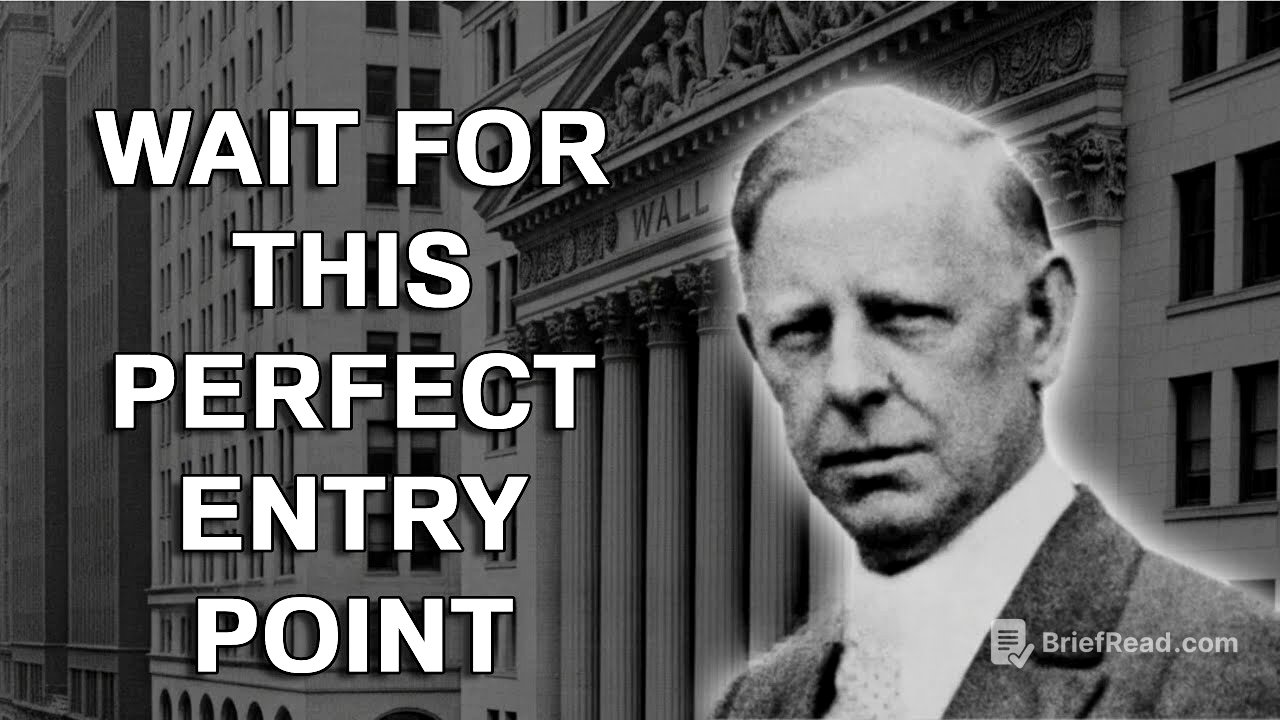
TLDR;
This video outlines a five-step test developed by Jesse Livermore to filter emotions from trading decisions and achieve clarity. It emphasizes the importance of discipline, patience, and self-control over prediction and analysis. The test focuses on aligning with market trends, confirming movements through action, synchronizing with the general market, testing reactions, and assessing volume behavior to identify strong hands.
- The best trades are born from clarity, not excitement.
- Discipline and patience are more crucial than prediction.
- The five-step test is designed to confirm readiness, not to predict the market.
Introduction: The Essence of Successful Trading [0:00]
The market often leads traders to ruin due to a lack of understanding and discipline, not because of market changes themselves. Many traders act impulsively based on price movements and the success of others, failing to recognize that the market rewards preparation, not mere action. Emotions like fear, greed, hope, and desperation drive poor decisions, leading to losses. The key to successful trading lies in clarity and waiting for the right moment, not in chasing fleeting opportunities.
The Foundation: Internal War and the Importance of Discipline [1:29]
Most traders mistakenly believe the market is a battle between bulls and bears, overlooking the internal battle within themselves. While knowledge of price movements is valuable, obsession without reason can lead to ruin. Success in trading is not about predicting the market but about having the discipline to act when the signal appears. The five-step test is a method to filter out noise and identify genuine opportunities, emphasizing that analysis without discipline is akin to gambling.
The Story of Near Ruin: The Panic of 1907 [2:32]
In 1907, during a market panic, a trader initially profited greatly by shorting the market. However, they made the mistake of believing the move would never end, covering too late and going long too early. This resulted in significant losses, but it also provided clarity and led to the development of the five-step test. The experience highlighted that even experienced traders can be seduced by the market, emphasizing the need for a structured approach to decision-making.
The Mindset: Patience as a Position [4:14]
Most traders focus on analysis, charts, and indicators, but they often miss the importance of discipline. Trading should be based on personal readiness rather than the market's apparent readiness. Patience is a valuable asset in trading, allowing traders to align with the market's rhythm and observe the crowd's behavior before acting. The ability to wait without losing conviction is a crucial gift for any trader, as the market rewards those who wait well, not those who trade frequently.
Reading the Crowd: The Art of Observation [5:08]
In the past, traders relied on the tape to understand market behavior, focusing on every tick and trade to discern the underlying story. The tape revealed exhaustion near resistance, the end of buying activity when volume dried up, and a lack of conviction when prices moved without purpose. Modern traders, with their screens full of indicators, have often lost the art of observation, seeking signals instead of understanding the stories behind price movements. Every price tells a story of fear, greed, and uncertainty, and the key is to let it confirm existing suspicions.
The Five-Step Test: A Structured Approach to Patience [6:00]
The five-step test turns suspicions into structured patience, emphasizing that traders need to know what they will do when something happens, rather than trying to predict what will happen. Trading is an exercise in self-control, rewarding those who are prepared to do nothing until the moment is right. Each step of the test removes a layer of uncertainty, leading to a clear, calculated decision based on evidence rather than emotion.
Step One: The Line of Least Resistance [7:21]
The first step in the test is determining the direction of the market. Traders should assess whether the market is moving with them or against them. Instead of focusing on whether a price looks cheap, traders should align with the market's general trend, only looking for long opportunities when the market is trending up and short opportunities when it is trending down. Trading against the market's momentum is exhausting and often leads to losses.
Step Two: Confirmation by Action [8:57]
The second step involves waiting for confirmation by action. Traders should not buy simply because prices are rising but because prices have proven they can continue rising. It's crucial to differentiate between a move and a move that matters by observing the market's behavior. If a stock breaks through resistance and holds, then advances, that's confirmation. The real signal is in the follow-through, and patience is vital in this step.
Step Three: Synchronize with the General Market [10:44]
The third step is synchronizing with the general market trend. Even the strongest stock can be pulled down if the overall market is against it. In bull markets, the best trades come from stocks that lead the advance, not follow it. Traders should ensure that their stock is moving in harmony with the general market, as synchronization increases the probability of success.
Step Four: The Test of Reaction [12:22]
The fourth step involves waiting for the reaction after every advance. The market pauses and tests conviction, and this reaction reveals whether the move was real or merely emotional. If a stock pulls back slightly on low volume and then turns upward again, that's strength. If it falls sharply with heavy volume, that's weakness. Traders should let the market show its hand before buying, waiting for the reaction to prove strength.
Step Five: The Final Proof - Volume Behavior and Conviction [14:17]
The final and most crucial step is assessing the volume, behavior, and conviction of the market to confirm that strong hands are in control. Volume is the footprint of intention, and traders should watch for conviction in behavior, not just in words. Quiet accumulation, with volume increasing on up days but never collapsing completely on down days, is a sign of strong hand control. When all five steps align, the market is in your direction, and only then should you buy.
The Perfect Entry: Logic Over Magic [15:52]
The perfect entry is not about magic but about logic. By the time all five steps are aligned, the market has already revealed its intentions, and the trader's job is simply to listen. The decision to act should be made in advance, allowing for instant execution when the market confirms. The five-step test is about waiting for alignment, not predicting movement.
The Real Enemy: Emotion and the Armor of Discipline [18:45]
Emotion, particularly fear and greed, is the real enemy in trading. The five-step test serves as armor, forcing traders to slow down and earn each trade instead of chasing it. The test builds patience until certainty reveals itself, emphasizing that the perfect entry point is about readiness, not prediction. Discipline means delayed action, reserved for the right conditions when all five tests align.
Patience and Decisiveness: The Partners of Success [20:29]
Patience and decisiveness are partners in trading. Patience prepares you, and decisiveness pays you. The market rewards those who wait and then act without hesitation when the time comes. Mastering oneself while the market tests patience is crucial for survival. Habits stronger than temptation must be built, and humility is the final defense.
Trading Behavior, Not the Market [22:10]
Traders ultimately trade their own behavior, not the market itself. Charts are reflections of emotion, and traders must act out of logic rather than fear. Disciplined behavior leads to predictable results. The psychology of the market never changes, and the lessons learned from the past endure because they are based on human nature.
Conclusion: The Patient Trader's Advantage [23:11]
The market always gives one last chance to those patient enough to wait for it. Preparation, observation, and confirmation are key. Waiting is a position, and the perfect entry point belongs to the patient trader, not the fastest one. The market rewards patience, not prediction.

![Python for Beginners – Full Course [Programming Tutorial]](https://wm-img.halpindev.com/p-briefread_c-10_b-10/urlb/aHR0cDovL2ltZy55b3V0dWJlLmNvbS92aS9lV1JmaFpVenJBYy9ocWRlZmF1bHQuanBn.jpg)