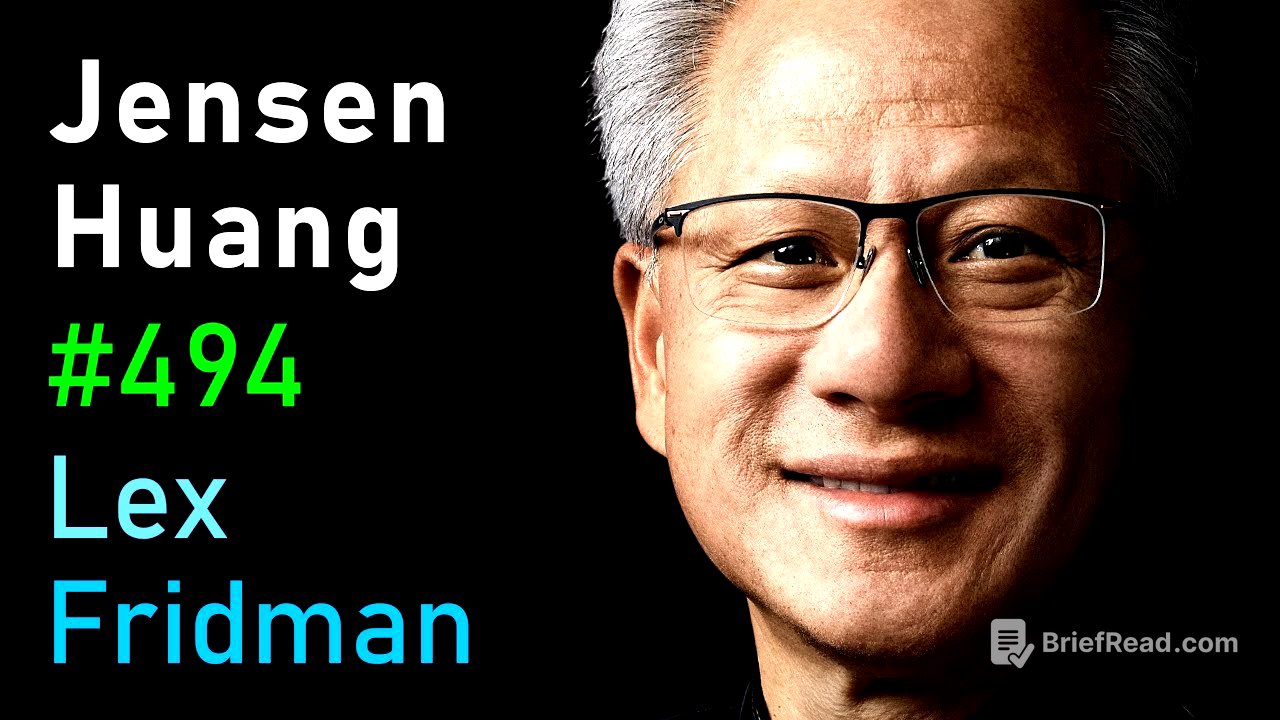
TLDR;
This conversation with Jensen Huang, CEO of NVIDIA, covers a wide range of topics, from extreme co-design and AI scaling laws to NVIDIA's moat and the future of programming. Huang shares insights into how NVIDIA operates, his leadership philosophy, and his vision for the future of AI and computing. He emphasizes the importance of extreme co-design, continuous learning, and adapting to the changing environment.
- Extreme co-design is crucial for solving complex problems that exceed the capacity of a single computer.
- NVIDIA's success is attributed to its install base, CUDA platform, and ecosystem.
- Huang believes AI will transform various industries and create new opportunities.
Introduction [0:00]
Lex Fridman introduces Jensen Huang, CEO of NVIDIA, highlighting NVIDIA's role as a key player in the AI revolution and attributing its success to Huang's leadership and strategic decisions.
Extreme co-design and rack-scale engineering [0:33]
Jensen Huang explains the necessity of extreme co-design, which involves optimizing across the entire technology stack, from architectures to chips to systems, to solve problems that exceed the capabilities of a single computer. He emphasizes the importance of considering all components, including CPUs, GPUs, networking, power, and cooling, to achieve optimal performance when distributing workloads across multiple computers. Huang describes NVIDIA's approach to extreme co-design, which involves bringing together experts from various disciplines to attack problems collectively.
How Jensen runs NVIDIA [3:18]
Jensen Huang describes his unique approach to managing NVIDIA, emphasizing that the company's architecture should reflect its goals and the environment in which it operates. He explains that his direct staff consists of 60 people, each with expertise in different areas, and that he fosters a collaborative environment where problems are attacked collectively rather than through one-on-one meetings. Huang also discusses NVIDIA's strategic decisions, such as putting CUDA on GeForce, and how he shapes the company's belief system to ensure everyone is aligned with the company's vision.
AI scaling laws [22:40]
Jensen Huang discusses the four scaling laws: pre-training, post-training, test time, and agentic scaling. He explains that the industry initially thought data would limit AI intelligence, but synthetic data has allowed for continued scaling. Huang emphasizes that inference, or thinking, is compute-intensive and that agentic scaling, which involves multiplying AI through sub-agents, is the next frontier. He also highlights the importance of anticipating AI innovation and having a flexible architecture to adapt to changing algorithms.
Biggest blockers to AI scaling laws [37:40]
Jensen Huang identifies compute as the primary factor for scaling intelligence, noting that different hardware is required for optimal performance of different components. He also points out that power is a concern, but extreme co-design is helping to improve tokens per second per watt.
Supply chain [39:23]
Jensen Huang acknowledges the constant challenges in the AI supply chain, including ASML's EUV lithography machines, TSMC's advanced packaging, and SK Hynix's high bandwidth memory. He emphasizes the importance of informing and shaping the supply chain, working closely with CEOs of upstream and downstream companies to ensure they understand the dynamics driving growth and invest accordingly.
Memory [41:18]
Jensen Huang shares how he convinced DRAM industry CEOs to invest in HBM memory, even though it was scarcely used at the time. He also discussed adapting low power memories from cell phones for supercomputers in data centers.
Power [47:24]
Jensen Huang discusses the energy problem and suggests utilizing the excess power in the grid, which is designed for worst-case conditions but rarely operates at full capacity. He proposes building data centers that can gracefully degrade and working with utilities to offer more segments of power delivery promises.
Elon and Colossus [52:43]
Jensen Huang praises Elon Musk's approach to engineering and management, highlighting his ability to think through multiple disciplines, question everything, and act with urgency. He notes that Musk's presence at the point of action and his minimalist approach contribute to overcoming obstacles and accelerating progress.
Jensen's approach to engineering and leadership [56:11]
Jensen Huang shares his philosophy of "speed of light" thinking, which involves comparing everything against the limits of physics. He emphasizes the importance of first principles engineering and continuous learning, as well as the need to challenge complexity and strive for simplicity.
China [1:01:37]
Jensen Huang discusses China's success in building its technology sector, attributing it to factors such as a large pool of AI researchers, a strong software industry, intense internal competition, and a culture of open knowledge sharing. He notes that China is the fastest innovating country in the world today.
TSMC and Taiwan [1:09:50]
Jensen Huang describes TSMC's culture and approach, emphasizing their ability to orchestrate the demands of hundreds of companies, their focus on both technology and customer service, and the intangible asset of trust they have built with their customers. He also shares a story about being offered the CEO position at TSMC and declining it to continue his work at NVIDIA.
NVIDIA's moat [1:15:04]
Jensen Huang identifies NVIDIA's biggest moat as the install base of its computing platform, particularly CUDA. He emphasizes that the company's dedication, execution, and ecosystem contribute to its competitive advantage.
AI data centers in space [1:20:41]
Jensen Huang discusses the possibility of doing compute in space, noting that NVIDIA GPUs are already in space for imaging purposes. He acknowledges the engineering complexities involved, such as cooling and radiation, but emphasizes the potential benefits of 24/7 solar power and reduced data transmission.
Will NVIDIA be worth $10 trillion? [1:24:30]
Jensen Huang expresses confidence in NVIDIA's growth, citing the shift from retrieval-based to generative-based computing and the transformation of computers into AI factories. He believes that the world's GDP will accelerate, and a larger percentage will be used for computation.
Leadership under pressure [1:34:39]
Jensen Huang discusses how he deals with the pressure of leading NVIDIA, emphasizing the importance of reasoning, breaking down problems, and sharing the load with others. He also highlights the need to forget setbacks and focus on the future.
Video games [1:48:25]
Jensen Huang discusses NVIDIA's GeForce GPUs and their role in bringing joy to gamers. He addresses the controversy around DLSS 5, emphasizing that it is intended to be a tool for artists to enhance their creations, not to create AI slop.
AGI timeline [1:55:16]
Jensen Huang believes that AGI has already been achieved, defining it as an AI system that can start, grow, and run a successful technology company. He suggests that an AI could create a viral web service and monetize it, even if it doesn't last forever.
Future of programming [1:57:29]
Jensen Huang predicts that the number of programmers will increase, not decrease, as AI elevates the role of coding to specification. He believes that everyone will become a coder, and AI will enhance various professions.
Consciousness [2:11:01]
Jensen Huang questions whether a chip can ever replicate human emotions and subjective experiences. He emphasizes the importance of humanity, character, and compassion, suggesting that intelligence is becoming a commodity.
Mortality [2:17:22]
Jensen Huang reflects on his mortality and the importance of succession planning, emphasizing the need to pass on knowledge and empower others. He expresses hope for the future of humanity, citing the potential to solve problems, build great things, and achieve scientific breakthroughs.

![[ENG SUB] Official Pilot: รักสุดท้าย My Safe Zone The Series | Ch3 Thailand](https://wm-img.halpindev.com/p-briefread_c-10_b-10/urlb/aHR0cDovL2ltZy55b3V0dWJlLmNvbS92aS82YjRVbkRDR1lzSS9ocWRlZmF1bHQuanBn.jpg)