TLDR;
This video addresses audiophile concerns about jitter and noise in digital audio transmission, particularly in the context of high-end audio streamers. It argues that while digital audio transmission is technically analog, the inherent noise immunity of digital signals makes these concerns largely overblown in typical home setups. The presenter emphasizes the importance of measurements in assessing audio equipment performance, contrasting this with subjective, sighted reviews.
- Digital audio transmission is analog, but its noise immunity makes jitter and noise concerns overblown in typical home setups.
- Data loss can occur with excessively long cables or substandard equipment, resulting in audible glitches and pops, not subtle sound degradation.
- Jitter and noise are measurable, and well-designed DACs effectively mitigate these issues, making cable differences negligible.
- Subjective testing should be blind to avoid bias, unlike sighted reviews that are unreliable.
Introduction: Addressing Audiophile Concerns and a YouTuber's Analogy [0:01]
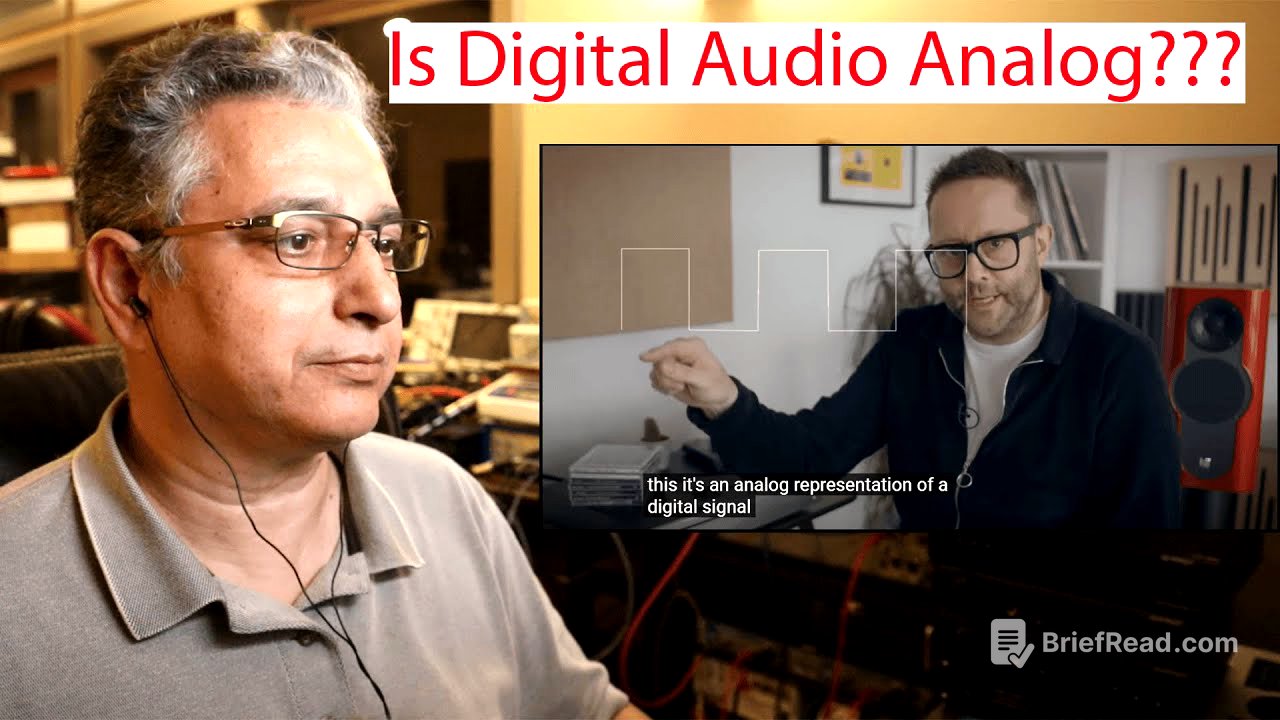
The presenter introduces a technical discussion on digital audio transmission, motivated by questions from viewers and a video from Darko Audio. Darko used an analogy of tasting water to argue against the need for measurements in audio equipment, which the presenter finds flawed. He argues that blind taste tests would be more appropriate to eliminate bias based on price and branding. The core of the presentation will focus on a review of a high-end digital audio streamer and the claim that digital sources can have different sounds.
Digital Audio Transmission: Analog Nature and Noise Immunity [3:54]
The presenter confirms that digital audio transmission is indeed analog but clarifies that the key difference lies in how the signal is interpreted. Digital transmission uses a threshold to distinguish between ones and zeros, making it highly immune to noise and variations in the analog waveform. This noise immunity is a fundamental advantage of digital over analog, countering the idea that analog characteristics inherently degrade digital audio quality.
Data Loss in Digital Audio: Catastrophic vs. Subtle Degradation [5:56]
The discussion shifts to the potential for data loss in digital audio transmission over long distances, such as in broadcast studios. While signal degradation can occur, the impact is typically catastrophic, resulting in glitches, buzzing, and pops rather than subtle changes in micro-details or bass. Data loss is unlikely in typical home stereo setups with reasonably short cables. To cause data loss over USB, one would need an excessively long, thin cable with poor transmission and receiving capabilities.
Timing and Sample Rate: The Role of the DAC [9:20]
The presenter explains that in addition to data samples, the DAC (Digital-to-Analog Converter) needs to know the sample rate to play the audio at the correct timing. Common connections like coax and Toslink (S/PDIF) operate in a master-slave relationship, where the host (e.g., streamer, CD player) dictates the timing to the DAC. The DAC must extract the timing from the incoming data, which can be susceptible to noise.
Eye Patterns and Jitter: Visualizing Digital Signal Quality [12:15]
The presenter uses an audio precision analyzer and an oscilloscope to visualize the digital signal using an eye pattern. A clear and wide eye pattern indicates that the receiver can easily extract the data. Jitter, or timing variations, can affect the accuracy of the sample rate, but DACs are designed with internal mechanisms like phase-locked loops (PLLs) to filter out high-frequency noise and stabilize the clock.
USB Audio: Asynchronous Mode and Clock Management [16:03]
USB audio initially used a master-slave configuration, where the PC controlled the timing, leading to higher jitter. Modern USB audio employs asynchronous mode, where the DAC controls its own clock and tells the host to speed up or slow down to maintain synchronization. This eliminates dependency on the noisy digital clock of the USB, making jitter over USB a non-issue.
Noise and Ground Loops: Electrical Link Considerations [18:15]
While data errors and jitter over USB are not significant concerns, noise can still be an issue. Noise on the USB power supply or ground can affect the DAC's performance. Galvanic isolators can provide complete isolation. Balanced audio outputs (XLR) are more immune to these problems than RCA connections.
Internal Jitter and Noise: DAC Implementation [20:31]
The main source of jitter and noise is often internally generated within the DAC itself due to its mixed-signal nature and high resolution. The presenter emphasizes that these issues are measurable, contrary to claims that they cannot be. He presents examples of DACs with clean jitter performance and others with excessive jitter and noise, demonstrating that performance varies.
Measurements and Psychoacoustic Analysis: Evaluating DAC Performance [22:47]
The presenter shows measurements from various devices, including an Onkyo AVR, a high-end Audio-GD DAC, a Naim Uniti Atom, and a Marantz SACD player, to illustrate that higher price does not guarantee better performance. He consistently performs psychoacoustic analysis to determine whether the measured jitter and noise are audible, often finding that they are below the threshold of hearing.
Streamers and Digital Output: Jitter and Noise Considerations [27:55]
The presenter discusses streamers, noting that the amount of jitter on their digital outputs is typically so small that it doesn't matter, and the DAC will filter out any remaining jitter. He highlights a Raspberry Pi-based streamer and DAC combo costing only $200 that performs exceptionally well. He reiterates that jitter is generally not an audible concern in well-designed systems.
Streamer Recommendations and System Setup [30:51]
The presenter recommends choosing a streamer based on features, price, and support rather than perceived sound quality. He uses a silent Windows PC as his streamer but acknowledges the inconvenience of Windows updates. He advises using a DAC that he recommends, along with balanced XLR connections, to minimize noise and ground loop issues.
Subjective Testing vs. Measurements: The Importance of Blind Tests [33:54]
The presenter emphasizes the importance of blind subjective testing, contrasting it with sighted tests that are prone to bias. He argues that if sound differences are easily distinguishable, reviewers should conduct blind A/B tests to validate their claims. He criticizes subjective reviews based on price, size, or freebies as worthless.