TLDR;
This lecture explores the foundations of Western civilization through the lens of ancient Greek culture, spanning from the Minoans and Mycenaeans to the Hellenistic period. It covers key aspects of Greek society, including their history, mythology, government, arts, and philosophy. The lecture emphasizes the importance of understanding the Greeks' seafaring nature, their interactions with other cultures, and their contributions to classical thought and art.
- Explores the Minoan and Mycenaean civilizations as precursors to Classical Greece.
- Discusses the significance of the Trojan War and Homeric epics in shaping Greek identity.
- Examines Greek religion, the roles of the gods, and the importance of oracles.
- Covers the Persian Wars and the subsequent Golden Age of Athens.
- Analyzes Greek government, society, culture, and the Olympic Games.
- Reviews Greek theater, poetry, and the contributions of playwrights like Aristophanes, Euripides, Aeschylus, and Sophocles.
- Discusses Greek philosophy, including the naturalists, sophists, Socrates, Plato, and Aristotle.
- Explores Greek art, including pottery, sculpture, and architecture, highlighting the shift from archaic to classical and Hellenistic styles.
- Concludes with the Hellenistic Age and the spread of Greek culture under Alexander the Great.
Introduction [0:00]
The lecture serves as the second chapter in a humanities class, building upon previous discussions of religion in Mesopotamia, Egypt, India, and Taoism. It transitions into the study of the Greeks, focusing on their gods and culture, and sets the stage for examining the formation of modern religions in Judaism, Christianity, and Islam in the subsequent chapter. The lecture also outlines the reading assignment from "Landmarks of the Humanities" by Gloria K. Fierro and a discussion assignment based on Plato's allegory of the cave, accompanied by an animated video narrated by Orson Welles.
Map of the Aegean and the Greeks [2:08]
The study of the Greeks is divided into four sections: the Minoans, the Mycenaeans, Classical Athens, and Hellenistic Greece under Alexander the Great. The Greeks, as seafaring traders in the Aegean Sea, interacted with various cultures, including those in Lebanon, Egypt, and North Africa, where they built cities like Alexandria. Their civilization, rooted in the Bronze Age, saw the use of copper and tin for bronze weaponry and art, later transitioning to the Iron Age. The Cyclades, a group of islands, also played a role in shaping Greek identity, influenced by Hellenic ideals of reason, beauty, and the good life.
Cyclades and Minoans [6:03]
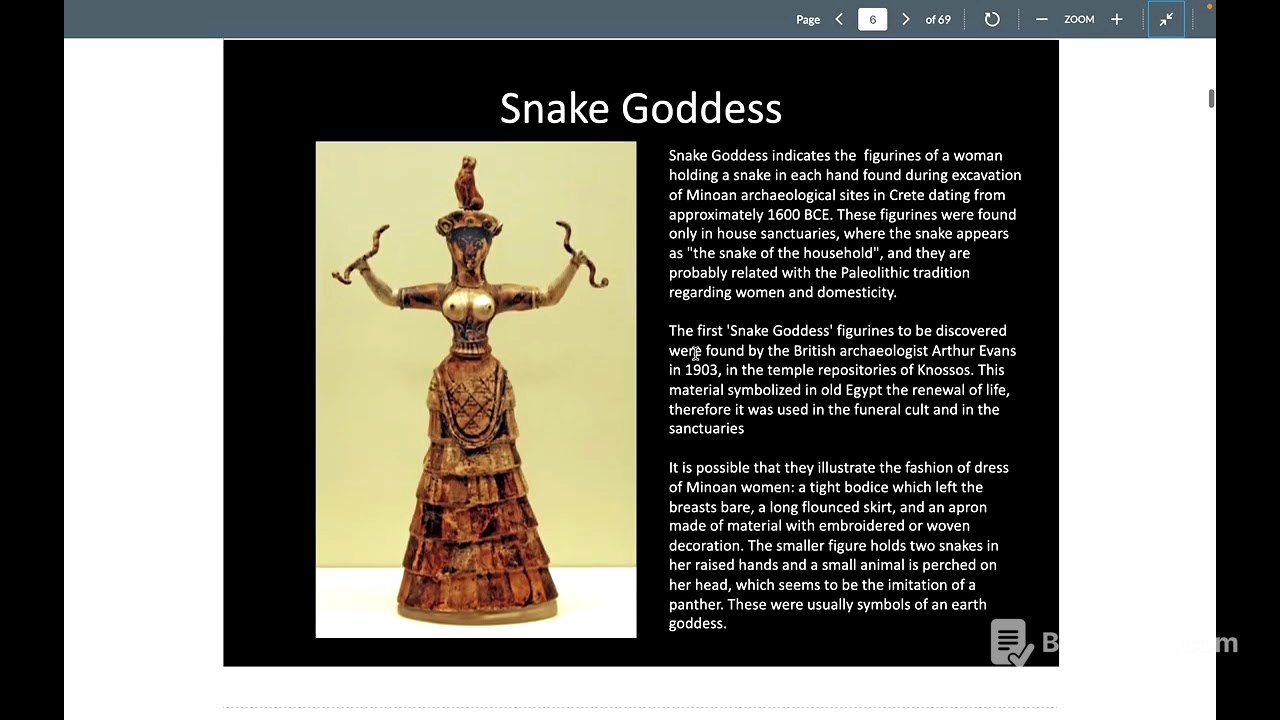
The Cyclades, a group of circular islands between Greece and Turkey, show evidence of settlements dating back to 5000 BC, including marble figurines found at the Getty Museum. The Minoans, based on the island of Crete, were a thriving artistic and trading community until their civilization was absorbed or destroyed by the Mycenaeans around 1400 BC. The Minoan palace of Knossos, with its labyrinthine structure, was a center for ceremonial processions and Cretan life, known for frescoes like the leaping bull fresco. While they had writing systems (Linear A and Linear B), they have not yet been deciphered. The legend of the Minotaur, a half-bull, half-man, is associated with Knossos, symbolizing Athens' liberation from Minoan bondage.
Mycenaeans and Trojan War [11:53]
The Mycenaeans, a militant civilization from around 1600 to 1200 BC, were known for their massive walls, believed to be built by giants. They engaged in the Trojan War around 1200 BC, attacking Troy, a commercial stronghold in Asia Minor. The Iliad and the Odyssey, attributed to Homer, provide insight into Greek society, with the Odyssey detailing Odysseus's journey home. The Trojan War, a 10-year conflict, involved the Greek gods and was a significant part of Greek identity, though much of what is known about it comes from writings 400 years later.
The Iliad and The Odyssey [16:50]
The Iliad focuses on the last days of the Trojan War and the anger of Achilles, highlighting the flaws of even the most powerful individuals. The Odyssey recounts Odysseus's journey home, emphasizing the quest for individual honor and glory. While the Epic of Gilgamesh explores the pursuit of everlasting life, the Greek epics focus on individual achievement. Odysseus faces numerous challenges, including captivity by a Cyclops, before returning home to reclaim his kingdom and reunite with his wife, Penelope.
Greek Gods in Homer [20:59]
The Greek gods personify every aspect of the Greek world, both natural and cultural, but are often portrayed as flawed and selfish. Zeus, the strongest of the gods, favored the Trojans, while Hera favored the Greeks. The history of the Greek gods includes primordial gods, Titans, and the Olympian gods, with stories of their origins and behaviors found in Hesiod's Theogony. The Greeks worshipped the gods in temples and sought divination at Delphi, where the Oracle predicted future events under the influence of Apollo.
Greek City-States and Persian Wars [25:32]
The Persian Wars began in 490 BC, with the Greeks defeating the Persians despite being outnumbered. The Golden Age of the Greeks emerged after the second Persian War, leading to the formation of the Delian League. Tensions over the league's treasury led to the Peloponnesian War between Sparta and Athens, documented by historians like Thucydides and portrayed in Greek literature, such as Aristophanes' Lysistrata. Pericles praised Athens as a school of Hellas in his funeral oration, marking the beginning of the Greek classical age.
Greek Government [29:13]
Greek government was based on the polis, run by Greek citizens, with Athenian democracy emphasizing the common good. Plato's Republic and Aristotle's writings discuss the ideal government, with Aristotle favoring rule by the middle class. Athenian democracy, while seemingly democratic, excluded slaves, out-of-state workers, and women from power. Plato identified five economic classes and four virtues (wisdom, courage, moderation, and justice) essential for a just city. Athenian democracy began with Solon and Cleisthenes, aiming for equality and less corruption, though non-citizens and women had limited rights.
Culture in Athens [32:19]
Athenian culture included the Olympic Games, instituted in 776 BC in honor of the Greek gods, with truces guaranteed even during wartime. Women were excluded from participation, and prowess was valued over cunning. Greek ceramics from the classical age, known for the red style, depicted elongated, stylized figures. Greek theater, growing out of rituals associated with Dionysus, featured tragedies, comedies, and satyr plays, with playwrights like Aristophanes, Euripides, Aeschylus, and Sophocles contributing significantly to the art form.
Greek Theater and Playwrights [33:59]
Greek theater evolved from rituals honoring Dionysus, with the poet Thespis introducing the actor separate from the chorus. Greek comedies, especially those by Aristophanes, often involved body humor, while later comedies by Menander focused on family life and social tensions. Theaters, like the one at Epidaurus designed by Polyclitus the Younger, were built for acoustics and could accommodate thousands of spectators. Tragedians like Aeschylus, with works like Prometheus Bound, and Sophocles, known for Antigone and Oedipus, explored complex themes and individualized characters. Aristotle's Poetics outlined the structure of a story, emphasizing plot, conflict, and resolution.
Greek Poetry and Philosophy [44:16]
Greek poetry included epic, lyrical, odes, and hymns, with lyrical poetry often accompanied by a lyre. Sappho, a lyrical poet from Lesbos, led a group of women in the cult of Aphrodite and wrote love poetry. Early Greek philosophers, known as naturalists, explored the nature of reality, with figures like Heraclitus emphasizing flux and Democritus proposing the existence of atoms. Pythagoras believed in the importance of proportion and numbers, contributing to geometry and discovering the relationship between musical harmonics and numbers.
Sophists, Socrates, and Plato [46:48]
The sophists focused on metaphysics, questioning the limits of human knowledge and arguing that truth and justice are relative. Socrates, unlike the sophists, was interested in virtue and believed that to know good is to do good. He used the dialectical method of questions and answers and inductive reasoning. His student, Plato, wrote about Socrates and explored the meaning of justice and the nature of a just society. Plato's allegory of the cave illustrates the dualistic nature of reality, with prisoners mistaking shadows for reality.
Aristotle [52:37]
Aristotle, a student of Plato and tutor to Alexander the Great, developed the empirical method for science, emphasizing direct observation. He used deductive reasoning and the syllogism. Aristotle also wrote about ethics, emphasizing the golden mean and living a good life. He believed the best government was run by the middle class.
Greek Art [54:49]
Greek art, influential even today, evolved from older styles like archaic pottery to classical styles emphasizing humanism, realism, and idealization. Pottery styles included the black style and the red style, often depicting Greek literature and mythology. Sculpture evolved from archaic forms like the Kouros and Kore to classical forms emphasizing realism and contrapposto, with idealized faces and bodies perfected by math. Greek architecture, exemplified by the Parthenon, featured Doric temples with post and lintel construction, triglyphs, metopes, and sculptures by Phidias.
Greek Music and Dance [1:01:50]
Greek music, likely present since early campfires, included stringed instruments like lyres and flutes. Scales were based on Pythagoras's numerical relationships between strings and tones. Greek dances were part of festivals, with clothing and hairstyles reflecting classical styles.
Hellenistic Age [1:03:46]
The Hellenistic Age, from 323 to 30 BC, followed the rise of the Macedonians. Alexander the Great, a student of Aristotle, expanded the Macedonian Empire, spreading Greek culture across Asia Minor, Persia, India, and Northern Egypt. Hellenistic sculpture emphasized emotion and movement, as seen in the Laocoön Group. Alexandria became a conflux of cultures, blending Egyptian, Roman, and Greek elements. The lecture concludes with a reminder to complete the reading assignment and watch the video on Plato's allegory of the cave for discussion.