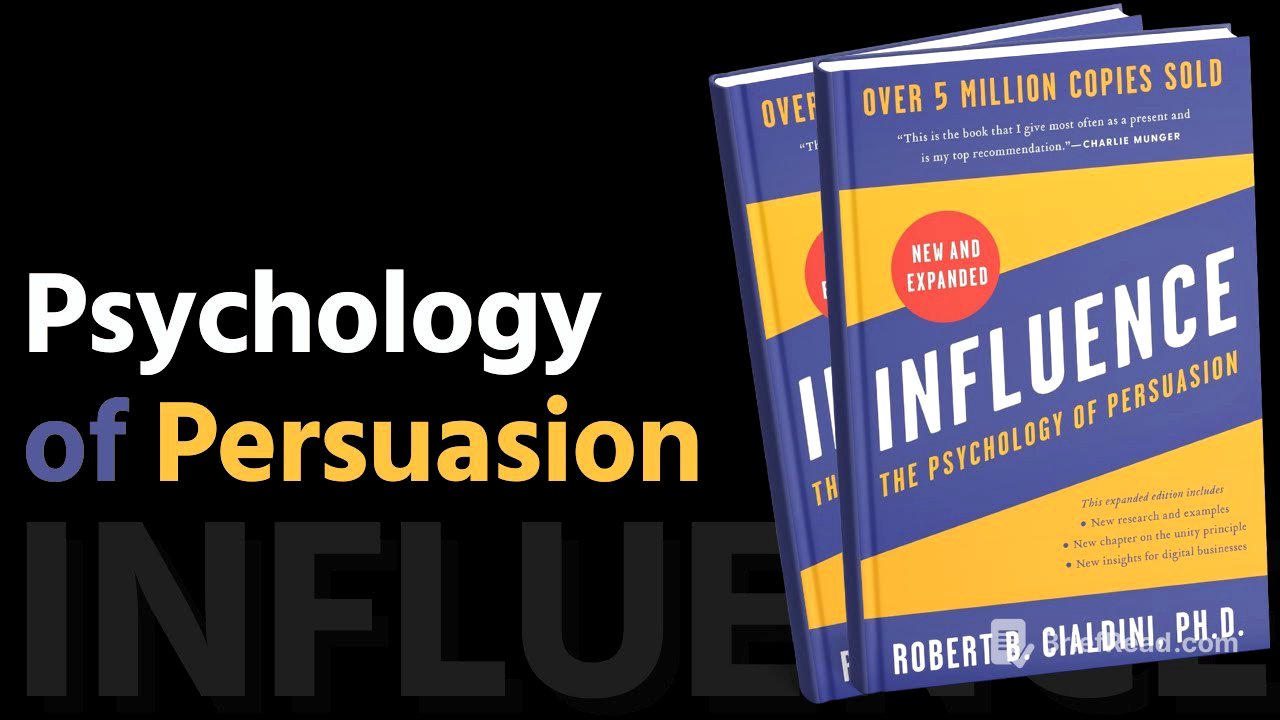
TLDR;
This video summarizes the six key principles of influence as outlined in Robert Cialdini's book "Influence: The Psychology of Persuasion." These principles are reciprocation, commitment and consistency, social proof, liking, authority, and scarcity. The video uses anecdotes, experiments, and real-world examples to illustrate how these principles are used to persuade people to say "yes." It also provides strategies for recognizing and defending against these influence tactics.
- Reciprocation: The tendency to return favors, even unwanted ones.
- Commitment and Consistency: The desire to remain consistent with prior commitments and behaviors.
- Social Proof: The reliance on the behavior of others to determine appropriate actions.
- Liking: The inclination to agree with people we like, who are often similar, attractive, or complimentary.
- Authority: The tendency to obey authority figures, even without legitimate power.
- Scarcity: The perception that things are more valuable when they are rare or limited.
INTRODUCTION [0:00]
The author introduces the topic of influence and persuasion, admitting to being easily persuaded in the past. He explains his motivation to understand the underlying principles that make people say "yes." He describes his journey of researching these principles, starting with experiments in a lab and then immersing himself in the real world, studying professionals in sales, marketing, and advertising. The author reveals that despite the myriad of persuasion techniques, they all fall into six categories, each driven by a fundamental psychological principle. These principles are the weapons of influence.
Chapter 1: WEAPONS OF INFLUENCE [5:03]
The chapter starts with a story about a jewelry store owner who accidentally sold unsold turquoise stones at double the price because her manager misread her note. This leads to the concept of fixed-action patterns in animal behavior, using the example of a mother turkey whose maternal instincts are triggered solely by the "cheep-cheep" sound of her chicks. Similarly, humans have mental shortcuts that can be exploited. An experiment is described where a person cutting in line at a copy machine was more successful when using the word "because," even with a nonsensical reason. The chapter explains that people often use the shortcut "expensive equals good," leading them to make decisions without critical thinking. These shortcuts are generally useful but can be exploited by those who know how to trigger them. The chapter introduces the idea of "mimics," individuals who imitate trigger features to exploit others, and the "contrast principle," where the perception of something is affected by what came before it. For example, salespeople show expensive items first to make cheaper items seem more affordable. A college girl's letter to her parents exaggerates problems to make her failing grades seem less severe, illustrating the contrast principle.
Chapter 2: RECIPROCATION [17:53]
The chapter begins with an anecdote about a professor who sent Christmas cards to strangers and received a surprising number of cards in return, illustrating the principle of reciprocation. This principle dictates that people feel obligated to return favors, gifts, or services. The chapter highlights the strength of reciprocation with the example of Ethiopia donating to Mexico in 1985 despite facing famine, because Mexico had supported Ethiopia during Italy's invasion in 1935. An experiment is described where participants who received a Coke from an experimenter were more likely to buy his raffle tickets, regardless of whether they liked him. The Hare Krishna society's success in fundraising by offering a flower before asking for donations is also discussed. The chapter explains that free samples in stores and "free trials" are based on the principle of reciprocation, creating a sense of obligation to purchase. The chapter emphasizes that the rule of reciprocation can be triggered even when the initial favor is uninvited. People are often willing to return a much larger favor than they received to relieve the psychological burden of indebtedness and avoid being seen as a moocher. The chapter introduces the "rejection-then-retreat" technique, where making a large request first, followed by a smaller, more reasonable request, increases the likelihood of compliance. This technique is illustrated with an example of a boy selling circus tickets and chocolate bars, and its use by Richard Nixon's advisors during the Watergate scandal. The chapter concludes by explaining how to defend against the principle of reciprocation by recognizing when a gift or favor is merely a manipulation tactic and redefining it as a sales technique.
Chapter 3: COMMITMENT AND CONSISTENCY [38:22]
The chapter starts by describing how people at a racetrack become more confident in their chosen horse's chances of winning immediately after placing their bet. This illustrates the principle of commitment and consistency, which states that people have a desire to remain consistent with their prior actions and decisions. The chapter tells the story of Sara, who repeatedly takes back her alcoholic boyfriend despite his broken promises, because she wants to justify her decision to choose him over another man. An experiment is described where people who agreed to watch a stranger's belongings were more likely to chase after a thief who tried to steal the radio. The chapter explains that consistency is valued by society and provides a mental shortcut, but it can also lead to irrational behavior. The chapter discusses how toy companies exploit this principle by advertising a desirable toy before Christmas, creating high demand, then limiting the supply, leading parents to promise their children the toy. After Christmas, the companies re-advertise the toy, and parents fulfill their commitment by buying it. The chapter emphasizes the power of written commitments, citing examples of Chinese captors getting American soldiers to write anti-American statements and companies encouraging salespeople to write down their goals. Public commitments are even more powerful because people want to be seen as consistent and reliable. The chapter describes a car sales tactic where a low price is initially offered to get the customer to commit, only to be later retracted. The chapter explains how to recognize when the commitment and consistency principle is being used against you by paying attention to your stomach and heart feelings. If you feel trapped or uneasy, it's a sign that you're being manipulated.
Chapter 4: SOCIAL PROOF [50:56]
The chapter begins by discussing the use of canned laughter in TV shows, which, despite being disliked, causes people to laugh more and find jokes funnier. This illustrates the principle of social proof, which states that people determine what is correct by looking at what other people are doing. The chapter explains that social proof is often a useful shortcut, but it can be exploited by operators. Examples include bartenders putting money in tip jars, advertisers highlighting the popularity of a product, and club owners creating artificial lines outside their venues. The chapter emphasizes that social proof is most influential when people are uncertain or confused. The chapter describes the bystander effect, where people are less likely to help in an emergency when others are present, because everyone assumes someone else will take action. The chapter cites the tragic case of Kitty Genovese, who was murdered while 38 neighbors watched without intervening. The chapter advises that if you need help in a crowd, single out one person and give them a specific instruction. The chapter discusses how social proof can be used to reinforce beliefs, citing the example of a doomsday cult that became more fervent in their proselytizing after their predictions failed. The chapter concludes by explaining that social proof is most effective when people see others who are similar to themselves engaging in a behavior.
Chapter 5: LIKING [59:26]
The chapter begins by stating the obvious: people are more likely to say yes to those they like. The chapter uses the example of Tupperware parties to illustrate how the principles of reciprocation, commitment, social proof, and liking all work together to drive sales. The chapter explains that the key to Tupperware parties is that the salesperson is a friend, making it harder to say no. The chapter describes how some operators exploit this by asking for the names of friends who might be interested in a product, then using that name to gain entry and credibility. The chapter tells the story of Joe Girard, a car salesman who sent "I like you" cards to his customers every month. The chapter explains that people are more likely to be persuaded by those they find physically attractive, similar to themselves, or who give them compliments. The chapter describes an experiment where boys in a camp became enemies but then became friends after working together to solve a water shortage problem. The chapter explains the "good cop/bad cop" interrogation technique, where one officer is harsh and the other is friendly, to gain the suspect's trust. The chapter concludes by explaining how to defend against the liking principle by separating the person from the product and focusing on the merits of the offer itself. The chapter introduces the concept of association, where people are influenced by the things they associate with a person or product.
Chapter 6: AUTHORITY [1:10:27]
The chapter begins by stating that people tend to obey authority figures. The chapter describes the Milgram experiment, where participants were instructed to administer electric shocks to others, even when they protested in pain. The chapter explains that the experiment demonstrated that people are willing to inflict harm on others simply because an authority figure told them to do so. The chapter explains that people are taught from a young age to respect authority figures, such as teachers, police officers, and judges. The chapter emphasizes that it is not necessary to have real authority to be influential; it is enough to display symbols of authority, such as titles, clothing, and expensive possessions. The chapter explains how to defend against the authority principle by asking two questions: "Is this person truly an expert?" and "Is this person telling the truth?". The chapter describes how waiters sometimes recommend cheaper dishes to appear honest, then upsell more expensive items later.
Chapter 7: SCARCITY [1:18:14]
The chapter begins with a personal anecdote about the author's sudden desire to visit a Mormon temple after learning that a restricted area would be open to the public for a limited time. This illustrates the principle of scarcity, which states that people value things more when they are rare or limited. The chapter explains that people are more motivated by the fear of losing something than by the prospect of gaining something. The chapter explains that operators use two main tactics to exploit the scarcity principle: limited quantity and limited time. The chapter describes a sales tactic where a salesperson tells a customer that the last unit of a desired item has just been sold, then offers to check if another one can be found in the back. The chapter explains that scarcity makes people feel like their freedom is being threatened, leading them to desire the scarce item even more. The chapter describes the "terrible twos," where toddlers become more defiant when their freedom is restricted. The chapter explains the Romeo and Juliet effect, where parental interference intensifies the love between teenagers. The chapter explains that censorship increases the desire for and belief in the censored information. The chapter explains that competition for scarce resources intensifies the effect of scarcity, leading to a "feeding frenzy." The chapter explains how to defend against the scarcity principle by recognizing the physical signs of arousal and asking yourself why you want the item.