TLDR;
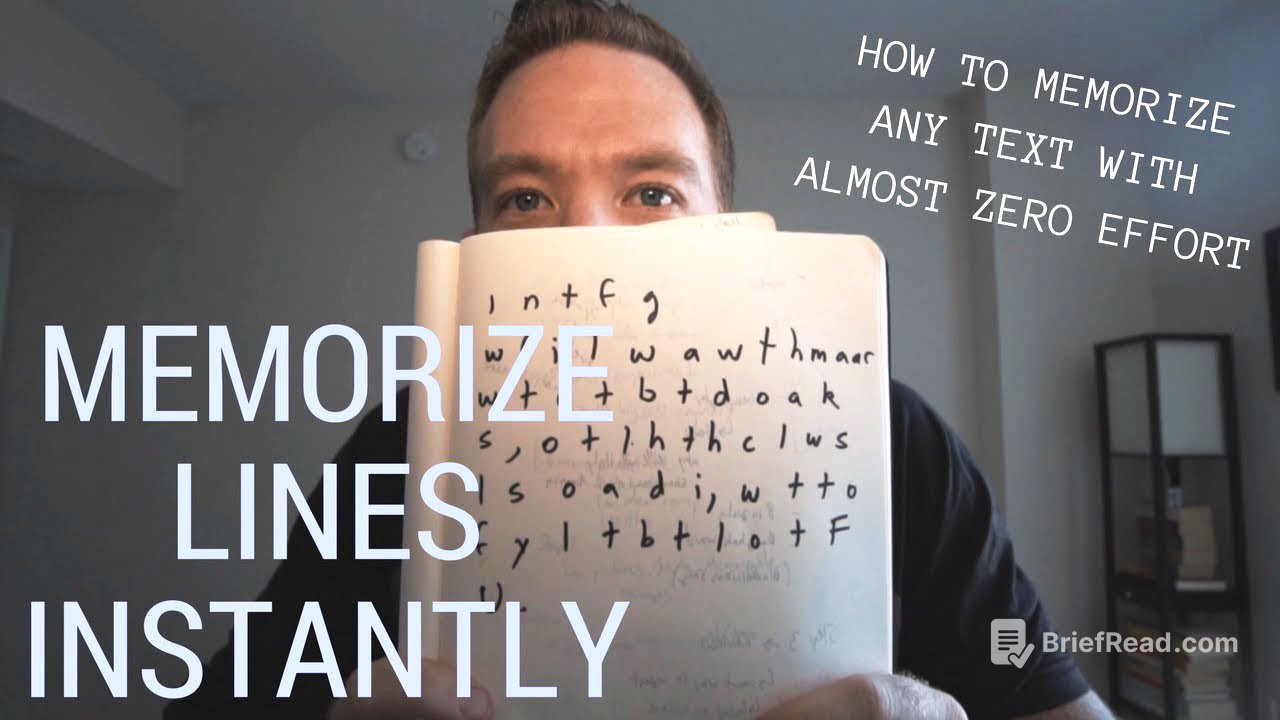
This video presents a simple yet effective technique for quickly memorizing lines of text or poetry without relying heavily on traditional memory techniques like the memory palace. The method involves writing down the first letter of each word in the text and then using this abbreviated version to reconstruct and memorize the original lines. This approach leverages visual and contextual memory to facilitate rapid memorization, making it particularly useful for actors or anyone needing to quickly learn and recite specific texts.
- Write down the first letter of each word
- Reconstruct and memorize the original lines
- Use visual and contextual memory
Intro [0:00]
Nelson Dellis introduces a technique for quickly memorizing lines of text or poetry. He mentions that he learned this method from Lauren Tothero's video and that it doesn't heavily rely on traditional memory techniques. The technique is presented as a quick solution for memorizing lines, especially useful in situations where immediate recall is needed, such as on a set.
STEP 1 [1:09]
The initial step involves selecting a short text, such as the first two lines from a poem. For example, "The Sasquatch squats, flowers in hand, on an old stump by the riverbed." The user should read these lines a few times to familiarize themselves with the content.
STEP 2 [1:35]
The next step is to write down the first letter of each word in the selected lines, including punctuation and capitalization. For the example lines, this would look like: "T S s, f i h, o a o s b t r." This creates a visual aid that captures the structure of the text.
STEP 3 [2:09]
Attempt to reconstruct the original lines using only the first letters as a guide. This may seem challenging initially, but by recalling the visual and contextual elements from when the lines were first read, it becomes easier to piece them together. If needed, the original text can be referenced for assistance.
STEP 4 [2:41]
Once the lines can be reconstructed from the first letters, read the original lines over a few times to reinforce the memory. This step solidifies the memorization process, making recall more reliable.
A more difficult example [2:58]
Dellis demonstrates the technique with a more complex quote: "I'm not the first guy who fell in love with a girl he met in a restaurant who then turned out to be the daughter of a kidnapped scientist, only to lose her to a childhood lover who she'd last seen on a deserted island and who turned out, 15 years later, to be the leader of the French Underground." He emphasizes the importance of writing the first letters in the same format as the original text to maintain visual memory.
THE FINAL ATTEMPT! [4:42]
Dellis attempts to recite the complex quote after preparing the first-letter blueprint. He successfully recalls the entire quote, demonstrating the effectiveness of the technique even with longer and more complicated texts.
Outro [4:58]
Dellis concludes by reiterating that this method is a quick and accessible way to memorize text, especially when a memory palace or other more time-consuming techniques are not feasible. He encourages viewers to try the technique and notes that it can be surprisingly effective for anyone.
![‘세계 최초 금지법’까지 만들었는데...왜 미국·유럽처럼 안 바뀌는 거죠? [뉴스 쉽게보기]](https://wm-img.halpindev.com/p-briefread_c-10_b-10/urlb/aHR0cHM6Ly9pbWduZXdzLnBzdGF0aWMubmV0L2ltYWdlLzAwOS8yMDI1LzA5LzIxLzAwMDU1NjIxMzJfMDAxXzIwMjUwOTIxMTM1NDA3MjMyLnBuZz90eXBlPXc4MDA=.jpg)