TLDR;
The video explores how the Pentagon's internal patterns and logistical needs inadvertently reveal information about its operations. Despite its design for secrecy, predictable routines like late-night food deliveries and unusual activity at loading docks serve as indicators of heightened activity and potential crises. This "pizza index" and other observable patterns have become a crowdsourced early warning system, highlighting the challenge of maintaining secrecy in a building that relies on predictable systems to function.
- The Pentagon's design prioritizes efficiency, creating predictable routines that can be observed.
- The "pizza index," based on increased pizza orders, signals heightened activity and potential crises.
- The National Military Command Center (NMCC) and the Joint Chiefs of Staff conference room ("the tank") are key locations shielded against electronic surveillance.
Intro [0:00]
The Pentagon, designed for secrecy with no inward-facing windows and walls blocking frequencies, paradoxically leaks information through its daily routines. These patterns are so reliable that they once predicted the invasion of Kuwait. The building's design and the activities within it create observable patterns that reveal when something significant is happening.
Pentagon's Layout and Power Dynamics [0:48]
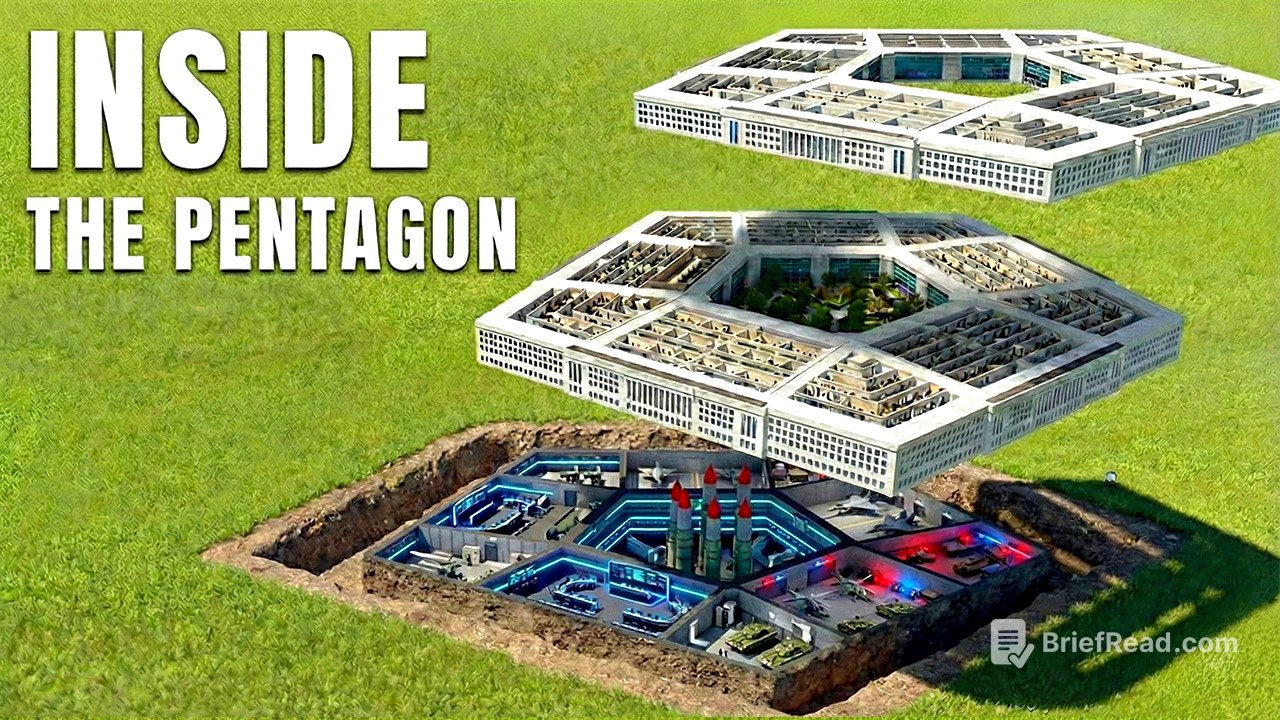
The Pentagon consists of five concentric rings (A to E) connected by 10 corridors. The E-ring, particularly the third floor near the river entrance, houses the most powerful offices, including the Secretary of Defense and the Joint Chiefs. Each branch of the military has its own distinct style in its hallways, displaying artifacts and symbols of their service. Helicopter traffic, especially late-night Blackhawk landings, also indicates important, urgent meetings.
The Need for Efficiency and Predictability [2:57]
The Pentagon was built to consolidate the War Department, previously scattered across 17 buildings, ensuring that anyone inside could reach anyone else within 7 minutes. This efficiency creates predictability, as routines develop within the building. Increased activity, such as packed parking lots and lights on late in the E-ring, signals that the Pentagon is operating in crisis mode.
Navigating the Maze [4:16]
Every office in the Pentagon has a five-character code indicating its location (floor, ring, corridor, bay). However, the uniformity of the corridors and rings makes navigation difficult, even for experienced personnel. The building's design, constructed rapidly during wartime with standardized materials, contributes to this disorientation. Until 2011, there was only one passenger elevator, reserved for the Secretary of Defense, with everyone else using ramps.
Self-Contained Infrastructure [6:59]
The Pentagon is a self-contained facility with its own zip code, police, fire department, and metro station. Inside, there are numerous amenities, including a bank, post office, dining facilities, and a fitness center, allowing employees to stay within the building for extended periods. The logistics of supplying 23,000 people require scheduled delivery routes, but changes in these schedules can signal crisis mode.
Underground Secrets and Shielded Rooms [8:31]
During the Cold War, the Soviets monitored the Pentagon, believing a hot dog stand in the courtyard was the entrance to an underground command bunker. While the bunker was never built, the Pentagon does have two subterranean levels with classified facilities. Certain sections, like the National Military Command Center (NMCC) in the Joint Staff Area, are shielded against electronic surveillance.
The National Military Command Center (NMCC) [11:39]
The NMCC operates 24/7, keeping the President and Secretary of Defense informed about military activities worldwide. It houses secure terminals connecting to combatant commands and the nuclear codes. The facility operates on multiple classification levels, with some information highly compartmentalized. It also houses the American end of the Moscow-Washington hotline.
The Tank: Joint Chiefs of Staff Conference Room [13:08]
The Joint Chiefs of Staff conference room, known as "the tank," is a sensitive compartmented information facility shielded against electronic surveillance. Here, the Joint Chiefs discuss war plans and contingency operations. Phones are collected, and no aides are allowed inside during meetings. The goal is clarity, ensuring the President knows the military advisors' true opinions.
The Pizza Index [15:34]
Frank Meeks, a Domino's franchise owner, noticed that large pizza orders from the CIA and Pentagon often preceded major news events, creating the "pizza index." This index became a reliable indicator of heightened activity. The press began monitoring pizza deliveries, and today, accounts like the Pentagon Pizza Report track foot traffic at pizzerias near the building to provide early warnings of potential crises. Despite the Pentagon's denial, the pizza index remains a crowdsourced early warning system, along with other metrics like ride-share activity and energy usage.