TLDR;
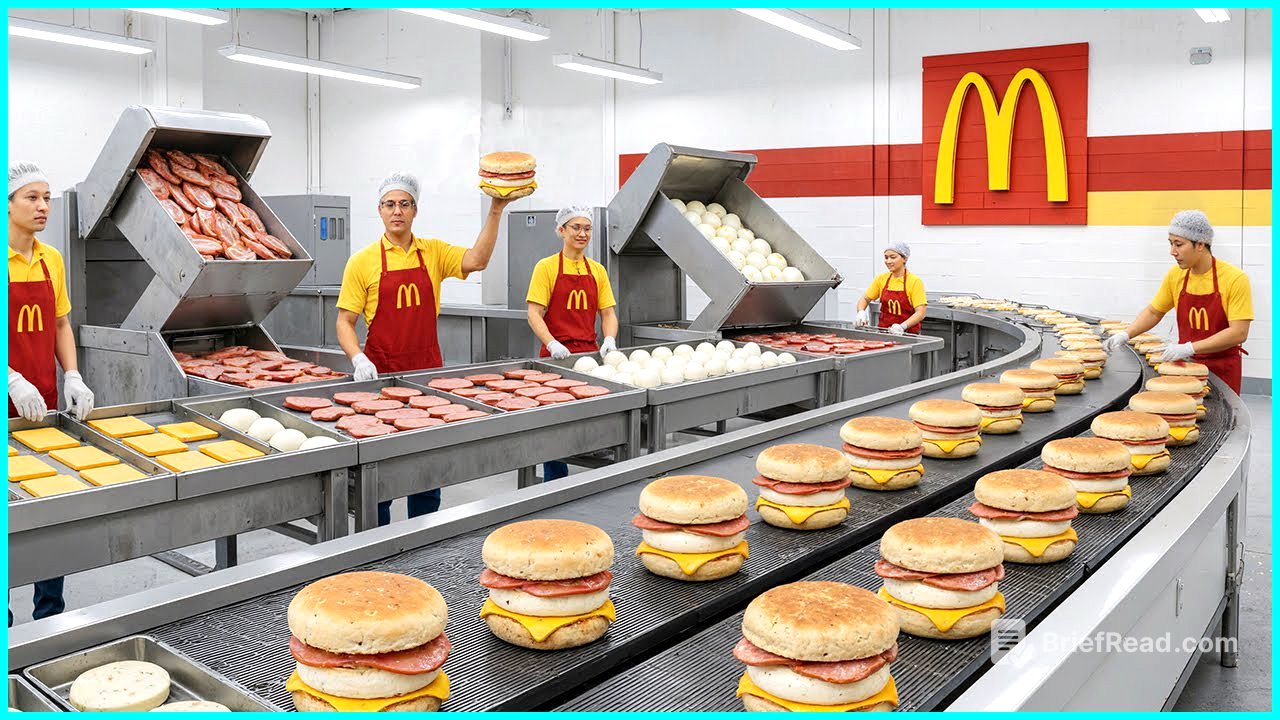
This video explores the intricate supply chain and production processes behind McDonald's iconic breakfast sandwiches, particularly the Egg McMuffin and Sausage McMuffin. It traces the origins of the Egg McMuffin, invented in 1971, and details the specialized manufacturing of each component, including English muffins, Canadian bacon, sausage patties, American cheese, and fresh eggs. The video also examines the in-store preparation process, highlighting the efficiency and precision of McDonald's breakfast assembly line.
- The Egg McMuffin was invented in 1971 by Herb Peterson, a McDonald's franchise owner.
- Key components like English muffins, Canadian bacon, and sausage patties are produced in specialized factories with high precision.
- McDonald's uses fresh, grade A eggs that are cracked directly onto the grill for the Egg McMuffin.
- The in-store assembly process is highly efficient, designed to quickly serve millions of customers each morning.
Introduction [0:00]
McDonald's breakfast sandwiches, such as the Egg McMuffin and Sausage McMuffin, are popular and have a fascinating production story. These sandwiches symbolize the fast-food breakfast concept and rely on a precisely engineered supply chain. The video explores how McDonald's has perfected this breakfast icon.
The Origin of the Egg McMuffin [1:05]
In the early 1970s, McDonald's franchise owner Herb Peterson created the Egg McMuffin, inspired by eggs benedict, to open his restaurant earlier. Invented in 1971, it consists of a toasted English muffin, egg, Canadian bacon, and melted American cheese. Peterson used a custom-made six-ring stainless steel tool to cook perfectly round eggs. Despite initial hesitation from Ray Croc, the Egg McMuffin became a nationwide success within six years, leading to extended operating hours and a broader breakfast menu.
How English Muffins Are Made [2:45]
Bimbo Bakeries supplies English muffins to McDonald's in the United States. The process begins with bread flour, water, yeast, sugar, salt, and oil mixed in industrial mixers for about 10 minutes. The dough is then transferred to proofing tanks for an hour, where yeast activates, causing it to rise. A dividing machine cuts the dough into equal portions, which are rounded into smooth balls and dusted with cornmeal to prevent sticking. The dough balls enter a proofing chamber with controlled temperature and humidity to allow the yeast to create tiny gas pockets. The dough pieces are placed in steel baking rings and baked in a 50-foot oven at 390°F for about 5 minutes, then move to a lower temperature zone. The muffins cool in a spiral cooling tower before being fork-split to create uneven air pockets. Finally, the muffins are packed, sealed, and shipped to McDonald's restaurants.
Canadian Bacon Production [5:20]
The production of Canadian bacon starts with fresh pork, transported to the processing plant in large tubs. Whole muscle sections are trimmed, bones are removed, and excess fat is trimmed to achieve the ideal lean-to-fat ratio. The curing stage involves injecting a brine of salt, sugar, sodium nitrate, and color enhancers directly into the pork loins using an injector with over 120 needles. The meat is then packed tightly into cylindrical molds with a caramel-coated mesh sleeve to maintain shape during cooking and create a light brown exterior. The molded pork loins are steam-cooked at low temperatures for about 5 hours to allow the brine to penetrate fully. After cooking, the meat cylinders are chilled, the mesh sleeves are removed, and the loins are sliced into uniform round slices about 3 inches wide and 1/4 inch thick. The slices are vacuum-sealed and shipped to McDonald's restaurants.
Sausage Patty Processing [7:40]
Sausage patty production begins with fresh pork, lean meat and fat, blended in precise ratios. The mixture is ground using razor-sharp blades and combined with salt, pepper, garlic powder, onion powder, paprika, sugar or syrup, and sage. After 4 minutes of mixing, the meat becomes smooth and uniform. A forming machine presses the mixture into round patties, which are then deep-frozen at -31°F for about 7 minutes. The factory produces up to 3 million patties per day, totaling over 70 million pounds annually. The frozen patties are stacked, packed, and stored in cold storage before being delivered to McDonald's restaurants.
How McDonald’s American Cheese Is Made [10:00]
LRO Foods produces McDonald's American cheese slices using a custom formula for even melting and stable texture. The process starts with 44lb blocks of cheese ground into small pieces and transferred to cooking kettles with milk, whey, and stabilizers. The mixture is stirred at 185°F and heated to nearly 207°F to activate emulsifiers, creating a thick cheese melt. The hot cheese is pumped onto a chilled steel conveyor, where forced air cooling firms it up. The cheese is pressed into large blocks to remove moisture and then sliced into uniform, thin squares. These slices are boxed, cold-stored, and delivered to McDonald's kitchens.
Fresh Grade A Egg Production [12:05]
McDonald's uses only fresh, large grade A eggs, cracked directly onto the grill for the Egg McMuffin. Hens, about 20 weeks old, are fed a balanced diet to lay roughly one egg per day. The eggs are automatically collected and sent to the grading line for quality inspection. The eggs are washed and sanitized in a 120°F wash bath to remove dirt and bacteria. They then move to a candling station where technicians and imaging systems check for blood spots, cracks, or internal defects. Only grade A eggs are selected for McDonald's, then sorted by size, boxed, chilled, and delivered to McDonald's restaurants, where they stay fresh for 3 to 4 weeks.
McDonald’s Breakfast Grill Process [13:55]
Inside McDonald's, English muffins are toasted in a high-speed dual-sided toaster for 15 to 20 seconds. Canadian bacon slices are seared on the griddle until golden, taking about 1.5 minutes per side. For sausage McMuffins, frozen patties are cooked on the griddle for about 50 seconds per side, reaching an internal temperature of 160°F. Fresh eggs are cracked onto the grill inside round egg rings, the yolk is broken, and water is added to create steam for even cooking. The ring is covered for 2.5 minutes, then the cooked eggs are removed and placed in warming cabinets. All components are stored in warming units to maintain serving temperature.
Final Assembly & Conclusion [15:50]
When an order is placed, the two halves of the toasted English muffin are placed onto a wrapper. A slice of American cheese is placed on the bottom muffin, followed by the steamed round egg and Canadian bacon. The top half of the muffin is then added to complete the Egg McMuffin. For the Sausage McMuffin, the Canadian bacon is replaced with a sausage patty. This structure creates a quick and convenient breakfast sandwich, embodying the fast-food breakfast concept McDonald's pioneered. The Egg McMuffin remains an iconic fast-food breakfast.