TLDR;
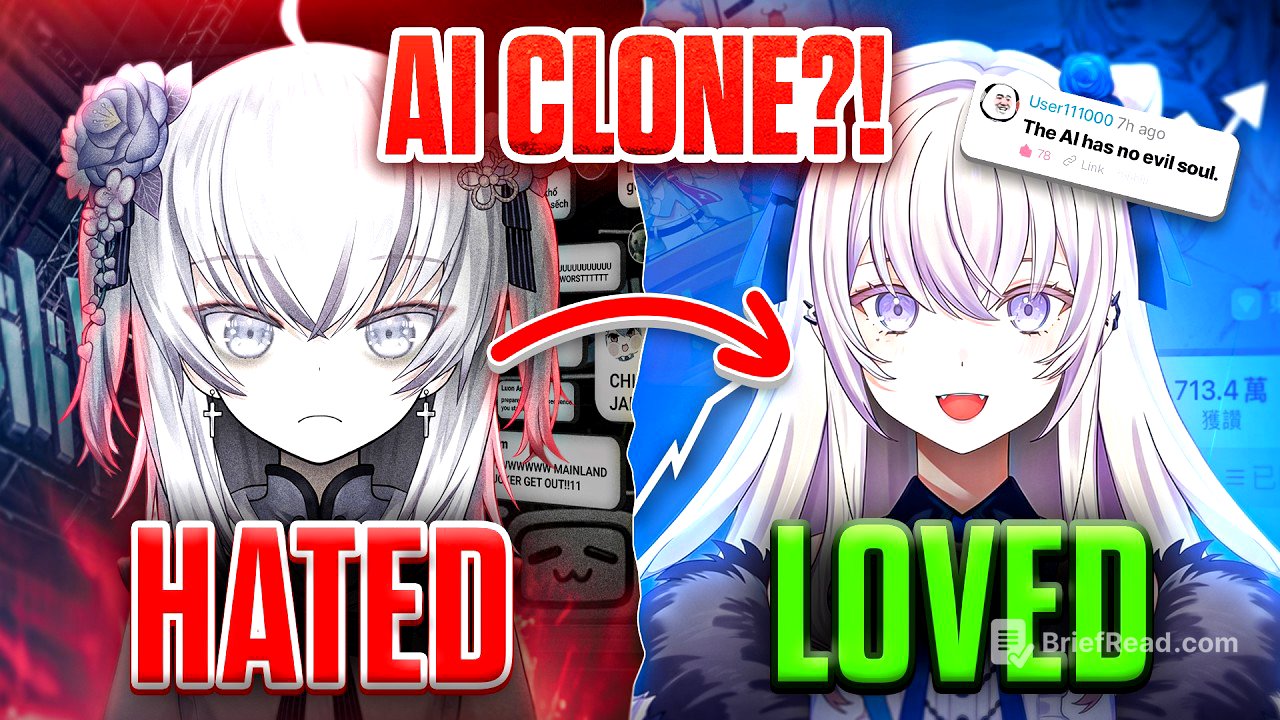
Azuma Seren, known on Bilibili as Dong Xuelian, survived a nationalist backlash, the collapse of her creator group, and several personal and public controversies. Her management agency then secretly created an AI version of her using her avatar and cloned voice, allowing the automated account to compete with her while both channels generated revenue.
- China’s MCN agencies often own VTuber character IP and tightly control the performers who bring those characters to life.
- A mistranslated comment about learning Mandarin triggered years of harassment, compounded by personal disputes and organized fan-circle attacks.
- Seren’s agency operated a popular AI clone without her freedom to object, exposing the conflict between corporate ownership and performers’ rights.
- Her story highlights the risks of using AI to replace human creators, while showing that genuine community and human creativity remain difficult to reproduce.
China’s Livestreaming Industry and MCN Agencies [0:00]
China’s livestreaming industry is a multibillion-dollar business built on intense competition. Bilibili, a major hub for anime, gaming, and creator culture, has developed a large VTuber market in which many creators work under MCNs, or multi-channel networks. These agencies typically own the character’s intellectual property (IP)—including its model, name, artwork, and trademarks—and provide equipment, rigging, sponsorships, and promotional support.
The human performer behind a VTuber is sometimes called the “person in the shell,” while the avatar is the “shell person.” Performers commonly receive a base salary and a limited share of donations or memberships, while agreeing to strict nondisclosure terms. This arrangement creates a conflict: agencies may view the avatar as a permanent, controllable asset and the performer as replaceable, while audiences often connect most strongly with the performer’s voice, humor, emotions, and personality.
By the time Azuma Seren entered Bilibili, thousands of agency-backed VTubers were competing with similar gaming, chatting, and karaoke content. The pressure to stand out led to demanding schedules and widespread burnout, giving agencies an incentive to find ways to produce content without relying on human performers.
A Translation Error Sparks a Nationalist Backlash [4:53]
Before becoming Azuma Seren, she streamed around 2019 as Tsukuma Nemu. Born in Hong Kong and raised in Japan, she was most comfortable speaking Japanese. She had learned Mandarin at home from her mother, could hold ordinary conversations, and used her streams to improve her fluency. During one broadcast, she described the difficulty of learning complex Mandarin grammar in Japanese. Translation software distorted her words, making it sound as if she had called Chinese an “evil language.”
The mistake triggered accusations that she was a traitor to China. Seren apologized and explained her upbringing, but the online backlash continued, with attackers portraying her as a foreign sellout or someone hiding her roots. Bilibili’s automated filter eventually blocked the explicit insult, so hostile viewers used “Han Jian,” a homonym that means “rare,” to keep spamming the same accusation indirectly.
The incident became a lasting stain on her reputation across later identities. Seeking a fresh start, she erased her old channel history and debuted on Bilibili as Dong Xuelian, joining the MCN group Blanche Fleur with Anna Mori Nako and Akuma no Shippii.
Blanche Fleur Collapses and Seren’s Harassment Returns [7:38]
Blanche Fleur struggled to gain traction in Bilibili’s crowded market. Seren could communicate in Mandarin, but her two Japanese groupmates had difficulty connecting with mainland viewers and often fell back on Japanese. The group fractured within about a month. Shippii streamed for roughly eight months before stepping away in late 2021; her accounts were locked and her channel page was transferred to another creator. Nako tried streaming independently on YouTube, including Japanese and Spanish content, but her viewership remained low and her channel later went silent. Blanche Fleur’s corporate account eventually stopped updating after canceling merchandise orders.
Seren was the only member who continued streaming. She joined a new agency, Menge Culture, and began building her personal channel, but viewers eventually connected her to her earlier identity, reigniting the old harassment campaign. Personal conflicts then added to the pressure, particularly the breakdown of her friendship with Lilla, a Chinese creator living in Japan who had publicly defended her.
According to Lilla, their friendship deteriorated because Seren treated her like an unpaid assistant. Lilla described a Kyoto trip involving missed airport check-in, costly baggage fees, and problems caused by Seren’s name being written in Hong Kong-style romanization rather than mainland pinyin. Lilla also said Seren later blamed her publicly for the travel problems. Their friendship finally ended after Lilla turned back from delivering medicine when Seren said someone else had brought it; a moderator later spread a rumor that the visitor was Seren’s secret boyfriend. Seren accused Lilla of leaking private information, and Lilla went public with her reasons for cutting ties. Seren’s moderators left her channel, and she did not publicly refute Lilla’s account.
Public Feuds, Doxxing, and Fan-Circle Attacks [12:33]
Seren’s public feud with League of Legends streamer John Chen further damaged her reputation. After viewers mentioned Chen’s financial difficulties in her chat, Seren mocked his situation and said he could bow down and beg her for money. When people demanded an apology, she responded with a video of sarcastic barking noises rather than a sincere apology, presenting her critics as noisy dogs whose anger she did not respect.
Rumors alleged that Seren and Chen had been romantically involved, though the relationship was not confirmed. After their fallout, Chen leaked private photos of her real face and insulted her appearance, calling her an ordinary Japanese schoolgirl who looked different without makeup. The leak gave trolls new material for attacks and revived the nationalist narrative that she was not Chinese. A separate ex-boyfriend also publicly accused her of cheating him out of money intended for overseas tuition; the transcript notes that this allegation may have been exaggerated or unverified, but it circulated widely.
The video explains how China’s “fan circle” culture can turn audiences into coordinated online groups. Fans may mass-vote, report rivals, review-bomb them, spend heavily on gifts, or try to trigger bans and censorship. Because fans invest heavily in a creator’s success, disappointment can turn that devotion into organized hostility. In Seren’s case, the attacks did not only aim to drive her off the platform; they also encouraged support for anything that might replace her.
An AI Clone Overtakes Seren’s Channel [17:08]
In early 2023, a Bilibili channel called Dong Yang Shulian appeared, posting polished 3D Blender animations, MMD dance videos, and song covers. Its character used the same model as Seren, and its voice sounded like a synthetic clone trained on her stream audio. Viewers initially assumed it was a fan project, but the channel produced high-effort content at a near-daily pace, suggesting a professional operation.
Seren’s antis—organized anti-fans—rallied behind the account to spite her. Some praised the clone as a better creator because it retained the character and voice while removing the “evil soul” of the person behind it. The channel gained hundreds of thousands of followers and, at points, surpassed Seren’s main account in followers and video views. Its song covers and animations also received praise compared with her live singing.
AI VTuber content already had an audience on Bilibili, where viewers could find AI song covers, MMD videos, and complex animations that differed from the repetitive live gaming and chat formats. That existing interest, combined with anti-fan promotion, helped the clone grow. Seren watched the automated account outpace her work while viewers mocked her for seeming jealous of her own double.
The Agency’s Role in the Clone Is Exposed [20:19]
The clone’s origins remained uncertain until May 2023. During a Seren livestream, the 3D animator Zuto So accidentally bought a channel membership. Seren reacted by calling him out and banning him, prompting viewers to investigate why she had treated a paying subscriber so harshly. They found that Zuto So’s publicly posted Blender projects, MMD renders, and animation assets matched the clone’s videos.
The discovery identified Zuto So as the technician and animator behind the AI account. Seren’s agency boss, known as Huxi or Yufu, then admitted that Zuto So was his employee and that the agency had commissioned him to create the clone’s animations and song covers. Huxi called the subscription incident an accidental failure to switch accounts, but said the agency had no intention of shutting down the clone.
During a later stream, Seren broke down and confirmed that the AI account had been created and operated by her own MCN—not by an independent fan or rogue copycat. She said that both her main channel and the clone belonged to the agency, and strict NDAs prevented her from speaking freely or taking legal action. She had to continue streaming while her employer used her voice and avatar to build an automated alternative that required no salary, sick leave, or human emotions.
AI Voice Rights and the Legal Gray Zone [24:36]
When agencies began deploying AI clones in 2023, voice cloning occupied a legal gray zone. Some management companies argued that owning a character’s IP and avatar gave them the right to train AI systems on a performer’s archived voice. Chinese courts later issued rulings that addressed some of these concerns. In April 2024, the Beijing Internet Court ruled that cloning a performer’s voice without explicit consent violated personal rights under China’s Civil Code. The transcript also cites a September 2026 ruling by the Shanghai First Intermediate People’s Court, which said that when an AI model has at least 90% acoustic similarity to a real voice, the platform must prove its training data was obtained legally.
The video contrasts protections for individual performers with corporate control over character assets. When miHoYo, the developer of Genshin Impact, sued an AI app for cloning 63 character voices, the app argued that voice rights belonged to individual actors rather than the studio. The court rejected that defense and ruled that character voices could become important commercial assets owned by the studio after years of commercial use. The company was ordered to pay more than $100,000 in damages to protect the studio’s brand rights.
The same logic could benefit agencies: companies may use character-IP ownership to defend their commercial interests while relying on that ownership to create AI versions of their own talent. As the clone grew, other creators also made similar AI copies using Seren’s archived streams and modified avatars. A VTuber named Tio faced accusations of being a secret Seren account or copycat because her voice and Live2D model resembled Seren’s.
AI Mashups Stir Rivalries Between Fandoms [26:46]
The clone’s popularity inspired a broader wave of “Dong Xuelian” content: AI covers, memes, posts, and other fan-made creations. Bilibili users call such derivative works “secondary creations.” One major creator caught in the resulting arguments was Jong Chu Taffy, a Bilibili VTuber formerly known as Spade Echo from Hololive China. International fans may remember her for not joining the dogpile against Kiryu Coco during the 2020 Taiwan controversy.
Taffy was repeatedly paired with Seren in AI voice mashups and collaborative meme videos. Their respective fandoms clashed, and viewers interpreted Taffy’s criticism of Seren’s agency as an attack on Seren herself. Taffy had said she disliked being linked to a company she did not know or support, describing the agency as strange and opaque.
However, Seren and Taffy were actually on good terms. Seren had wished Taffy a happy birthday and praised her creativity, while Taffy had hinted that she would like to collaborate. Both disliked being forced together in AI mashups, but the conflict came from rival fans using edits to manufacture a feud—not from hostility between the creators.
Seren Confronts Harassers and Reclaims Her Voice [29:47]
By May 2024, repeated accusations that she was a traitor had pushed Seren to her limit. After months of xenophobic comments, she snapped during a livestream and again explained that she was born in Hong Kong, educated in Japan, still lived there, and learned Chinese from her mother. Exhausted by constant challenges to her identity, she insulted those questioning her as “motherless,” which brought another wave of backlash.
The harassment also turned into an unusual source of entertainment for her community. A self-described hater sent a 50 RMB paid message wishing for Seren’s downfall. Other viewers soon sent larger paid messages pretending to be haters, turning the antagonistic exchange into an in-joke. In another incident, a former fan who had switched allegiance to the AI account tried to stop Seren from calling him out, claiming he had been hurt by her and would forgive her if she stayed silent. Seren refused and exposed him on stream.
The ASoul Scandal and the Business Case for AI [32:02]
The agency’s decision to create an AI clone came amid corporate anxiety following the 2022 ASoul scandal. ASoul, a major virtual idol group created by Yuehua Entertainment and ByteDance, appeared polished to viewers, but its human performers endured punishing workloads. Its star vocalist, Carol, suffered a thoracic spine injury after late-night dance sessions and physical cuts from heavy motion-capture equipment, while receiving only a small fraction of the revenue she helped generate. Her departure exposed the company’s treatment of performers, prompting a large fan backlash and the group’s eventual collapse.
The scandal showed entertainment executives how much their businesses depended on human workers who could become injured, burned out, unhappy with working conditions, or critical of their employers. AI appeared to offer a dependable alternative that could work continuously without illness, fatigue, emotional distress, or a substantial salary. A Chinese tech publication, Huxiu, described the ASoul fallout as a factor encouraging agencies to treat AI as a way to safeguard their investments and core IP.
Companies could prepare AI versions to take over if a performer became unavailable. Seren’s case went further: her agency launched the clone while she was still active, effectively making the two compete. When viewers taunted her with the clone’s rising metrics, Seren once said she would stop streaming if her imitation surpassed her.
Seren’s Return, Future Plans, and the Limits of AI [34:43]
After taking time away for throat surgery, Seren returned to Bilibili in July 2026. She began visibly upset, admitted that the AI clone’s success had made her consider quitting, and then said she had decided against retiring. She would allow her employer to keep operating the AI channel as long as it did not interfere with her own activities, describing her earlier retirement comments as frustration rather than a firm decision.
Seren recognized that many viewers compared the two accounts simply to provoke her. She told those who preferred the AI version to watch it instead of messaging her. She also clarified that she had feared her boss was trying to take her character, but said her contract would give her the Azuma Seren IP when it ended in 2028. She insisted the clone would not exist without her voice and likeness, although her NDA prevented her from explaining further. She planned to focus on independent songwriting and music production on her own terms.
The clone did not end the harassment, though it seemed to draw some of the hostility away from Seren’s own comment section. Her real channel also retained longtime supporters and gained newcomers who knew about her controversies but still wanted her to recover and succeed. Seren was not portrayed as faultless: her treatment of friends and some of her responses contributed to criticism. Still, the story raises concerns about companies being allowed to clone workers so they can produce content indefinitely.
The video closes by framing Seren’s story as a warning about an industry trying to engineer human vulnerability out of its business model. AI can imitate a voice and animate a model, but it cannot reproduce a person’s identity, resilience, or genuine creative connection. Seren’s AI double remains a reminder that an automated substitute may copy a creator’s surface qualities without replacing the human soul behind them.