TLDR;
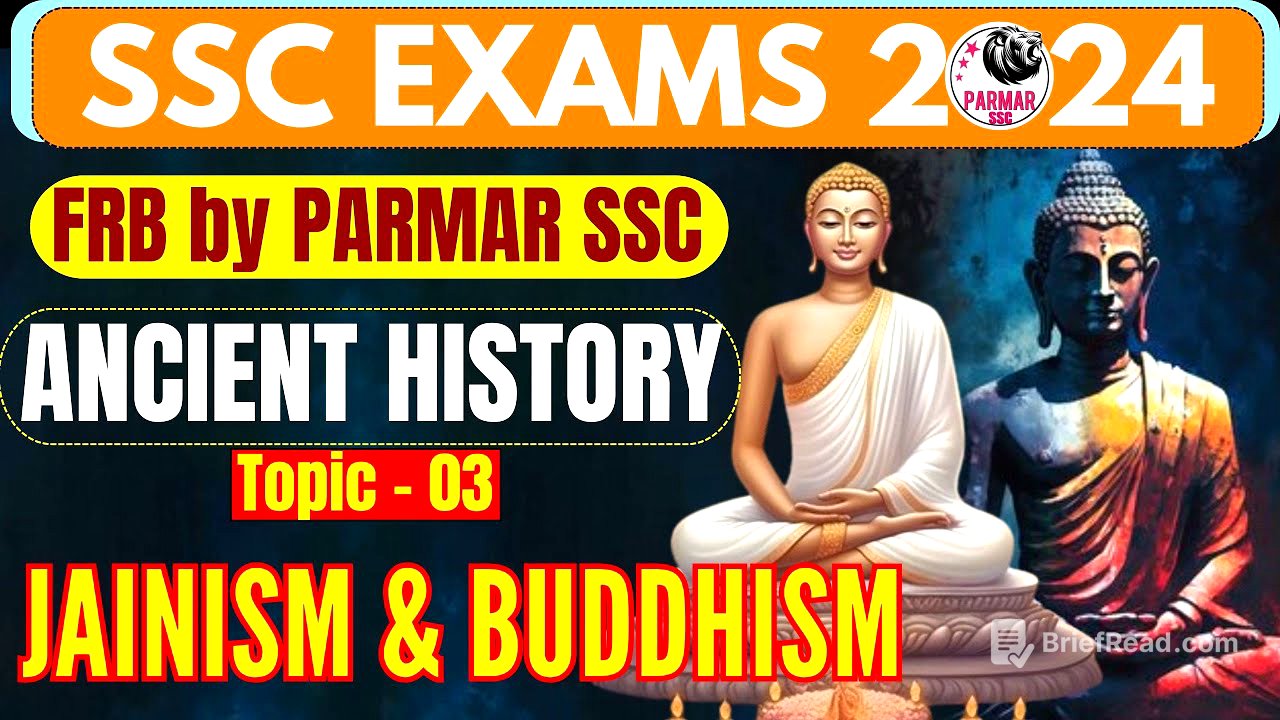
This lecture provides a detailed overview of Jainism and Buddhism, contrasting them with the Vedic Age and Brahminical dominance. It covers the life and teachings of Gautam Buddha, including his birth, enlightenment, first sermon, and death, as well as key Buddhist concepts like the Four Noble Truths and the Eightfold Path. The lecture also discusses Buddhist texts, sects (Hinayana, Mahayana, Vajrayana), and councils. Additionally, it explores Jainism, focusing on the Tirthankaras, particularly Rishabh Dev and Mahavir, the three gems of Jainism, the five principles of living, and the sects of Digambars and Shwetambars. The lecture concludes with a look at important stupas, monasteries, and Jain architectural sites.
- Key figures: Gautam Buddha, Mahavir
- Core concepts: Four Noble Truths, Eightfold Path, Triratna
- Sects: Hinayana, Mahayana, Digambars, Shwetambars
Introduction to Jainism and Buddhism [0:00]
The lecture begins by contrasting Jainism and Buddhism with the Vedic Age, noting the dominance of the Brahmin class and the limitations placed on lower classes in attaining salvation through traditional Vedic rituals. This resistance from the Kshatriyas led to the emergence of heterodox schools of thought, primarily Jainism and Buddhism.
Life of Gautam Buddha [2:13]
Gautam Buddha was born in 623 BCE in Lumbini, Nepal, and died in 483 BCE in Kushinagar. His father was Suddhodana of the Shakya clan, and his mother was Mahamaya of the Koliya clan. After witnessing an old man, a sick person, a dead body, and a meditating monk, he renounced his home at the age of 29. His first teachers were Alara Kalama and Udraka Ramaputra. He attained enlightenment under the Bodhi tree in Bodh Gaya, on the banks of the Niranjana River, and gave his first sermon in Sarnath, Varanasi.
Symbolic Representations and Stupas [5:37]
Important events in Buddha's life are represented by specific symbols: birth by the lotus, renunciation by the horse (Mahabhinishkramana), enlightenment by the Bodhi tree (Nirvana), first sermon by the wheel (Dharma Chakra Pravartan), and death by the stupa (Mahaparinirvana). The lecture details the architecture of stupas, including elements like the railing (Vedika), Medhi, Anda (hemispherical dome), Hermika, and Chhatra. Stupas often contain relics of Buddha or important Buddhist figures (Boddhisattvas).
Important Stupas and Buddhist Philosophy [9:31]
The lecture mentions several important stupas, including the Sanchi Stupa (oldest, built by Ashoka), Dhamek Stupa (Sarnath), Chaukhandi Stupa (Varanasi), Shanti Stupa (Ladakh), and Borobudur (Indonesia). Buddhist philosophy is centered around the Four Noble Truths: life is full of suffering, desires are the root cause of suffering, suffering can end, and there is a path to end suffering. The path to end suffering is the Eightfold Path, which includes right view, right intention, right speech, right action, right livelihood, right effort, right mindfulness, and right concentration.
Buddhist Texts and Sects [12:25]
Key Buddhist terms include Chaitya (prayer hall) and Vihara (monastery). The three gems of Buddhism are Buddha, Dhamma (religion), and Sangha (community). Buddhist texts are primarily written in Pali. Important texts include the Buddha Charita (biography of Buddha by Ashvaghosha), Jataka Tales (stories of Buddha's previous births), and the Tripitaka (Sutta Pitaka, Vinaya Pitaka, Abhidhamma Pitaka). Buddhism is divided into Hinayana (lower vehicle, original teachings, no idol worship, Pali language) and Mahayana (higher vehicle, idol worship, Sanskrit language). Vajrayana (Tantric Buddhism) is another form.
Buddhist Councils and Universities [15:44]
Four Buddhist councils were held: 1st in Rajgir (483 BC, Ajatashatru), 2nd in Vaishali (383 BC, Kalashoka), 3rd in Pataliputra (250 BC, Ashoka), and 4th in Kundalvan, Kashmir (72 AD, Kanishka). The division into Hinayana and Mahayana occurred during the fourth council. Important Buddhist universities included Nalanda, Vikramshila (Bihar, built by Dharmapala), and Odantapuri (built by Gopala).
Important Monasteries [19:20]
The lecture lists several important monasteries: Rumtek Monastery (Sikkim), Mindrolling Monastery (Himachal Pradesh), Hemis Monastery (Ladakh), Namdroling Monastery (Karnataka, also known as the Golden Temple), and Namgyal Monastery (location to be researched).
Introduction to Jainism and Tirthankaras [20:32]
Jainism has 24 Tirthankaras. Rishabh Dev was the first founder, symbolized by the bull. His son, Gomateshwara Bahubali, has a statue in Shravanabelagola, Karnataka, where the Mahamastakabhisheka festival is held every 12 years. Parshvanath was the 23rd Tirthankara, symbolized by the serpent.
Mahavir and Jain Principles [22:06]
The 24th Tirthankara, Vardhaman Mahavir, is considered the main founder, symbolized by the lion. He was born in 540 BC in Kundalagrama, Vaishali, and died in 468 BC in Pawapuri, Bihar. His father was Siddhartha, and his mother was Trishala. He left home at 30 and attained Kaivalya (enlightenment) at 42 on the banks of the Rijupalika River. The three gems of Jainism are right knowledge, right faith, and right conduct (KFC). The five principles of living are Ahimsa (non-violence), Satya (truth), Asteya (non-stealing), Brahmacharya (celibacy), and Aparigraha (non-attachment).
Jain Sects and Councils [26:35]
Jainism is divided into Digambaras (sky-clad, naked) and Shwetambaras (white-clad). The first Jain Council was held in Pataliputra in 298 BC, where the 12 Angas were compiled in Ardha Magadhi Prakrit. Bhadrabahu, the founder of the Digambara sect, boycotted this council. The second Jain Council was held in Vallabhi, Gujarat.
Jain Architecture [29:56]
Examples of Jain architecture include the Gomateshwara Bahubali statue, the Elephant Cave (built by Khara Vela in Bhubaneswar, Orissa), the Udayagiri caves (Madhya Pradesh), and the Dilwara Jain Temple (Mount Abu, Rajasthan, built by Vastu Pal brothers).