TLDR;
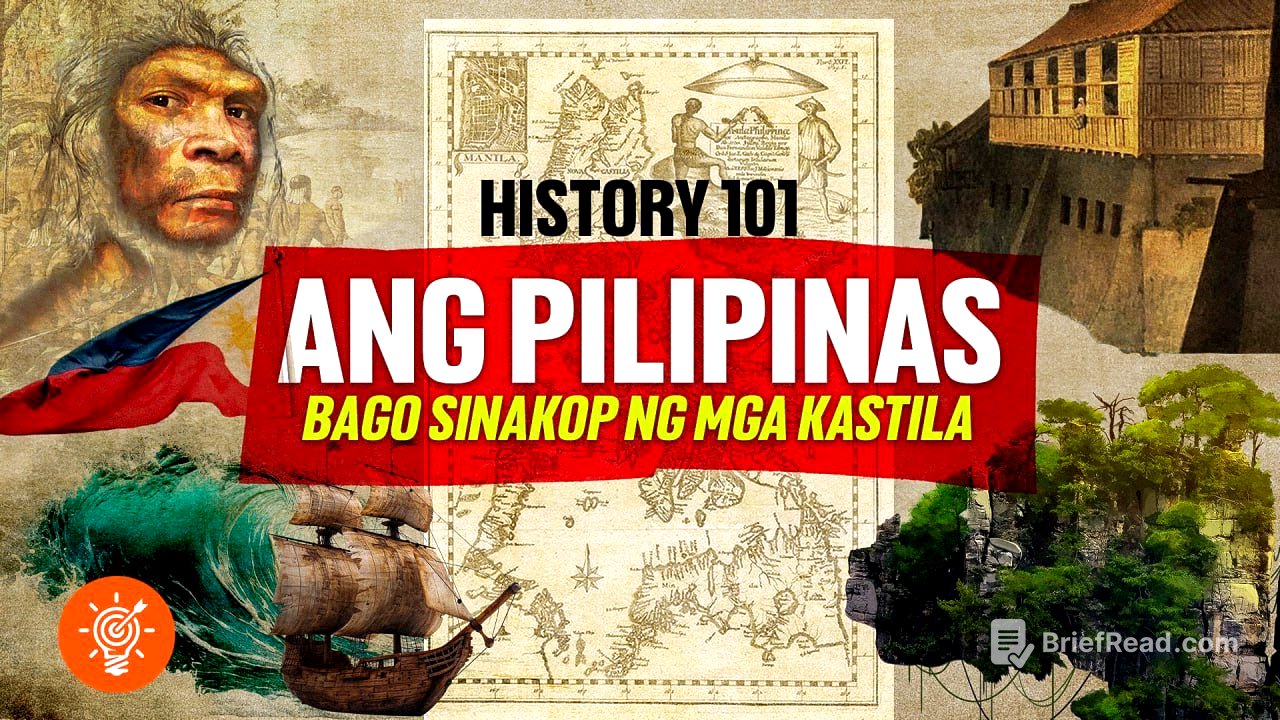
The video discusses the history of the Philippines before Spanish colonization, detailing the islands' early society, culture, and governance. It describes the communities known as barangays, their social structure, the significance of trade, and the influence of early human inhabitants. The arrival of Islam and the existence of various kingdoms illustrate the rich cultural heritage of the region prior to 1521.
- The Philippines was a collection of separate kingdoms and communities.
- Early inhabitants included various human species, and significant archaeological finds date back tens of thousands of years.
- The barangay system was a fundamental aspect of governance, and spiritual beliefs focused on nature and ancestral spirits before the arrival of Islam.
- Islamic traders brought new beliefs and political structures, leading to the emergence of sultanates and trade centers.
The Philippines Before Colonization [0:00]
Before Spanish colonization in 1521, the Philippines was composed of independent kingdoms, sultanates, and communities. Each region had its own distinct culture, beliefs, and governance system. The islands did not have a collective name, and the inhabitants coexisted in organized but separate communities. Trade relations were essential, with influences from nearby regions like China and Borneo fostering cultural exchanges and technological advancements.
Early Human Inhabitants [2:10]
The Philippines has been home to ancient humans such as Homo erectus, Homo sapiens, and the unique Homo luzonensis. Archaeological evidence from Tabon Cave suggests that humans have lived in the Philippines for around 47,000 to 67,000 years. These early people relied on hunting, gathering, and rudimentary stone tools, adapting well to their environment. Over time, small communities evolved into more complex barangays, each led by a Dato who played crucial roles in governance.
Barangay System and Governance [3:06]
The barangay was the primary societal unit in pre-colonial Philippines, each serving as a small community led by a Dato. This leader maintained order, implemented laws, and ensured the welfare of the community. Governance was decentralized, allowing barangays to operate autonomously while sometimes forming alliances for trade and defense. Each barangay was composed of up to 100 families working cooperatively, fostering strong social and legal traditions.
Religious Beliefs [5:00]
Prior to the arrival of Islam and Christianity, the inhabitants practiced animistic religions, believing in spirits and deities tied to nature, referred to as anito and diwata. Spiritual leaders known as babaylan conducted ceremonies to honor these spirits, seeking their protection and favor for agriculture and daily life. Regular rituals were an integral part of community life, reflecting deep-rooted beliefs in the spiritual domain.
Arrival of Islam [6:06]
In the 13th century, Muslim traders from Borneo and Malacca introduced Islam to the Philippines, particularly in Mindanao and Sulu. Islam spread rapidly, establishing sultanates like Sulu and Maguindanao that became centers of trade in Southeast Asia. The introduction of Islam resulted not only in new religious practices but also in organized governance systems under sultans, contributing to the region’s political structure.
Various Kingdoms in the Archipelago [7:00]
Before Spanish colonization, the Philippines consisted of multiple organized kingdoms with complex social structures across the archipelago. Notable kingdoms included Butuan in northern Mindanao, specializing in gold trade, Cebu under Rajah Humabon, and Tondo led by Kandula, which maintained ties with the Ming dynasty of China. These kingdoms had distinct cultures and legal systems, showcasing their developed societies before colonization.
Spanish Colonization [8:10]
The arrival of Ferdinand Magellan in 1521 marked the beginning of Spanish colonization, which brought significant changes to the archipelago. Miguel Lopez de Legaspi returned in 1565, taking control of Cebu, leading to the establishment of the Philippines as a Spanish colony. Although many kingdoms were conquered, resistance remained in areas like the Sultanate of Sulu, which formed alliances to defend their independence. The Spanish claim extended over the entire archipelago, regardless of individual conquests.
Cultural Legacy [9:30]
The history of the Philippines before Spanish colonization highlights a rich tapestry of culture, governance, and trade among its early inhabitants. Despite the changes brought about by colonization, the legacy of pre-colonial societies remains evident in contemporary Filipino identity. Understanding this pre-colonial past is essential to appreciating the nation’s cultural heritage and historical development.