TLDR;
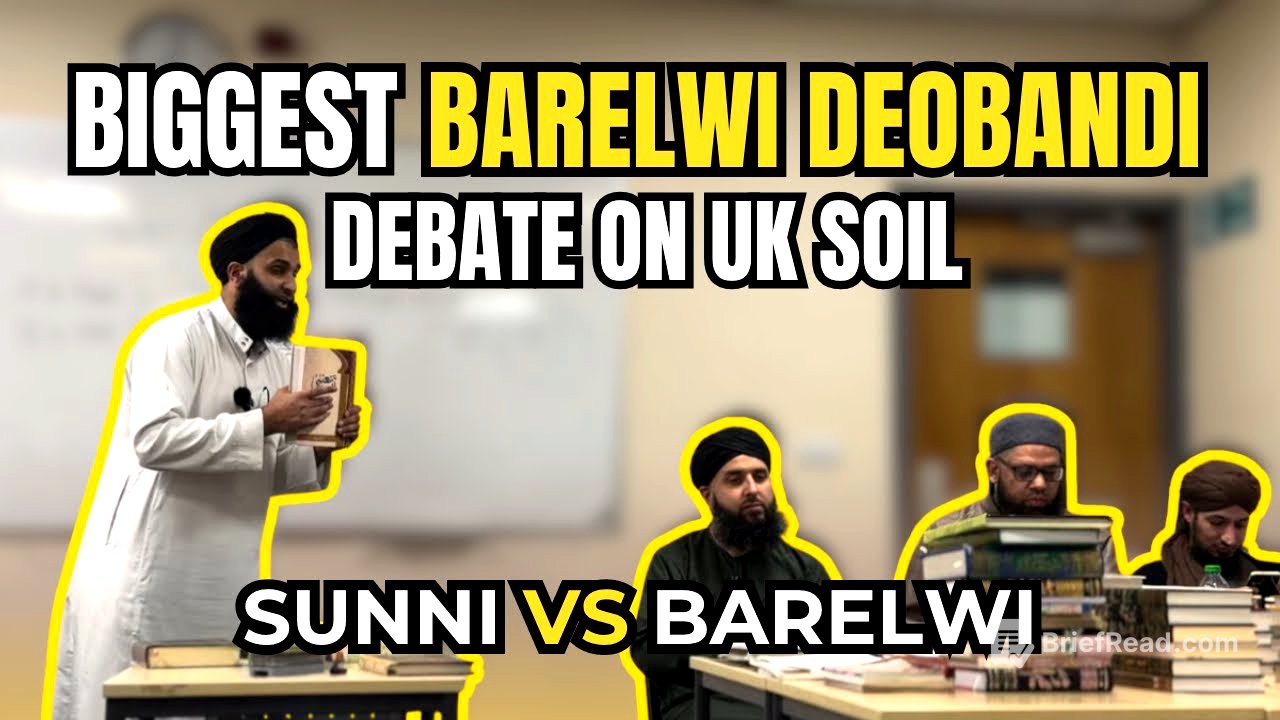
This video features a debate about the beliefs of the Obandi and Barelvi movements within Islam, specifically focusing on the interpretation of key Islamic texts and the concept of the finality of prophethood. The debaters discuss the views of prominent figures from both movements, including Ahmed Raza Khan and Qasim Nanotvi, and examine their stances on various theological issues.
- The debate centers on the interpretation of Islamic texts related to the finality of prophethood.
- The speakers discuss the historical context and implications of these theological differences.
- The discussion includes references to various scholars, books, and historical events relevant to the Obandi-Barelvi divide.
Initial Setup and Ground Rules [0:00]
The video begins with a discussion about the setup of the debate, including camera angles, table arrangements, and the number of participants allowed. The participants agree to keep the discussion in the middle ground and adhere to the agreed-upon conditions. Two moderators are present to keep time. It's clarified that only five extra people are allowed to stay, while the rest will have to leave.
Introduction and Background [3:48]
One of the speakers starts by praising Allah and sending blessings upon the Prophet Muhammad. He mentions that he used to make videos about the Obundis and their elders but stopped recently. He re-released some older clips, which prompted the Al-Islam Productions team to call him out for a dialogue. He emphasizes that if any scholar has made a mistake, it should be accepted, and efforts should be made to unite upon what is right. The subject of discussion is a work by Mulvi Kasim Nanoti, which contains passages that deny the finality of prophethood.
Analysis of Qasim Nanotvi's Work [5:58]
The speaker analyzes passages from Qasim Nanotvi's work, highlighting statements that deny the finality of prophethood. He quotes Nanotvi as saying that being first or last in terms of era is not an intrinsic quality and that the verse "but he is the messenger of Allah and the last of the prophets" cannot denote the last prophet. The speaker argues that these statements contradict the fundamental Islamic belief in the finality of Prophet Muhammad's prophethood. He also points out Nanotvi's assertion that even if another prophet existed during Prophet Muhammad's lifetime or after his era, it would not affect Prophet Muhammad's finality, which the speaker deems illogical and against common sense.
Critique of Ahmed Raza Khan and the Barelvi Movement [13:57]
The next speaker argues that Ahmed Raza Khan was the man who split the ummah and that he will prove Ahmed Raza Khan to be a Kafir through his own speech. He claims that Ahmed Raza Khan opened the doors for Kadani's claims of prophethood. He questions why the previous speaker has not refuted Ahmed Raza Khan in his books. The speaker asserts that Ahmed Raza Khan strung together three incomplete sentences to misguide and deceive the ummah. He also accuses the Barelvi movement of seeing Ahmed Raza Khan as close to infallible, quoting Ahmed S Kazmi as saying that Allah made it impossible for Ahmed Raza Khan's tongue and pen to err.
Historical Context and Refutations of Qasim Nanotvi [24:23]
The speaker returns to the topic of Qasim Nanotvi's book, mentioning that Imam Ahmed wasn't the first person to refute Qasim Nanotvi for denial of finality of prophethood. He lists several works prior to Imam Ahmed that refuted Qasim Nanotvi on his creed of denial of finality of prophethood. He also discusses Imam Abdul Laknavi's stance on Qasim Nanotvi, explaining that Imam Abdul Laknavi initially took a neutral position but later retracted it and endorsed the refutation of Qasim Nanotvi.
Further Analysis and Counter-Arguments [34:37]
The speaker continues to analyze Qasim Nanotvi's work, focusing on his interpretation of the verse. He argues that Nanotvi denied the explicit meaning of as being the last of prophets. The speaker questions why Nanotvi reduced it to maj and gave far-fetched explanations. He also challenges the previous speaker to answer whether a new prophet being born today would violate the prophethood of Muhammad.
Debate on the Correct Interpretation of Texts [1:14:36]
The speaker accuses the previous speaker of moving away from the order of Ahmed Zakan in Hamulh. He argues that Imam is not denying chronological finality but strengthening it by explaining its reason. The speaker presents the full text of Qasim Nanotvi's statement, which Ahmed should have quoted, and challenges him to prove it to be kufur.
Defense of Imam Ahmed Raza Khan and Critique of Qasim Nanotvi [1:22:27]
The speaker defends Imam Ahmed Raza Khan, stating that he did not lie or distort the words of Gasim Naoti. He argues that the order in which Imam Ahmed conveyed the statements is irrelevant as long as the meaning is not distorted or changed. The speaker analyzes the original Udu statements of Qasim Nanoti and compares them to Imam Ahmed's translations, concluding that Imam Ahmed conveyed the same meaning without distortion.
Further Examination of Key Concepts and Figures [1:32:17]
The speaker continues to defend Qasim Nanotvi, arguing that he did not deny the finality of prophethood but merely provided a deeper understanding of it. He cites various scholars and texts to support his interpretation. The speaker also challenges the previous speaker to provide a fatwa on Ali, accusing him of being a fanatic of Imizi.
Continued Debate on Theological Differences [1:42:48]
The speaker emphasizes that Na did not deny finality but that the interpretation he gave of this verse denied the meaning. He questions why he reduced it to maj and went to far-fetched explanations. He says that in this verse it cannot mean last. He said if it means last it cannot mean last because this is a place of praise and being last is not something of praise.
Analysis of Historical Texts and Figures [1:52:52]
The speaker argues that the previous speaker is moving from the topic and not quoting the text correctly. He puts on the board the exact text that Ahmed Rahan has quoted. He explains that Ahmed had a chance to prove three kufur but he was so generous that he did it in one.
Debate on the Interpretation of Islamic Texts and Figures [2:03:02]
The speaker explains that the explanation of this hadith is different to the words which kasimi uted he on the udahan said if there was a prophet being born after sallallahu alaihi wasallam then the prophet sallallahu alaihi wasallam would have remained.
Further Discussion on Theological Points and Accusations [2:09:30]
The speaker emphasizes that when there is then with you cannot do of right you cannot negate the meaning of the law by taking instead. He also turns back to the questions which he's asked before and repeats again. The question is, if supposedly a new prophet was born today, please answer this question I'm repeatedly asking you.
Continued Arguments and Counter-Arguments [2:11:39]
The speaker explains that the verse is indicating towards Allah has the power to send the like of Muhammad sallallahu alaihi wasallam in every region. It's not going to happen but Allah has the power. So it's under his what is he saying?
Further Debate and Challenges [2:22:01]
The speaker says that he's going to explain that. He wants him first to say doesn't mention the three of that's why I'm shocked. He says the same thing. Those people who are blind from knowing the deeper meaning of they don't know that they just think it means last. Of course it means last. But why last?
Continued Discussion on Theological Differences and Accusations [2:32:48]
The speaker says that the of starts from and ends on it. So it starts on Bat and ends on it. Soasoolah wasallam being the first nabi from arwah allyah were given nubu through the baraka of rasoolah throughasoolah sallallahu alaihi wasallam and the nubu ended at rasoolah in this worldly life that is it immal.
Further Debate on Theological Points and Figures [2:42:50]
The speaker says that we need to make the of ismi. Is that correct? based on our principles you're saying we need to make of sha is let me know you want to.
Continued Arguments and Counter-Arguments [2:52:54]
The speaker says that this loom thing there's no replies being given it's all on record. This is alakad I'm going to bring it up again.
Further Discussion and Challenges [3:03:11]
The speaker says that he's going to explain that. He wants him first to say doesn't mention the three of that's why I'm shocked. He says the same thing. Those people who are blind from knowing the deeper meaning of they don't know that they just think it means last. Of course it means last. But why last?
Final Arguments and Conclusion [3:11:57]
The speaker says that he's going to explain that. He wants him first to say doesn't mention the three of that's why I'm shocked. He says the same thing. Those people who are blind from knowing the deeper meaning of they don't know that they just think it means last. Of course it means last. But why last?
Closing Remarks and Apologies [4:56:10]
The speaker says that he's going to explain that. He wants him first to say doesn't mention the three of that's why I'm shocked. He says the same thing. Those people who are blind from knowing the deeper meaning of they don't know that they just think it means last. Of course it means last. But why last?