TLDR;
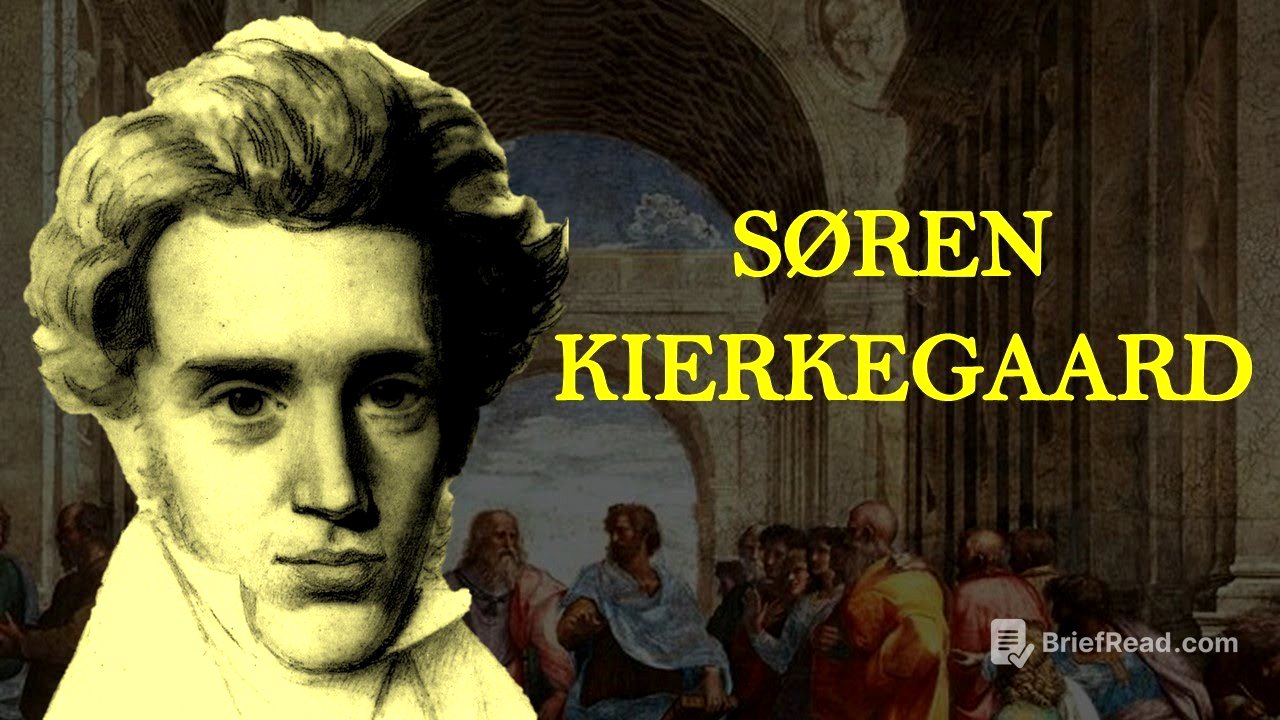
This video explores the philosophy of Søren Kierkegaard, the father of Existentialism, focusing on his emphasis on individual existence, subjectivity, and the problem of existence. It covers his key concepts such as the aesthetic, ethical, and religious stages of life, the teleological suspension of the ethical, anxiety, angst, and the leap of faith. The video also touches on Kierkegaard's critique of the established church and his call for individuals to find their own truth.
- Kierkegaard's philosophy emphasizes individual existence and subjectivity.
- He outlines three stages of life: aesthetic, ethical, and religious.
- Key concepts include anxiety, angst, the absurd, and the leap of faith.
- Kierkegaard critiques the established church and calls for individual truth-seeking.
Introduction [0:00]
The video introduces Søren Kierkegaard as a 19th-century writer and philosopher of the Danish Golden Age, considered the father of Existentialism. Existentialism emphasizes the existence of the individual and subjectivity, focusing on the problem of existence. Kierkegaard believed individuals should personally answer the question of existence through their own lives. His stress on subjective experience, long ignored by philosophers, is a key contribution. While Existentialism gained popularity later with Jean Paul Sartre, Kierkegaard laid its foundations by examining problems of existence, angst, and the absurd.
Kierkegaard’s “Philosophy” [5:25]
Kierkegaard focused on the human condition, arguing that while science progresses, individual experiences of suffering and enjoyment remain constant. He believed personal values shape one's perception of the world. Born into a religious and melancholic family, Kierkegaard's father's past deeply influenced him. A transformation of faith after his father's death led Kierkegaard to love God as a resolution to his being. His broken engagement with Regine Olsen led him to become a freelance writer, exploring his personality through his work. Public mockery pushed him into isolation, strengthening his resolve to challenge societal norms.
Either/Or. The Two Stages: Aesthetic vs Ethical [9:21]
In "Either/Or," Kierkegaard presents the aesthetic and ethical as two distinct life views or individual existences. The aesthetic stage focuses on sensory experiences and pleasures like music and seduction, aiming to maximize these pleasures to combat boredom. However, this stage is considered immature, as aesthetic pleasures are fleeting and lack altruism. The ethical stage involves adhering to social rules and internalized ideals for the good of society, similar to Freud's superego. While ethical behavior is based on coherent rules, it lacks self-exploration, as it involves following socially accepted norms. Kierkegaard encourages readers to consider these experiences, emphasizing that philosophy is about human experience rather than abstract concepts.
Stages On Life’s Way. The Third Stage: The Religious [11:17]
Continuing from "Either/Or," Kierkegaard introduces the religious stage in "Stages on Life's Way." He aimed to be "a Christian in Christendom," criticizing the Danish Established Church for fostering religious laziness. He observed that many were nominally Christian without understanding true faith. Kierkegaard sought to live authentically religious amidst false religiosity, as religion had merged with culture and lost its personal connection to God. He saw the established church as a distraction from the personal relationship a true Christian should have with God, considering the religious life the highest plane of existence. In the aesthetic life, one is ruled by passion; in the ethical life, by societal regulations; and in the religious life, by total faith in God.
Fear and Trembling. The Religious vs The Ethical [13:14]
In "Fear and Trembling," Kierkegaard explores the conflict between the ethical and the religious through the biblical story of Abraham and Isaac. He presents four viewpoints on Abraham's decision to sacrifice his son, highlighting the tension between ethical wrongness and religious rightness. Abraham's anxiety stems from this conflict. Kierkegaard argues that Abraham performs a "teleological suspension of the ethical," suspending ethical standards due to his faith in God's righteousness. By prioritizing religious concerns over ethical ones, Abraham demonstrates his ultimate faith in God.
Teleological Suspension of the Ethical [14:08]
Kierkegaard argues that Abraham suspends his ethical standards when he decides to kill Isaac, but he does so with faith in the righteousness of the end that God will bring about. Abraham prioritizes his religious concerns over ethical concerns, thus proving his faith in God.
Knights of Infinite Resignation vs Knights of Faith [14:50]
Kierkegaard distinguishes between knights of infinite resignation and knights of faith. Knights of infinite resignation accept the nature of the world and reconcile themselves to loss, as illustrated by the story of a man in love with a princess who gives up their being together in this world. This renunciation expresses an eternal love, assuming a religious character that provides spiritual reconciliation. Knights of faith, however, take it a step further by placing complete faith in themselves and God, believing that with God, all things are possible, even if humanly impossible. They maintain the belief that they will be together in this world through divine possibility.
Anxiety and Angst [15:41]
Kierkegaard discusses concepts like anxiety, angst, the absurd, and despair. His concept of anxiety or angst is a profound pre-Freudian exploration of psychology. Human beings experience both the appeal and terror of freedom of choice. Angst is a deeper dread without a specific object, making it worse than regular dread because it is unexpected. The overwhelming number of possibilities can paralyze individuals. While many claim to be individuals, they may lack the ability to act freely, lost in an endless sea of possibilities.
Leap of Faith [17:51]
Kierkegaard suggests that the only way to escape this paralysis is to take a leap of faith, which, though irrational, is the most reasonable action. This leap allows one to act and become an individual, representing the ultimate subjective experience. He justifies this leap as a path toward true Christianity.
The Absurd [18:17]
Kierkegaard emphasizes that the world is absurd, and we must live within it. He notes that we fear both death and the prospect of eternal existence.
Find Your Own Truth [19:02]
Kierkegaard argues against imposing worldviews or templates on life, as they will inevitably shatter. Instead, he advises starting with oneself, emphasizing subjectivity and finding identity outside of pre-established systems. He questions the value of constructing philosophical systems that one does not personally live by, advocating for integrating one's view into one's own life. Taking full possession of one's existence and accepting responsibility for it is crucial. Existence is a significant risk, with no certainty about the right way to live, leading to angst. Subjective truths without objective evidence are grounded on nothing, revealing the nothingness of existence and the uncertainty of illusion.
Kierkegaard’s Final Moments [20:46]
By 1855, at 42, Kierkegaard was worn out and penniless. He collapsed and was taken to a hospital, where he refused Holy Communion from the priest and declined to see his brother, a bishop. He ended his life attacking Christendom, viewing the established church's support of Danish society's modernization as an illusion. His funeral drew a large crowd and sparked a protest against the church's appropriation of a man who had publicly defied it, marking a fitting end for an outsider and exception.