TLDR;
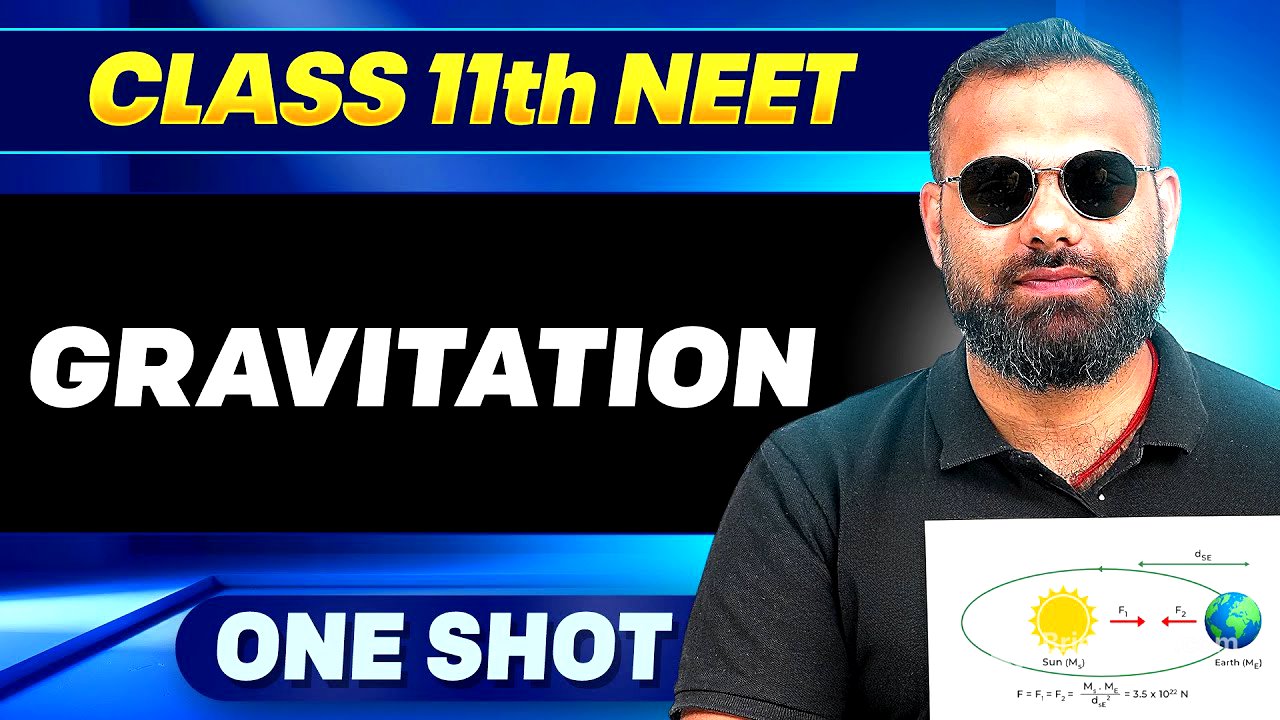
This YouTube video by Competition Wallah provides a comprehensive overview of the chapter on Gravitation for NEET 2025 aspirants. The lecture covers various topics, starting from Newton's law of gravitation to Kepler's laws, and includes numerous examples and problem-solving techniques. The instructor emphasizes conceptual clarity and problem-solving skills, ensuring students can tackle a wide range of questions.
- Newton’s law of gravitation and its properties.
- Gravitational field and potential.
- Escape velocity and orbital velocity.
- Kepler’s laws.
Introduction [0:00]
The lecture begins with an engaging introduction, highlighting the universal attraction between any two objects with mass, termed as gravitation. It's emphasized that mass is a necessary condition for gravitational force. The chapter is the first in Mechanics II, which is more formula-based compared to Mechanics I. The instructor promises to cover all theory, NEET questions, and some JEE questions in detail, aiming for a comprehensive understanding over a longer duration of 5-6 hours.
Topics to be covered [6:10]
The lecture will cover Newton's law of gravitation, acceleration due to gravity (including variations), gravitational field, gravitational potential, gravitational potential energy, conservation of mechanical energy, escape velocity, orbital velocity of satellites, and Kepler's laws.
Newton’s law of gravitation [7:52]
Newton's law of gravitation is valid only for point masses or spherical masses with symmetry. The gravitational force between two objects with masses m1 and m2, separated by a distance r, is directly proportional to the product of their masses and inversely proportional to the square of the distance between them. The formula is F = G(m1m2)/r², where G is the universal gravitational constant (6.67 x 10^-11 Nm²/kg²). The force is always attractive and acts along the line joining the two objects (central force).
Principle of superposition theorem [49:06]
The principle of superposition states that the gravitational force between any two objects is independent of the presence of other objects. The net force on an object is the vector sum of all individual gravitational forces acting on it. An analogy with "lonely Pinky" is used to illustrate this concept, where Pinky attracts multiple individuals with independent forces.
Gravitational field intensity [1:31:18]
Gravitational field intensity is defined as the gravitational force per unit mass. It is a vector quantity with the unit N/kg and is directed parallel to the force. For a point mass M, the gravitational field intensity at a distance r is I = GM/r². The concept is extended to scenarios with multiple masses and symmetrical arrangements, emphasizing that the net gravitational field intensity at the center of symmetrical arrangements is zero.
Gravitational field due to different structures [1:43:23]
The gravitational field intensity due to a hollow sphere is discussed, noting that the field is zero inside the sphere and GM/r² outside. For a solid sphere, the field inside is given by I = GM r/R³, and outside it is GM/r². The gravitational field due to a ring of mass M at a distance x from the center is I = GMx / (r² + x²)^(3/2).
Acceleration due to gravity [1:55:51]
Acceleration due to gravity (g) is the acceleration experienced by an object due to the gravitational force exerted by a planet. It is given by g = GM/R², where M is the mass of the planet and R is its radius. The value of g does not depend on the mass of the object. The relationship between gravitational force and gravity force is clarified, noting that gravity is specific to planets.
Class raid [2:43:48]
This section is a break in the lecture due to an interruption.
Class continues [2:49:12]
The lecture resumes, emphasizing that the acceleration due to gravity is analogous to gravitational field intensity.
Variations of g [2:56:08]
The acceleration due to gravity varies with depth and height. Inside the Earth, g decreases linearly with depth, and outside, it decreases non-linearly with height. The variations are quantified using formulas, and it's noted that the percentage change in g is -d/R * 100 at depth d and -2h/R * 100 at height h. The effect of the Earth's shape and rotation on g is also discussed, noting that g is higher at the poles than at the equator.
Break [3:05:58]
A break is announced, with the lecture set to resume after 9 minutes.
COME and Escape velocity [4:32:46]
The concept of escape velocity is introduced, defining it as the minimum velocity required for an object to escape the gravitational pull of a planet. The escape velocity is given by √(2GM/R) and is independent of the mass of the object. If an object is given a speed greater than the escape velocity, it will have a non-zero speed even at infinity.
Break [5:05:41]
Another break is taken.
Satellite Motion & Orbital velocity [5:12:06]
Satellite motion in a circular path is discussed, explaining that the centripetal force required for the motion is provided by the gravitational force. The orbital velocity is given by √(GM/r), where r is the distance from the center of the planet. The kinetic energy, potential energy, and total energy of the satellite are also derived.
Geostationary & polar satellite [5:45:19]
Geostationary satellites have a time period of 24 hours and orbit in the equatorial plane, while polar satellites orbit around the poles with a time period of about 100 minutes.
Binding energy of satellite [5:46:51]
Binding energy is the energy required to remove a satellite from its orbit to infinity. It is equal to the magnitude of the total energy of the satellite.
Kepler’s law [5:54:23]
Kepler's laws of planetary motion are discussed, including the law of orbits (planets move in elliptical orbits with the Sun at one focus), the law of areas (equal areas are swept in equal times), and the law of periods (the square of the time period is proportional to the cube of the semi-major axis).
Thank you bachhon [6:19:21]
The lecture concludes with a thank you message to the students.