TLDR;
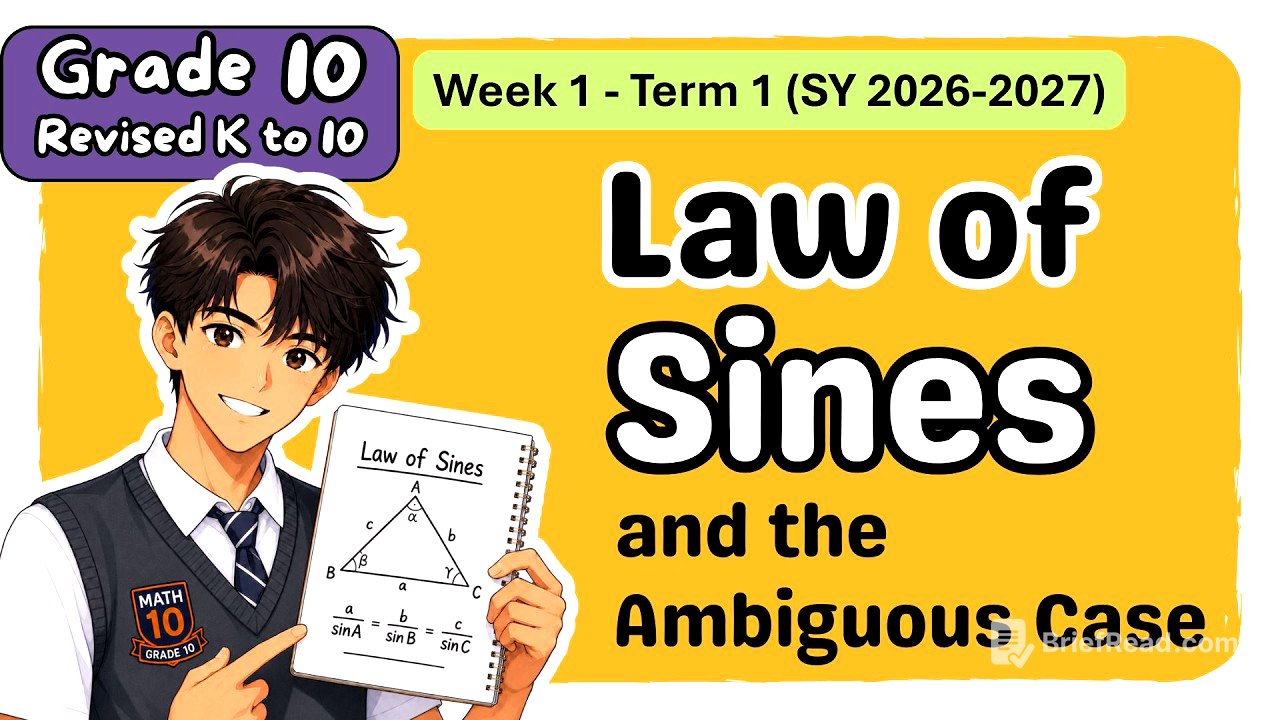
This video provides a comprehensive lesson on the Law of Sines and solving oblique triangles, including specific cases like the ambiguous case. It covers essential concepts such as right and oblique triangles, trigonometric ratios, and specific methodologies for solving triangles using the Law of Sines through different cases like ASA, AAS, and SSA.
- Review of right triangles and trigonometric ratios.
- Definition and explanation of oblique triangles.
- Introduction to the Law of Sines and when to use it.
- Examples demonstrating the resolution of various triangle cases including the ambiguous case.
Introduction & Topic Overview [0:00]
The video begins with an overview of the topic, focusing on the Law of Sines and how to approach oblique triangles, assuring viewers of a step-by-step guide.
Review: Solving Right Triangles (SOH-CAH-TOA) [0:43]
A review of right triangles is presented, detailing how to find the measurements of angles and sides using the mnemonic SOH-CAH-TOA. This involves understanding that sine (SOH) relates opposite and hypotenuse, cosine (CAH) relates adjacent and hypotenuse, and tangent (TOA) relates opposite and adjacent.
What are Oblique Triangles? (Acute & Obtuse) [1:59]
Oblique triangles, defined as triangles without a right angle, are explored. Acute triangles have all angles less than 90°, while obtuse triangles contain one angle greater than 90°. Examples are given to illustrate these definitions.
The Law of Sines Formula [3:30]
The Law of Sines is introduced with its formula, explaining the relationship between the sides and angles of an oblique triangle. This formula allows for calculations when at least one side and its opposite angle are known.
When to use Law of Sines (ASA, AAS, SSA) [5:41]
Different scenarios in which the Law of Sines applies are outlined. The SSA, ASA, and AAS cases are identified as suitable situations for using this law, while noting that SAS and SSS require other approaches (typically the Law of Cosines).
Example 1: Solving AAS Case [8:08]
An example illustrates solving an AAS triangle, explaining each step required to find missing angles and sides. The approach begins by calculating the third angle based on known angles and uses the Law of Sines to find the remaining sides.
Example 2: Solving ASA Case [14:44]
The second example focuses on an ASA case where two angles and the included side are given. The process includes finding the missing angle and calculating the other sides using the Law of Sines through cross-multiplication.
The Ambiguous Case (SSA Case) Explanation [19:04]
The ambiguous case for SSA scenarios is defined, emphasizing the potential for none, one, or two triangles to be formed based on the specific measurements provided. This case introduces uncertainty, requiring careful analysis of given sides and angles.
Visual Demonstration of SSA Possibilities [20:53]
A visual demonstration highlights the possible outcomes for the SSA case, showing how different values can correspond to various triangle configurations, ultimately affecting whether a triangle can be constructed.
Summary of Ambiguous Case Conditions [27:32]
The conditions under which the ambiguous case can yield no triangle, one triangle, or two triangles are summarized. These conditions rely on the relationship between the length of given sides and the triangle's height.
How to find the Altitude/Height (h) [28:56]
Instructions on finding the altitude or height of a triangle are provided, linking it to the relationship of the side opposite an angle and the sine function. This height plays a critical role in determining whether a triangle can be formed in ambiguous cases.
Example 1 (SSA): One Triangle Formed [30:03]
An example scenario is presented where only one triangle is formed under the SSA conditions. The video walks through calculations and logic steps to confirm that a triangle can be established.
Example 2 (SSA): No Triangle Formed [35:51]
The video continues with another SSA example, illustrating a scenario where no triangle can be formed. The importance of comparing sides and height is emphasized in making this determination.
Example 3 (SSA): Obtuse Triangle (No Triangle) [38:29]
In this case, an obtuse scenario is explored where, despite the SSA setup, no triangle can be formed due to the length comparisons, indicating the necessity of ensuring the longest side corresponds correctly to the obtuse angle.
Example 4 (SSA): Two Triangles Formed (Step-by-Step) [40:25]
The video concludes with a detailed example where two triangles can be formed. Both triangle possibilities are solved step-by-step, showing the application of the Law of Sines to find the angles and sides for each triangle.
Lesson Summary & Key Takeaways [50:00]
The lesson's critical points are summarized, reiterating the application of the Law of Sines for oblique triangles and underscoring the ambiguous case's complexities in identifying the number of possible triangles.
Practice Activity & Closing [50:39]
A practice activity is suggested for viewers to apply lessons learned. The video closes with gratitude for participation, encouraging viewers to test their understanding of the Law of Sines and oblique triangle solutions.





![Handling UI Events in Blazor Web Apps [Pt 6] | Front-end Web Development with .NET for Beginners](https://wm-img.halpindev.com/p-briefread_c-10_b-10/urlb/aHR0cDovL2ltZy55b3V0dWJlLmNvbS92aS9VMUg3MnJBU042SS9ocWRlZmF1bHQuanBn.jpg)