TLDR;
This video analyzes Donald Trump's actions in the context of a potential global collapse, suggesting his seemingly chaotic decisions might be a calculated strategy to benefit the United States. It explores how a war in the Middle East, while seemingly detrimental, could shift global economic dependence towards North America and Russia. The video also touches on the historical context, comparing Trump's vision to Putin's "Third Rome" plan and the concept of the "technate."
- Trump's actions may be a calculated strategy to benefit the United States during a potential global collapse.
- A war in the Middle East could shift global economic dependence towards North America and Russia.
- Trump's vision is compared to Putin's "Third Rome" plan and the concept of the "technate."
Trump's Address and Potential Ground Invasion of Iran [0:04]
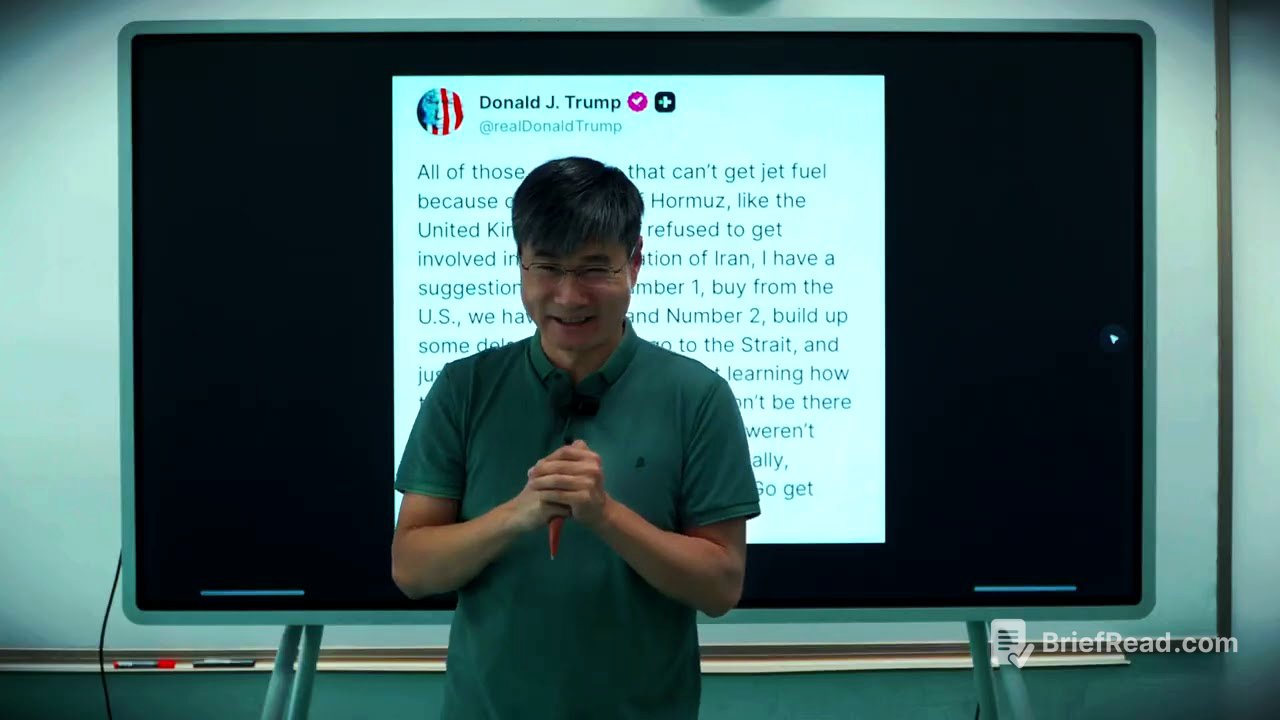
Donald Trump addressed the American people, indicating the continuation of the war and the potential for America to bomb Iran's energy infrastructure. He asserted that America is winning the war and will bomb the enemy "back to the stone ages." However, Peter Hegv announced that America will control all of North America, enforcing the Monroe Doctrine. There are rumors that Trump has authorized the use of ground forces, potentially leading to an invasion of Iran.
The Strategic Implications of Invading Iran [2:15]
A ground invasion of Iran is considered strategically unwise due to its large size, mountainous terrain, and desert landscapes, making it difficult to control. The current American troop presence in the Middle East is insufficient for such an operation. The Americans may aim to control the Strait of Hormuz to impact the global economy, but the strait's narrowness and proximity to Iranian defenses make it vulnerable.
Signs of Preparation for a Long War [6:06]
America is showing signs of preparing for a prolonged war, with 50,000 troops already in the Middle East and potential reserve deployments. Indicators on Poly Market, such as increased pizza orders at the Pentagon, empty gay bars, and large bets on a ground invasion, suggest an imminent ground invasion. Despite Trump's past statements about leaving the Middle East, NATO is expected to open the Strait of Hormuz, highlighting the inconsistency in Trump's policies.
Potential Outcomes of a Ground Invasion [9:02]
If a ground invasion of Iran occurs, America is likely to lose the war, leading to the collapse of the American empire and the global economy. However, the video explores a counter-argument: what if Trump intends to lose the war to destroy the American empire and global economy, positioning him as a genius. The world relies on the Middle East for 20% of its oil, primarily for East Asia, but a continued war could lead to global oil shortages by mid-April, impacting not only energy but also food production due to shortages of phosphate, ammonium, and sulfur.
Shifting Global Dependence to North America and Russia [13:39]
Despite the potential collapse, the world has oil reserves in Canada, Venezuela, and Russia. Closing the Strait of Hormuz would make the world more dependent on North America and Russia for oil. The United States benefits from a war in the Middle East because Europe, China, Japan, and Australia become more dependent on North America for resources, food, and energy.
The Importance of Nitrogen and Water Resources [16:16]
Europe needs more nitrogen for fertilizers and is forced to get it from North America and Russia. North America and Russia are the most stable parts of the world with the most resources, while Africa, Europe, the Middle East, and Southeast Asia are prone to conflict. China's control over water resources in the Tibetan plateau, which flows into India and Southeast Asia, presents a potential flashpoint.
Analyzing Oil Reserves and Consumption [20:47]
The war in the Middle East could disrupt oil production in Saudi Arabia, Iran, Iraq, UAE, and Kuwait, leaving Venezuela, Canada, the United States, and Russia as key players. China, India, Japan, and South Korea import a lot of oil from the Middle East and will need to get it from the United States or Russia. These Asian countries, along with Europe, are major holders of US debt, and their dependence on North America for resources could alleviate concerns about the US debt.
Putin's Strategy in Ukraine and the "Third Rome" Plan [25:16]
Putin's strategy in Ukraine serves as a model for Trump's actions. The ongoing war in Ukraine allows Russia to industrialize its economy and focus on war production. Russia is shifting its economy to war production, aiming to export drones and unify its people through nationalism and religion. This aligns with the "Third Rome" plan, which envisions Russia as a stable and resilient power amidst global collapse, building alliances with countries like Japan, Vietnam, India, and Iran.
America's "Technate" and the Trump World Order [34:03]
America's response to the coming collapse is the "technate," a self-sufficient North American alliance. Trump's actions, such as threatening Canada, Mexico, and Cuba, are part of this vision. The Trump world order is a response to the new world order, shifting America's focus from finance to resources and manufacturing, promoting Christian nationalism, and prioritizing national rejuvenation (MAGA) over global protection (Pax Americana).
The Inevitable Collapse and Trump's Strategy [41:56]
Both Putin and Trump believe the world will collapse due to America's increasing debt, corruption, and inequality. Trump aims to control this collapse to benefit his allies, including Christian evangelicals and Silicon Valley. By starting a war in the Middle East, Trump accelerates America's decline, transforming it from a finance-based economy to one based on resource exportation and manufacturing.
Different Factors at Play in War [46:50]
War involves different factors, including eschatological, geopolitical, economic, historical, and hubris. Religion is a memory of the ancient past, and geopolitics and economics drive historical forces. Analyzing events using eschatology, geopolitics, and history can lead to accurate predictions.