TLDR;
This lecture concludes the digital system design course by outlining potential future directions for students interested in chip design and ASIC development. It emphasizes the importance of platform-based design using intellectual property (IP) blocks, asynchronous design for managing different clock speeds, and the critical role of verification and testing in ensuring chip reliability. The lecture also touches on design automation using high-level languages, various design objectives like low power and high performance, and application-specific integrated circuits (ASICs) for fields like image processing, machine learning, IoT, networking, and industrial automation.
- Platform-based design is crucial for creating complex systems-on-chips (SoCs) quickly by integrating off-the-shelf IP blocks.
- Asynchronous design and globally asynchronous, locally synchronous (GALS) methodologies help manage circuits with varying speeds and latencies.
- Verification engineering and automated testing are essential for identifying and addressing potential faults in digital designs.
- High-level synthesis using languages like C, C++, and SystemC can automate the design process and enable the exploration of parallelism.
- Application-specific integrated circuits (ASICs) are vital for optimizing performance and power consumption in diverse fields such as image processing, machine learning, IoT, networking, and industrial automation.
Introduction [0:14]
The lecture serves as the final part of the digital system design course, aiming to guide students toward advanced topics and future learning in the field. It highlights that the course has provided a foundation in digital design, covering basic and fundamental aspects necessary for designing chips and application-specific integrated circuits (ASICs). The lecture suggests specific topics that can be useful for those interested in pursuing specialized design areas.
Platform-Based Design [1:26]
Designing a chip with billions of transistors requires a strategic approach. Platform-based design is a popular methodology where designers integrate off-the-shelf components known as intellectual property (IP) blocks, such as processors, accelerators, buses, interconnects, and interfaces like USB and HDMI. This approach allows for the rapid development of sophisticated systems-on-chips (SoCs) by focusing on component selection, verification, and the design of glue logic to connect different components.
Asynchronous Design [3:35]
The course primarily covered synchronous sequential design, which is clock-bound. Asynchronous design is presented as an alternative approach for integrating circuits operating at different speeds. This methodology allows units with varying speeds or latencies to work together efficiently. Globally Asynchronous, Locally Synchronous (GALS) design is also mentioned, where individual units are synchronous internally but asynchronous at the global level, further optimizing power consumption.
Verification and Testing [5:01]
While the course touched on verification, it didn't go into extensive detail. In practice, verification involves identifying potential faults and errors in a digital design, such as disconnected or incorrectly connected wires. Different fault models are used to simulate these scenarios, and stimulus is applied to check for the existence of these faults. Verification engineering is a systematic process, and automated verification and testing are areas with significant potential for improving efficiency and industrial applications.
Design Automation [7:01]
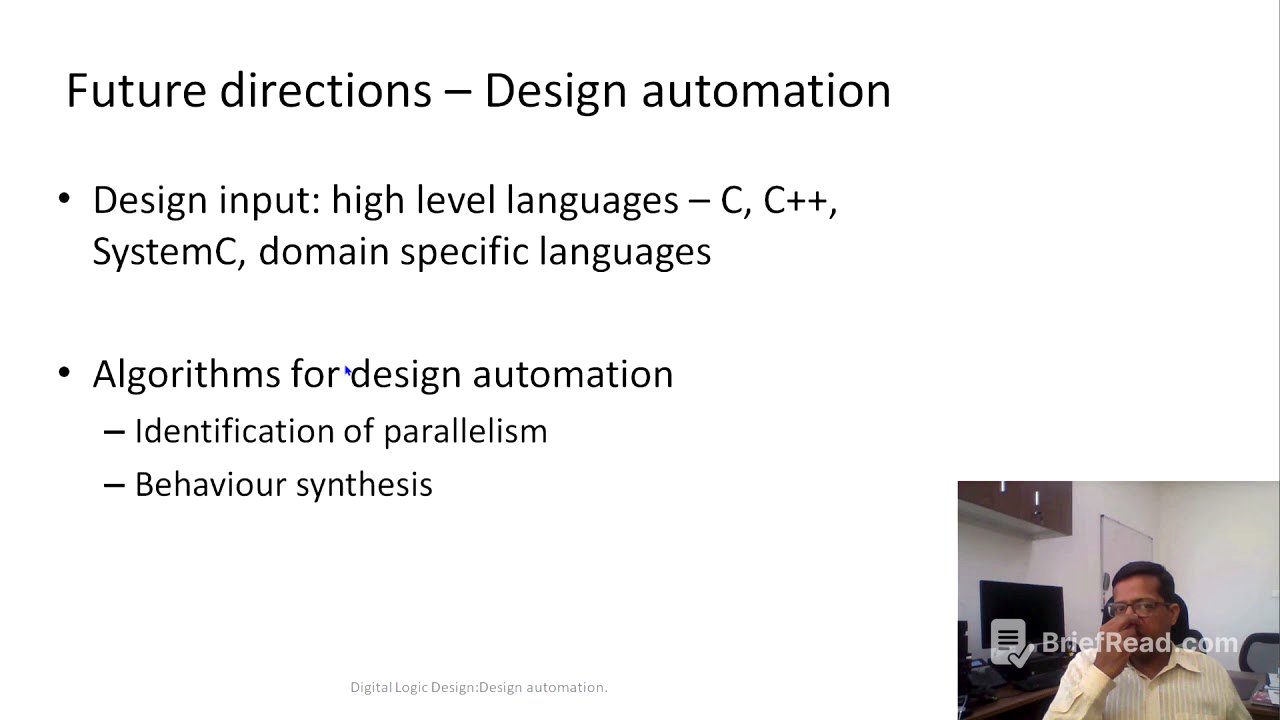
Design automation is another future direction, involving the use of high-level abstraction languages like C, C++, and SystemC instead of hardware description languages like Verilog. Specifying designs at a higher level can accelerate the design process. Automation tools can extract parallelism, identify blocks that can run in parallel, and generate RTL (Register-Transfer Level) circuits. Domain-specific languages are also used to address the limitations of C, C++ in specifying parallelism. The development of algorithms to automate the design process from these high-level specifications is an interesting field of study.
Parallelism and Behavioral Synthesis [9:30]
Identifying parallelism is crucial in design automation. Users can specify parallel hardware blocks in C, C++, or SystemC, or the design tool can automatically identify these blocks. Once identified, behavioral synthesis can schedule, allocate resources, and bind operations to generate an RTL circuit. This circuit provides information on area, cycle count, and operations performed in each cycle, making the automation of this behavior an interesting topic.
Design Objectives [10:31]
Design objectives can vary, including low power, low energy, and high performance. High-performance designs may use data flow or systolic array architectures, with multiple instances placed in a 2D grid for efficient data processing. These architectures are particularly useful for machine learning applications, where tensor processing units (TPUs) and machine learning processors leverage them to achieve the required performance for deep neural networks. Reconfiguration is another objective, with fine-grain reconfigurable circuits like FPGAs and coarse-grain reconfigurable circuits offering different levels of flexibility.
Application-Specific Integrated Circuits (ASICs) [13:20]
Various applications drive the need for application-specific integrated circuits (ASICs). Image processing, vision, and multimedia processing have been popular ASIC applications for decades due to their high computational demands. Machine learning and artificial intelligence are emerging application areas, requiring high-performance ASICs for mobile devices. Ultra-low power designs are essential for IoT devices that need to operate for extended periods without recharging. Networking and cloud applications also require ASICs to meet increasing bandwidth and computational demands. Automotive and industrial automation are additional areas where specific automation requirements necessitate different kinds of ASICs.
Conclusion [16:53]
The potential in designing ASICs is immense, benefiting various areas of interaction. The course serves as a starting point for further learning in different topics, ASIC types, and methodologies. The ultimate goal is to enable students to design their own ASICs. The lecture concludes with best wishes for the students' future endeavors.




![[Calvin University] Reading and Writing 6-1](https://wm-img.halpindev.com/p-briefread_c-10_b-10/urlb/aHR0cDovL2ltZy55b3V0dWJlLmNvbS92aS9Xd1o3WTdXV1lsZy9ocWRlZmF1bHQuanBn.jpg)