TLDR;
The video explains Kepler's three laws of planetary motion, focusing on the shape of orbits, eccentricity, and the speed of planets. Key points include:
- Kepler's first law illustrates that planets have elliptical orbits with the Sun as one focus.
- Eccentricity measures how stretched or flattened an ellipse is, affecting its shape.
- Kepler's second law explains that a planet's speed varies with its distance from the Sun, while the third law relates the periods of revolution to the mean distances from the Sun.
Kepler's First Law of Planetary Motion [0:05]
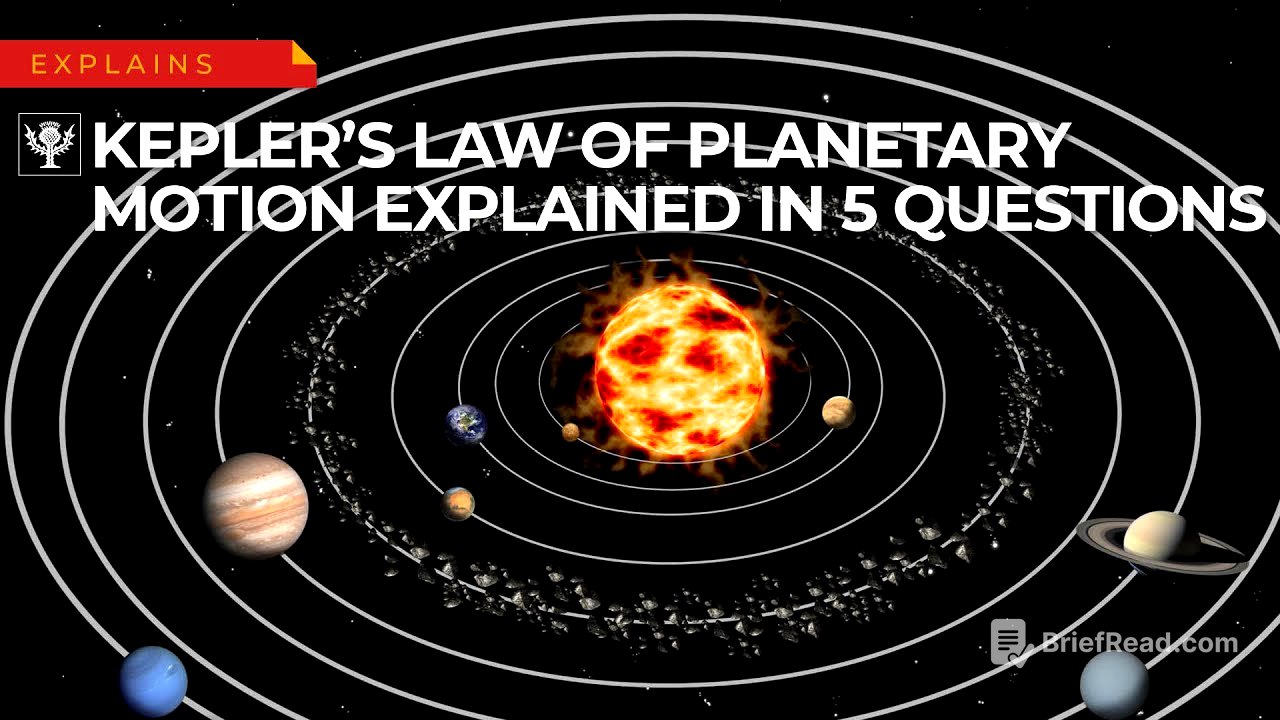
Kepler's first law states that all planets move around the Sun in elliptical orbits, with the Sun as one of the foci of the ellipse. An ellipse resembles a squashed circle with two foci that determine its shape. The distances from any point on the ellipse to the two foci always sum up to the same value. In reality, orbits are never perfectly circular, but knowing the Sun is one of the foci helps understand how planes orbit.
Understanding Eccentricity [0:32]
Eccentricity measures how elongated an ellipse is compared to a circle. It is calculated using the semi-major and semi-minor axes of the ellipse. An ellipse with zero eccentricity is a circle, while increasing eccentricity flattens the ellipse until it resembles a line. If the eccentricity is greater than one, the shape becomes a parabola or a hyperbola. For example, Oumuamua, an interstellar comet, had an eccentricity of 1.2, while Earth's orbit has an eccentricity of only 0.0167.
Kepler's Third Law Explained [2:06]
Kepler's third law states that the squares of the planets' sidereal periods of revolution around the Sun are directly proportional to the cubes of their average distances from the Sun. This means that each planet's orbital period relates to its distance from the Sun, resulting in a consistent constant value when comparing the two measurements across different planets.
Kepler's Second Law and Planetary Speed [2:33]
Kepler's second law reveals that a planet travels more slowly when it is farther from the Sun. While a planet's angular momentum remains constant, the velocity decreases as the distance increases. Therefore, when a planet is closest to the Sun, it moves the fastest, occurring during perihelion, which for Earth is in early January at a distance of about 92 million miles. Conversely, during aphelion in early July, Earth is about 95 million miles from the Sun and moves at its slowest speed.






![Let’s Start a $373/day Business Together Live [Replay]](https://wm-img.halpindev.com/p-briefread_c-10_b-10/urlb/aHR0cDovL2ltZy55b3V0dWJlLmNvbS92aS9XQm5yNENTT0h5Yy9ocWRlZmF1bHQuanBn.jpg)