TLDR;
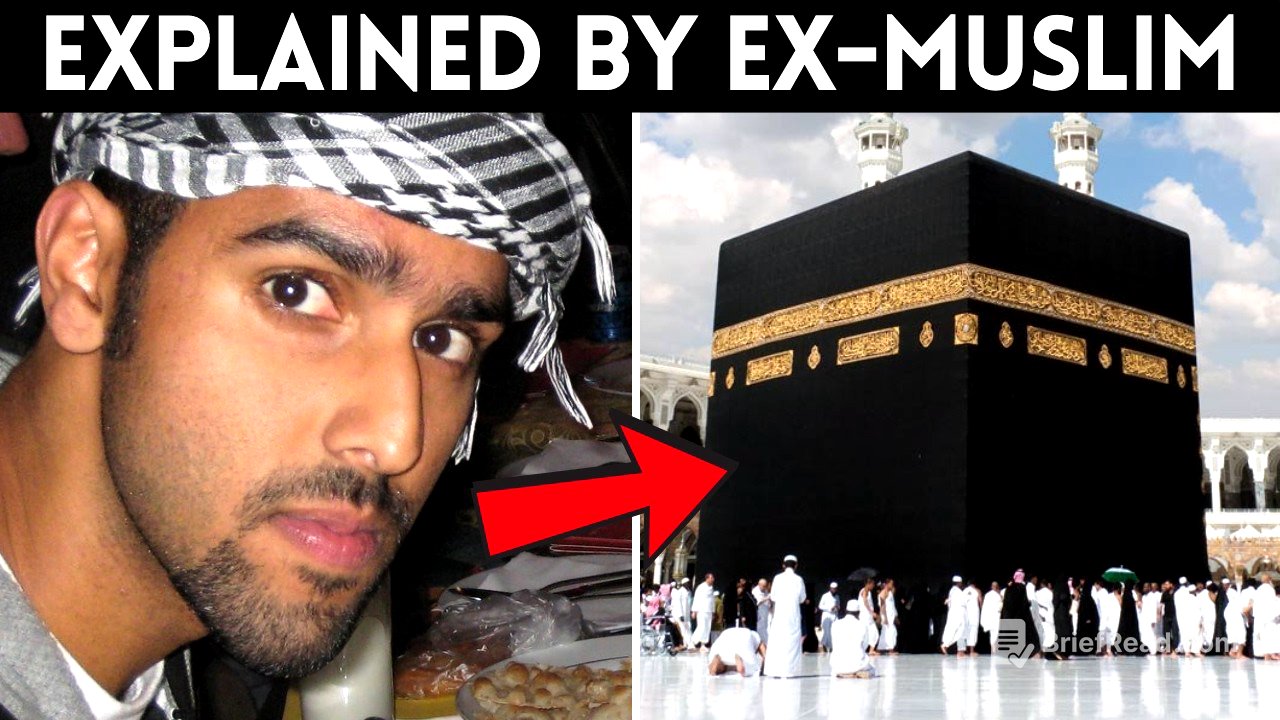
The speaker recounts his journey from a confident Muslim who enjoyed challenging Christians to becoming a Christian himself. This transformation was sparked by a friendship with a Christian named David, who effectively countered his arguments against the Bible's reliability. The speaker details his intellectual and spiritual struggles, including his examination of the New Testament, the concept of Jesus' divinity, and the historical evidence for the resurrection. He also discusses the cultural and personal challenges he faced as a Muslim considering conversion, such as family honor, the law of apostasy, and the fear of hell. Ultimately, his conversion was solidified through dreams, a deep reading of the Bible, and the realization of the profound love and sacrifice embodied in the gospel.
- Friendship and intellectual debate can lead to unexpected conversions.
- Examining evidence critically and applying consistent standards across different worldviews is essential.
- Personal and cultural challenges can make religious conversion a difficult and costly decision.
- Experiencing the gospel as a life-changing force involves recognizing God's love and willingness to sacrifice for humanity.
Meeting David and Initial Arguments Against the Bible [0:00]
The speaker begins by recounting his college days when he enjoyed debating and challenging the faith of Christians. He met a Christian named David during a public speaking tournament, and upon seeing David reading the Bible, the speaker initiated a debate, arguing that the Bible was untrustworthy due to its multiple translations from Aramaic and Hebrew to Greek, Latin, German, and finally English. He believed that these translations corrupted the original message of Jesus.
David's Rebuttal and the Beginning of a Friendship [0:35]
David countered the speaker's arguments by using the analogy of translating a message between languages, emphasizing that multilingual individuals can accurately convey a message in another language without corrupting it. He pointed out the existence of over 6,000 Greek New Testament manuscripts, along with thousands of Latin, Coptic, and Syriac translations, and over 30,000 quotations from early church fathers, which could reconstruct the New Testament multiple times. Initially skeptical, the speaker continued to debate with David, leading them to become best friends through their shared pursuit of truth.
The Reliability of the New Testament Manuscripts [3:56]
After a year of discussions, the speaker concluded that the New Testament manuscripts were reliable due to their widespread distribution and the impossibility of uniformly altering them without detection. He then challenged David on the issue of Jesus claiming to be God, a major point of contention for Muslims, who believe Jesus is the Messiah but consider it blasphemy to call him God. The Quran explicitly states that those who believe Jesus is God will go to hell.
Examining Jesus' Claims of Divinity [5:39]
The speaker began studying the Gospel of John, where John 1:1 states that Jesus is God. He initially tried to rationalize this by arguing that it was John, not Jesus, making the claim. However, he then encountered verses like John 8:58, where Jesus says, "Before Abraham was born, I am," which the speaker recognized as Jesus taking on the name of God from Exodus 3:14. He also noted John 20:28, where someone calls Jesus God, and Jesus affirms it. Despite this, the speaker dismissed the Gospel of John as being written too late and turned to the Gospel of Mark, where Mark 14:62 depicts Jesus making clear references to the Old Testament and claiming to be the God of Moses, Daniel, and David, leading the high priests to accuse him of blasphemy.
The Case for the Resurrection and the Crisis of Faith [8:00]
The speaker realized that the New Testament was reliable and that Jesus claimed to be God, which contradicted his Islamic upbringing. This caused cognitive dissonance, leading him to pray fervently and seek a solid case for Christianity. He found it in Romans 10:9, which states that confessing Jesus as Lord and believing in his resurrection leads to salvation. He recognized the resurrection as the vindication of Jesus' claim to be God. Despite the Quran denying Jesus' crucifixion, historical evidence from atheist and agnostic scholars supports it. The speaker found further evidence for the resurrection in "The Case for the Resurrection of Jesus" by Gary Habbermass and Mike Lacona.
Testing the Case for Islam and the Importance of Comparison [11:56]
After three years of friendship and investigation, the speaker estimated his belief in Christianity to be around 80-85%. However, he still felt certain about Islam. David challenged him to apply the same level of skepticism to Islam that he had applied to Christianity. Upon doing so, the speaker found that the earliest accounts of Muhammad's life were written much later than those of Jesus, and were considered unreliable by those who preserved them. He also discovered that the historical Muhammad differed significantly from the revered figure in the hearts of Muslims. The speaker then examined the Quran and the apologetic reasons for its divine origin, such as its unchanging nature, scientific miracles, and prophecies, but found these claims crumbling under scrutiny. He concluded that Christianity held up best when subjected to the same level of skepticism as other worldviews.
Cultural and Personal Challenges of Conversion [16:41]
The speaker faced a crisis because accepting Christianity would bring shame upon his family, who came from an honor-shame background. His conversion would undo the honor his ancestors had built by preaching Islam. Additionally, the law of apostasy in Islam traditionally dictates that those who leave the faith can be killed. These considerations made it extremely difficult for him to consider becoming a Christian.
Seeking Guidance Through Dreams and Visions [18:20]
The speaker began praying for God to reveal himself, seeking guidance through dreams, a common practice in Islamic culture. He received a vision and three dreams, one of which was particularly powerful. In this dream, he stood at the threshold of a narrow door leading to a wedding feast in heaven, but his friend David blocked the way. David told him, "You haven't responded." Upon waking, the speaker consulted the Bible and found Luke 13, which spoke of the narrow door and the wedding feast, confirming the dream's meaning.
The Final Decision and the Cost of Following Jesus [22:49]
Despite the dreams and evidence, the speaker hesitated to convert, realizing he needed time to mourn the loss of his former life. Seeking comfort, he turned to the Quran but found no verses that addressed his pain. He then opened the Bible and found comfort in Matthew 5:4, "Blessed are those who mourn, for they shall be comforted." Reading further, he felt a personal connection to the words of Jesus. However, Matthew 10:37-38 revealed the cost of following Jesus: giving up family and taking up the cross. The speaker finally prayed, submitting to Jesus and acknowledging his sacrifice.
The Impact of Conversion and the True Meaning of the Gospel [26:04]
The speaker's intellectual assent to the gospel transformed into a deeper understanding when he witnessed his father's devastation and his mother's sorrow upon learning of his conversion. He cried out to God, questioning why he hadn't been killed before he had to break their hearts. In that moment, he heard the words, "This is not about you," which rebooted his perspective. He realized that the gospel was not just something to believe, but something that should change his life. He understood that God was willing to enter the world, live among sinners, and die for them. This realization led him to understand that following Jesus meant loving others so much that he was willing to die for them, just as Jesus had done.






![[GOOVER] User's Guide 1. Good answers from good questions](https://wm-img.halpindev.com/p-briefread_c-10_b-10/urlb/aHR0cDovL2ltZy55b3V0dWJlLmNvbS92aS96LThUeFc3OTFlYy9ocWRlZmF1bHQuanBn.jpg)