
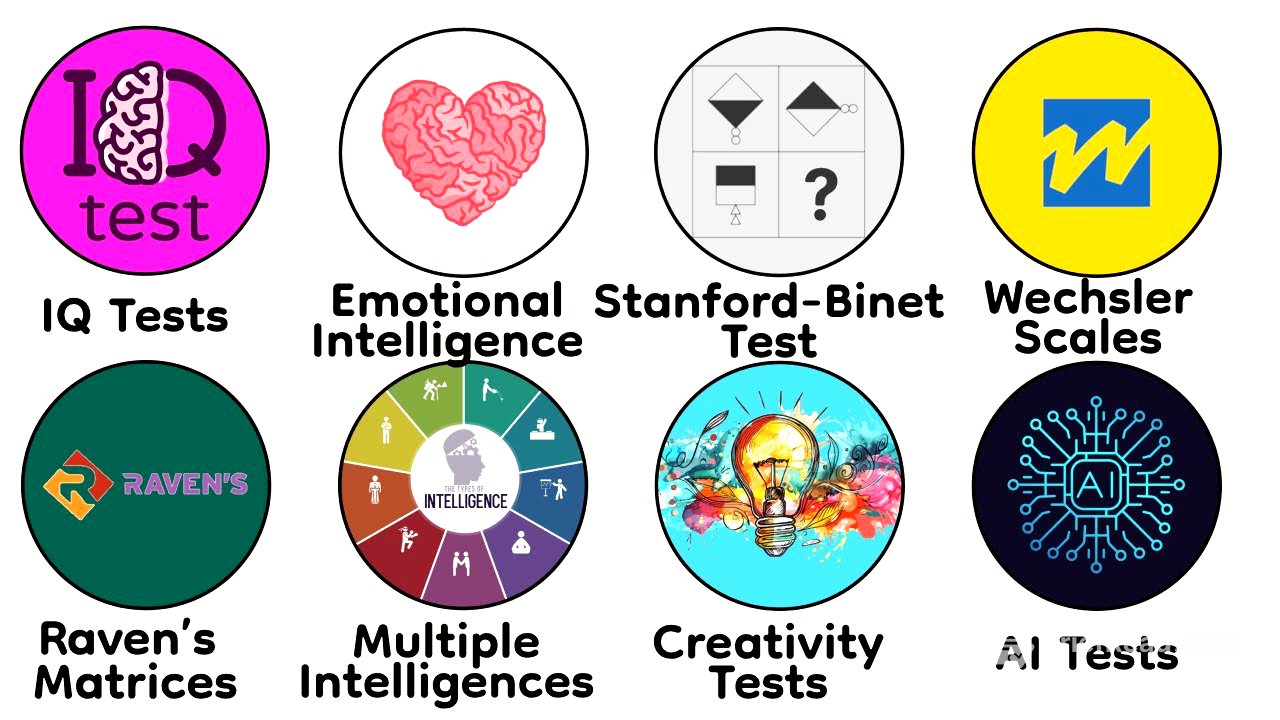
TLDR;
The video explores various methods of measuring intelligence, from traditional IQ tests to emotional intelligence (EQ), creativity tests, and AI-driven assessments. It highlights the limitations of IQ tests, emphasizing that intelligence is multifaceted and includes problem-solving, emotional understanding, creativity, and adaptability. The video also touches on the historical context of intelligence testing and introduces alternative theories like Howard Gardner's multiple intelligences.
- IQ tests measure problem-solving and information processing but are culturally biased and don't guarantee real-world success.
- Emotional intelligence (EQ) is crucial for leadership, relationships, and social interactions, and can be improved over time.
- Howard Gardner's theory of multiple intelligences suggests there are nine types of intelligence, not just one.
- Creativity tests measure divergent thinking and the ability to generate novel solutions.
- AI and machine learning are being used to develop more comprehensive and adaptive intelligence measurements.
Puzzle 1 [0:00]
The video starts with a quick puzzle to test the viewer's problem-solving skills, setting the stage for a discussion on the multifaceted nature of intelligence. Viewers are encouraged to share their solutions in the comments, prompting engagement and highlighting the diverse approaches to problem-solving. The puzzle serves as an introduction to the broader topic of how intelligence is measured and perceived.
IQ Tests – The Classic Standard [0:34]
The segment discusses the Intelligence Quotient (IQ) test, a widely recognized method for measuring intelligence developed over a century ago. It clarifies that IQ tests assess problem-solving skills, pattern recognition, and information processing speed rather than accumulated knowledge. Scores are based on a bell curve, with 100 representing the average, scores above 130 indicating genius-level intelligence, and scores below 70 suggesting intellectual challenges. The validity of IQ tests is questioned, with critics pointing out potential biases related to culture and education, and the fact that high IQ scores do not always translate to real-world success.
Emotional Intelligence (EQ) [1:29]
This section introduces Emotional Intelligence (EQ) as the ability to recognize, understand, and manage emotions in oneself and others. EQ is presented as a crucial factor for success, particularly in leadership, relationships, and social interactions. Studies suggest that EQ is often a better predictor of success than IQ. Unlike IQ, EQ can be improved through training and practice, making it a valuable skill to develop.
The Stanford-Binet Test [2:19]
The Stanford-Binet intelligence scale, developed in the early 1900s, is discussed as one of the first systematic attempts to measure intelligence. It introduced the concept of mental age, comparing a child's performance to the average performance of children of different ages. While still in use, the Stanford-Binet test shares similar limitations with other IQ tests, primarily focusing on academic intelligence and neglecting creativity, emotional intelligence, and real-world problem-solving abilities.
The Wechsler Scales [2:55]
The Wechsler Adult Intelligence Scale (WAIS) and the Wechsler Intelligence Scale for Children (WISC) are presented as tests that go beyond traditional IQ measurements. These scales break down intelligence into categories such as verbal comprehension, working memory, and processing speed. This approach allows for a more detailed assessment of intelligence, highlighting that individuals with the same overall IQ may excel in different areas. However, like other tests, the Wechsler scales do not cover all aspects of intelligence.
Raven’s Progressive Matrices [3:31]
Raven's Progressive Matrices are introduced as a method to measure intelligence without relying on language or cultural knowledge. The test focuses on pattern recognition and problem-solving abilities, making it suitable for diverse populations. It is used by the military, businesses, and researchers to assess fluid intelligence, which is the ability to think on the spot. However, it does not measure creativity, social intelligence, or emotional intelligence.
Puzzle 2 [4:07]
Another puzzle, presented as a Raven's Matrix, challenges viewers to identify the next shape in a sequence within a 10-second time limit. This interactive element reinforces the focus on problem-solving skills and encourages viewers to engage with the content. The puzzle serves as a transition to discussing theories that expand beyond traditional IQ tests.
Multiple Intelligences – Howard Gardner [4:40]
Howard Gardner's theory of multiple intelligences is introduced as a groundbreaking concept that challenges the traditional IQ model. Gardner proposed that there are nine types of intelligence: musical, bodily-kinesthetic, interpersonal, and naturalistic, among others. Traditional IQ tests do not measure most of these intelligences, meaning that many brilliant individuals may not score high on IQ tests. The video references a separate video that breaks down all nine types of intelligence in detail.
Creativity Tests – Measuring Imagination [5:41]
This section discusses creativity tests, such as the Torrance Tests of Creative Thinking (TTCT), which measure divergent thinking and the ability to think outside the box. Creativity tests assess how well individuals can generate multiple solutions to a single problem. The segment highlights the importance of creativity, exemplified by figures like Leonardo da Vinci, Einstein, and Steve Jobs, who created entirely new ways of thinking. Standard IQ tests do not measure creativity, but it is argued to be a critical type of intelligence for success.
Puzzle 3 [6:19]
The audience is presented with a description of a famous genius and prompted to guess their identity, encouraging engagement and highlighting the diverse ways intelligence can manifest. This interactive element reinforces the theme of creativity and innovation as key components of intelligence.
AI and Machine Learning Intelligence Tests [6:40]
The video explores the use of artificial intelligence (AI) to measure intelligence. AI can analyze problem-solving patterns, decision-making speed, and brain processing in real-time. Brain scans, neural activity tracking, and genetic markers are being explored to determine what makes someone intelligent. Some believe AI could create a perfect, adaptive intelligence measurement in the future.
Conclusion [7:17]
The video concludes by summarizing the various intelligence tests discussed, including IQ, EQ, creativity tests, and AI-driven assessments. It reiterates that intelligence is multifaceted and encourages viewers to consider which types of intelligence matter most to them. The final message emphasizes that intelligence is not just a number but a way of perceiving and shaping the world.



![Learn Python - Full Fundamental Course for Beginners | Python Tutorial for Beginners [2019]](https://wm-img.halpindev.com/p-briefread_c-10_b-10/urlb/aHR0cDovL2ltZy55b3V0dWJlLmNvbS92aS92X1M2NGtsZHJ5Yy9ocWRlZmF1bHQuanBn.jpg)

![[아라비아 ep.03] 1,200년 전 아라비아인이 본 신라인의 모습은? | 고대 아랍 문헌에 기록된 한국인의 ‘웃긴 해석’](https://wm-img.halpindev.com/p-briefread_c-10_b-10/urlb/aHR0cDovL2ltZy55b3V0dWJlLmNvbS92aS9PYUhtVFpQXzdSay9ocWRlZmF1bHQuanBn.jpg)