TLDR;
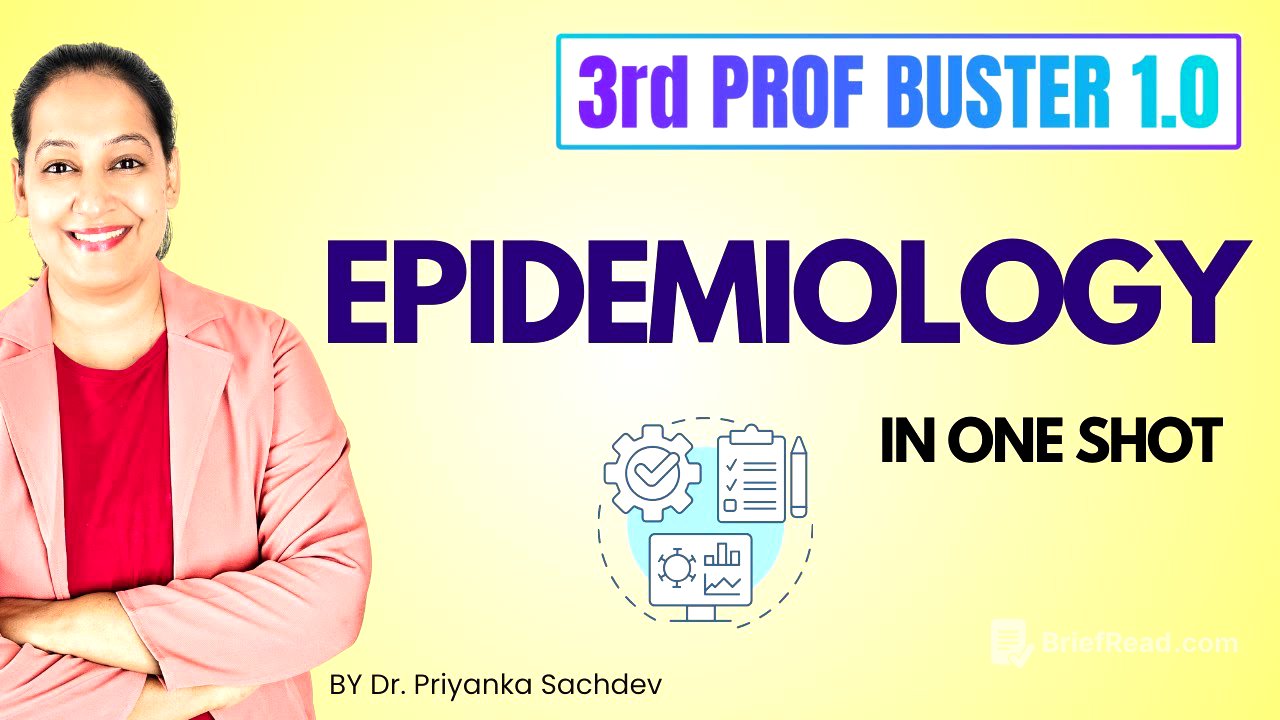
This YouTube video by Dr. Priyanka provides a comprehensive overview of epidemiology, focusing on study designs and measurements. It begins by addressing common struggles faced by third-year medical students and introduces a course designed to help them. The video then covers key epidemiological concepts, including the definition of epidemiology, tools for measurement (rate, ratio, proportion), measures of mortality and morbidity, and different types of epidemiological studies (descriptive and analytic).
- Key epidemiological concepts
- Tools for measurement
- Measures of mortality and morbidity
- Different types of epidemiological studies
Introduction and Course Overview [2:34]
Dr. Priyanka welcomes the audience and introduces herself as Dr. Priyanka Sajdev. She announces a demo session for third proper 1.0, focusing on community medicine. She outlines the struggles faced by third-year students, including managing four subjects (PSM, Forensic Medicine, ENT, Ophthalmology), applying theory clinically, lack of revision structure, and fear of viva questions. She also addresses curriculum confusion and time management issues due to various academic responsibilities. The third prop is crucial as it allows timely completion of subjects, freeing up time for final year subjects. To address these challenges, she introduces the third proper 1.0 course, covering all four subjects with live sessions and accessible recordings.
Course Details and Structure [8:17]
The course includes daily live interactive sessions, teaching with 3D models for clinical subjects, digital and printable notes, question banks for university and competitive exams, and a practical library. The course is designed for both university exams and competitive exam preparation. It includes 87 live sessions, with recordings available for one year (two years for ENT and ophthalmology). The course starts today and ends on February 22nd.
Introduction to Epidemiology [10:19]
Epidemiology is introduced as a science that protects people before treating them, emphasizing its preventive nature. It's described as where math meets medicine, with numbers serving a purpose. Epidemiologists are portrayed as detectives who save communities before they fall sick, differing from clinicians who save one life at a time. The bookish definition of epidemiology, given by John Amlast, is "the study of the distribution and determinants of health-related states or events in specified populations, and the application of this study to the control of health problems".
Tools of Measurement in Epidemiology: Rate, Ratio, and Proportion [17:36]
The three tools of measurement in epidemiology are rate, ratio, and proportion. All three involve a numerator, denominator, time specifier, and multiplier. A rate is the occurrence of an event during a given time in a population, with the numerator being part of the denominator, a time specifier of one calendar year, and a multiplier usually starting from 1,000. A ratio divides one quantity by another, where the numerator is not part of the denominator, there is no multiplier, and a time specifier may or may not be present. A proportion has a numerator that is part of the denominator, no time specifier, and a multiplier of 100, always expressed as a percentage.
Applying the Tools: Examples and Flowchart [25:28]
A flowchart is presented to decide whether a formula is a rate, ratio, or proportion. The first step is to see if the numerator is part of the denominator. If not, it's a ratio. If yes, check for a time specifier and multiplier. If a time specifier is present and the multiplier is 1,000 or more, it's a rate. If a time specifier is absent and the multiplier is 100, it's a proportion. Examples are given, and viewers are encouraged to create a separate copy for formulas.
MCQ and Mid-Year Population [29:36]
Two MCQs are presented to test understanding of rate, ratio, and proportion. The first question is about the incorrect statement regarding ratio, and the second question is about what case fatality rate is. The concept of mid-year population is explained as the population on the 1st of July, used as the median population for calculations.
Mortality vs. Morbidity [34:18]
Mortality means death, while morbidity means sickness or illness, any departure from physiological wellbeing. Mortality is measured in six ways: crude death rate (CDR), specific death rate (SDR), proportional mortality rate (PMR), survival rate (SR), case fatality rate (CFR), and standardized mortality rate (SMR). Morbidity is measured using incidence and prevalence.
Six Ways of Measuring Mortality: CDR and SDR [39:24]
The six ways of measuring mortality are detailed in a table format, including their formulas, numerators, denominators, multipliers, and time specifiers. Crude Death Rate (CDR) is the simplest measure, calculated as the number of deaths in a year divided by the mid-year population, multiplied by 1,000. Specific Death Rate (SDR) is the same but for a specific cause, group, or period.
Six Ways of Measuring Mortality: PMR, SR, and CFR [51:38]
Proportional Mortality Rate (PMR) is the death from a specific cause divided by the total deaths, multiplied by 100. Survival Rate (SR) is the number of survivors after a particular span divided by the total cases, multiplied by 100. Case Fatality Rate (CFR) is the number of deaths divided by the number of cases, multiplied by 100.
Six Ways of Measuring Mortality: SMR [1:08:36]
Standardized Mortality Rate (SMR) is the best indicator of mortality, used to compare mortality between two populations with different age compositions. It involves age standardization using a third standard population. Direct and indirect standardization methods are explained. SMR is calculated as observed deaths divided by expected deaths, multiplied by 100, and is a ratio.
MCQs on Mortality and Death Certificate [1:26:54]
MCQs are presented to test understanding of mortality measurements. Questions cover yardsticks for assessment of standard of therapy, estimating the burden of a particular disease, predicting virulence, the denominator of case fatality rate, and making comparisons between the health status of two populations. The international death certificate is discussed, including its four lines and the importance of the line of ascent.
Measurements of Morbidity: Incidence and Prevalence [1:31:12]
Morbidity is measured using incidence and prevalence. Incidence is the number of new cases in a year, while prevalence is the total number of cases (old and new) in that year. Incidence is a rate, calculated in cohort studies, while prevalence is a proportion, calculated in cross-sectional studies. Incidence is used to control a disease, while prevalence is used for administrative and planning purposes.
Incidence vs. Prevalence: Diagram and Properties [1:49:31]
A diagram is used to illustrate the difference between incidence and prevalence, with new water representing incidence and total water representing prevalence. The exit from the disease is either recovery or death. A table summarizes the differences between rate, ratio and proportion.
Relationship Between Incidence and Prevalence [2:02:03]
The relationship between incidence and prevalence is given by the formula: Prevalence = Incidence x Duration. Three tricky questions are posed: the effect of duration of disease on prevalence, the effect of treatment on prevalence, and the effect of vaccine on prevalence. The answers depend on whether the disease is curable or chronic and non-curing.
MCQs on Morbidity and Introduction to Epidemiological Studies [2:09:39]
MCQs are presented to test understanding of morbidity measurements. Questions cover the relationship between incidence and prevalence, the impact of treatment on incidence and prevalence, and numerical problems. The video transitions to introducing epidemiological studies, including observational and experimental studies.
Introduction to Epidemiological Studies: Descriptive and Analytic [2:21:11]
Epidemiological studies are divided into observational and experimental studies. Observational studies are further divided into descriptive and analytic studies. The video addresses two key questions: who conducts these studies (epidemiologists) and why (to confirm a hypothesis). Epidemiologists are described as detectives who save communities before they fall sick.
Hypothesis and Study Design [2:23:10]
A hypothesis is an educated guess that needs to be confirmed through epidemiological studies. Hypotheses have two components: a cause/risk factor/exposure and an effect/disease. The video uses the hypothesis "smoking leads to lung cancer" as an example. Epidemiological studies are conducted in three phases: descriptive, analytic, and experimental. Descriptive studies formulate the hypothesis, analytic studies test the hypothesis, and experimental studies confirm the hypothesis.
Descriptive Epidemiology: Steps and Examples [2:32:54]
Descriptive epidemiology involves four steps: defining the population, defining the disease, describing the disease in terms of time, place, and person, and formulating the hypothesis. The video details how to describe a disease in terms of time (short-term, long-term, periodic fluctuations), place (spot maps), and person (age, gender, ethnicity, etc.).
Descriptive Epidemiology: Time Component [2:46:39]
The time component of descriptive epidemiology is further broken down into short-term, long-term, and periodic fluctuations. Short-term fluctuations are epidemics, which can be point source, continuous source, or propagated. Examples are given for each type, including the Bhopal gas tragedy (point source), contaminated well (continuous source), and COVID-19 (propagated).
Descriptive Epidemiology: Place and Person Components [3:48:45]
The place component involves drawing spot maps to identify clustering of cases, as exemplified by John Snow's work on cholera in London. The person component involves describing the disease in terms of age, gender, ethnicity, marital status, occupation, and social class.
Descriptive Epidemiology: MCQs and Introduction to Analytic Epidemiology [3:56:09]
MCQs are presented to test understanding of descriptive epidemiology. Questions cover the purpose of descriptive studies and examples of different types of epidemics. The video then transitions to introducing analytic epidemiology, which tests the hypothesis.
Analytic Epidemiology: Case-Control Study Design [4:05:16]
Analytic epidemiology is introduced with a focus on case-control and cohort studies. A case-control study starts with identifying cases (people with the disease) and controls (people without the disease). The design involves taking a history of exposure in the past and comparing the two groups. The study is retrospective, going from effect to cause.
Case-Control Study: 4x4 Table and Analysis [4:22:36]
A 4x4 table is created to analyze the data, with disease status (present/absent) at the top and exposure status (present/absent) on the left side. The table is used to calculate the exposure rate in cases and controls, and the odds ratio. The odds ratio indicates the strength of association between the risk factor and the disease.
Cohort Study Design and Types
Cohort studies are introduced as an alternative to case-control studies. In a cohort study, the starting point is exposure, not disease. The study follows a group of exposed and non-exposed individuals over time to see who develops the disease. Cohort studies can be prospective, retrospective, or a combination of both.
Cohort Study: Analysis and Comparison with Case-Control
The analysis in a cohort study involves calculating the incidence rate among exposed and non-exposed individuals. The relative risk and attributable risk are then calculated to determine the strength of association. The video concludes with a comparison of case-control and cohort studies, highlighting their strengths, weaknesses, and appropriate uses.
Conclusion and Next Steps [5:24:36]
The video summarizes the topics covered, including measurements of mortality, international death certificates, measurements of morbidity, and epidemiological studies. The next session will cover experimental epidemiology. The audience is encouraged to join the next session on YouTube, which will cover forensic medicine and postmortem changes.