TLDR;
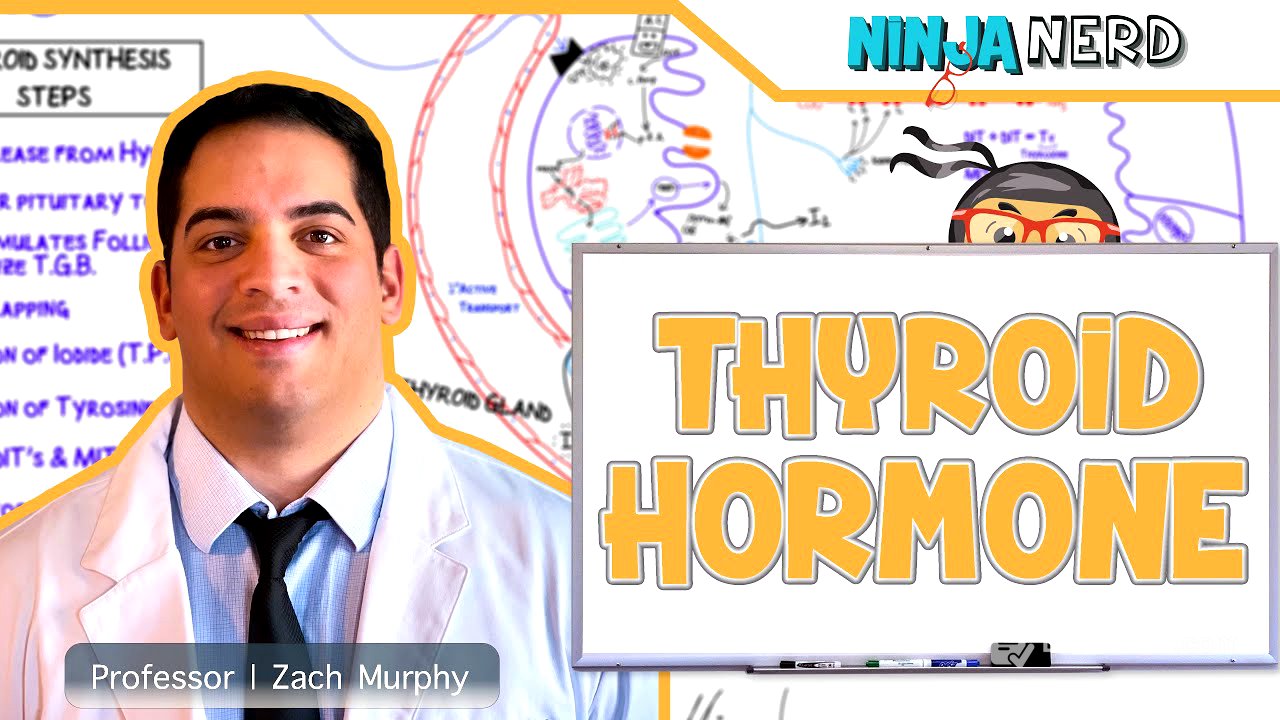
This video explains the synthesis of thyroid hormone within the thyroid gland's follicles, starting from the hypothalamus-pituitary-thyroid axis to the final release of T3 and T4 hormones into the bloodstream. It covers the roles of key hormones like TRH and TSH, the importance of iodine, and the various steps involved in creating and releasing thyroid hormones.
- The synthesis begins with the hypothalamus releasing TRH, which stimulates the anterior pituitary to release TSH.
- TSH then acts on thyroid follicles to synthesize thyroglobulin.
- Iodide is trapped and oxidized before being added to tyrosine amino acids on thyroglobulin.
- Coupling of these iodinated tyrosines forms T3 and T4, which are then released into the bloodstream.
Introduction to Thyroid Hormone Synthesis [0:07]
The video introduces the synthesis of thyroid hormone, focusing on the thyroid gland located in the anterior neck. The thyroid gland, shaped like a butterfly, consists of thyroid follicles, which are the structural and functional units. The explanation will zoom in on these follicles and their follicular cells to detail the mechanism of thyroid hormone synthesis, outlining the steps involved before a review.
Hypothalamic-Pituitary-Thyroid Axis [0:57]
The hormone production begins in the hypothalamus, which is part of the hypothalamic-pituitary-thyroid (HPT) axis. Neurons in the hypothalamus, specifically the paraventricular nucleus, secrete thyrotropin-releasing hormone (TRH). TRH stimulates thyrotrope cells in the anterior pituitary, which then release thyroid-stimulating hormone (TSH). TSH circulates in the blood and binds to receptors on the external face of the follicular cells in the thyroid gland.
TSH Activation and Protein Synthesis [3:25]
When TSH binds to its receptor, it activates a G stimulatory protein, which in turn activates adenylate cyclase. Adenylate cyclase converts ATP into cyclic AMP, which then activates protein kinase A. Protein kinase A phosphorylates transcription factors, stimulating genes to produce specific proteins. These proteins undergo modification in the rough endoplasmic reticulum and Golgi apparatus before being packaged into vesicles. These vesicles fuse with the cell membrane, releasing the synthesized protein into the lumen.
Thyroglobulin Synthesis and Iodide Uptake [7:19]
The synthesized protein is thyroglobulin, which contains tyrosine amino acids, the basic units of thyroid hormone. Iodine, obtained from nutrient sources and circulating in the blood as iodide (I-), is essential for the reaction. Iodide is actively transported into the follicular cells against its concentration gradient via secondary active transport, using sodium as a co-transporter.
Iodide Oxidation and Iodination [10:55]
Once inside the cell, iodide is transported into the luminal space by a protein called pendrin. In the lumen, thyroid peroxidase (TPO) oxidizes iodide into iodine. TPO then facilitates the iodination of tyrosine amino acids on the thyroglobulin, forming monoiodotyrosine (MIT) and diiodotyrosine (DIT).
Coupling of MIT and DIT to Form T3 and T4 [14:14]
Thyroid peroxidase couples MIT and DIT molecules. DIT coupled with another DIT forms T4 (thyroxine), while DIT coupled with MIT forms T3 (triiodothyronine). T3 and T4 are collectively known as thyroid hormones and are stored within the thyroglobulin colloid.
Endocytosis and Lysosomal Cleavage [16:54]
The thyroglobulin colloid, containing T3 and T4, is brought back into the follicular cells through endocytosis. Lysosomes fuse with the endocytic vesicle, and lysosomal enzymes cleave T3 and T4 from the thyroglobulin.
Release of T3 and T4 into the Bloodstream [18:34]
The isolated T3 and T4 are then released into the bloodstream via exocytosis. Because T3 and T4 are not very water-soluble, they are transported in the blood by thyroxine-binding globulin, a protein synthesized by the liver.
Recap of Thyroid Hormone Synthesis Steps [20:29]
The video concludes with a recap of the entire process:
- TRH release from the hypothalamus.
- TSH release from the anterior pituitary.
- Stimulation of thyroid follicular cells to synthesize thyroglobulin.
- Iodide trapping.
- Oxidation of iodide by thyroid peroxidase.
- Iodination of tyrosine amino acids.
- Coupling of DIT and MIT to form T3 and T4.
- Endocytosis of thyroglobulin with T3 and T4.
- Lysosomal enzyme cleavage of T3 and T4 from thyroglobulin.
- Exocytosis of T3 and T4 into the bloodstream, bound to thyroxine-binding globulin for transport to target tissues.