TLDR;
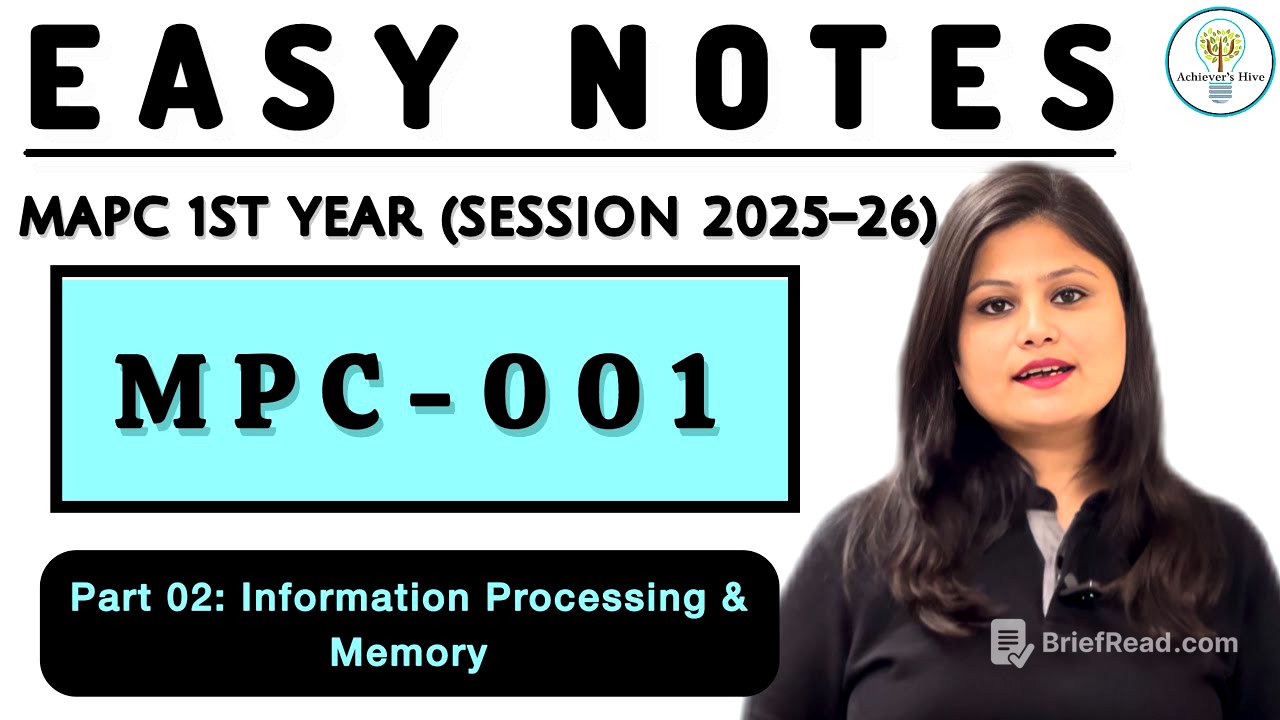
This video provides an overview of information processing and memory, focusing on key concepts and theories relevant to first-year IGNOU psychology students. It covers the principles of information processing, Sternberg's information processing approach, and the Atkinson and Shiffrin's stage model of memory.
- Principles of Information Processing: Limited capacity, control systems, two-way information flow, and biological readiness.
- Sternberg's Information Processing Approach: Focuses on mental steps in thinking and problem-solving, including meta-components, performance components, and knowledge acquisition.
- Atkinson and Shiffrin's Stage Model of Memory: Explains memory through sensory, short-term, and long-term stages, detailing how information flows between them.
Introduction [0:00]
The video serves as the second class for first-year IGNOU psychology students, focusing on information processing and memory. The presenter expresses gratitude for the positive feedback on the easy notes and their index, which provides a comprehensive overview of the paper. The presenter outlines the plan to cover the first three topics out of seven in this video, with the remaining four to be covered in the next video.
Principles of Information Processing [1:08]
The discussion begins with the principles of information processing, emphasizing that it involves receiving and processing information from the environment. The mind continuously receives information through various senses, and memory plays a crucial role in determining what information is retained. Information processing operates on four key principles: limited processing capacity, control system or executive function, two-way flow of information, and biological readiness to learn.
Limited Processing Capacity [4:08]
The first principle is that the brain has a limited capacity for processing information. It is impossible for the brain to store everything it encounters. Trying to handle too much information at once can lead to confusion or forgetfulness. Focusing on one task at a time improves learning and understanding, highlighting the importance of single-tasking over multitasking.
Control System or Executive Function [5:49]
The second principle involves the brain's built-in control system, known as the executive function. This system manages focus, attention, and actions, determining what to pay attention to, what to ignore, when to store information, and how to solve problems. The executive function works harder when learning something new but requires less energy for familiar tasks.
Two-Way Flow of Information [7:26]
The third principle describes the two-way flow of information: bottom-up processing and top-down processing. Bottom-up processing starts with sensory input from the environment, while top-down processing uses existing knowledge to understand new things. Bottom-up processing involves new learning, while top-down processing applies existing knowledge. The brain uses both methods as needed.
Biological Readiness to Learn [9:17]
The fourth principle is the biological readiness to learn, which suggests that humans are born with certain abilities that emerge over time, such as language and social interaction. The brain is genetically prepared for learning specific types of information.
Sternberg's Information Processing Approach [10:31]
Moving on, the video introduces Sternberg's information processing approach, which focuses on the mental steps people go through when receiving, processing, and using information to make decisions. Sternberg believed that intelligence is not just about knowing facts but about how effectively we process information. His theory views thinking as a series of steps that occur in the mind.
Components of Sternberg's Model [13:08]
Sternberg's model includes three components: meta-components, performance components, and knowledge acquisition. Meta-components involve planning and controlling problem-solving, performance components involve executing tasks, and knowledge acquisition involves learning and storing new information.
Explanation of the Components [13:59]
Meta-components are higher-level thinking processes used to plan and control problem-solving. Performance components are the mental processes used to execute a plan or task. Knowledge acquisition components help in learning new information and storing it for future use.
Importance of Sternberg's Approach [16:19]
Sternberg's information processing approach explains how students solve problems and learn new things. It supports better teaching methods, helps students memorize information, and shows that intelligence involves various processes like learning, planning, and adapting.
Atkinson and Shiffrin's Stage Model of Memory [17:05]
The video introduces the Atkinson and Shiffrin's stage model of memory, which explains that memory occurs in different stages. This model describes how information flows from one stage to another, involving specific processes. The theory posits that memory is not a single system but has three separate stages: sensory memory, short-term memory, and long-term memory.
Explanation of the Model [18:30]
The Atkinson-Shiffrin model illustrates how environmental stimuli are received through sensory input and processed through three stages: sensory memory, short-term memory, and long-term memory. Sensory memory briefly holds information received through the senses. If attention is given to this information, it moves to short-term memory. With rehearsal and maintenance, information can then be transferred to long-term memory for stable storage.
Sensory Memory [27:16]
Sensory memory is the first stage of memory, holding information from the senses for a very short time. It has two types: iconic memory (visual) and echoic memory (auditory). Sensory memory helps in focusing attention by filtering out irrelevant information.
Short-Term Memory [28:35]
Short-term memory, also known as working memory, is the second stage of memory, temporarily holding information for about 15 to 30 seconds. Rehearsal and chunking can help retain information longer.
Long-Term Memory [30:31]
Long-term memory has a large and unlimited capacity and is divided into explicit (declarative) memory and implicit (non-declarative) memory. Explicit memory includes facts and knowledge, while implicit memory includes skills and processes.
Conclusion [31:40]
The Atkinson and Shiffrin model helps understand how memory can be understood in three stages. The video highlights that types of memory can be derived from this model, which is important for exam preparation. The next video will cover the Norman and Waugh model.