TLDR;
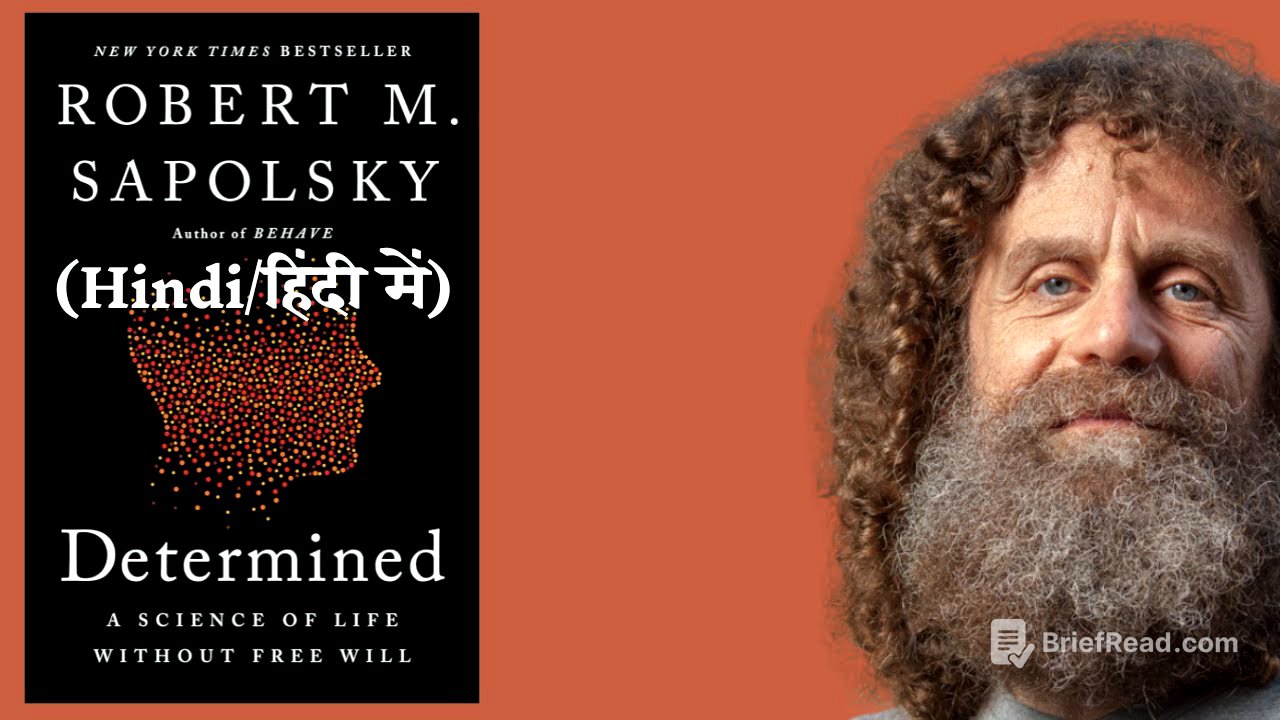
This video summarizes Robert Sapolsky's book "Determined," which argues against the concept of free will. Sapolsky uses neuroscience, evolution, and psychology to demonstrate that our decisions and behaviors are the result of biological and environmental factors beyond our conscious control. The book explores how genetics, prenatal experiences, hormones, and cultural influences shape our actions, suggesting that judging and punishing individuals based on the assumption of free will is misguided. Instead, Sapolsky proposes a more compassionate and fair approach to understanding human behavior, emphasizing the importance of context and the limitations of individual choice.
- Argues against free will using scientific evidence.
- Explores the influence of biology and environment on behavior.
- Advocates for a more compassionate and fair understanding of human actions.
Introduction [0:02]
Robert Sapolsky's "Determined" challenges the notion of free will, suggesting that our choices are predetermined by a combination of biological and environmental factors. Every decision, feeling, and reaction is the result of a chain of cause and effect stretching from seconds to millions of years into the past, encompassing DNA, prenatal environment, neighborhood influences, hormones, and neural circuits. This perspective implies that individuals, whether committing crimes or achieving great success, are not fully in control of their actions. Sapolsky argues that recognizing the absence of free will can lead to a more compassionate and just society, urging a shift away from judgment and blame towards understanding and fairness.
The Illusion of Randomness [1:56]
Human behavior is not random but follows a cause-and-effect chain, influenced by brain activity, neurons, hormones, past experiences, genetics, culture, and evolution. These factors, largely beyond our control, shape our actions. While society often makes exceptions for certain cases, such as not executing juveniles or providing extra support for dyslexic students, Sapolsky argues that free will is nonexistent in all cases. Blaming or punishing individuals for retribution is therefore wrong, and praise is only justified if it influences future behavior. Concepts like love, hate, respect, reward, and punishment become meaningless without free will, akin to being angry at a tornado or loving a flower for their actions. Sapolsky aims to prove that free will is an illusion by integrating data from various fields, advocating for a societal shift towards acknowledging this reality and adopting new ways of living.
The Movie Analogy and Libet Experiments [6:18]
The focus on the moment of decision overlooks the preceding factors that led to that choice. The Libet experiments, where brain activity was recorded as participants decided to press a button, showed that the brain decides before the conscious awareness of the decision. This has been supported by FMI and single neuron studies, with decisions occurring up to 10 seconds before conscious awareness. Libet himself called the feeling of making a decision an illusion created by the brain. Critics argue these experiments only cover simple decisions, but some research suggests complex decisions also have preceding brain signals. The "readiness potential" is debated, with studies showing it only predicts actions 60% of the time. The concept of "free won't" suggests we can veto actions, but Sapolsky argues this is also a brain function with a cause-and-effect system.
The Courtroom and the Thought Experiment [9:48]
The legal system focuses on whether a crime was intentional, but it doesn't question the origin of that intention. Sapolsky presents a thought experiment where someone is given the freedom to kill or not, but the question remains: where does the intention come from? Philosopher Dennett's idea of life as a marathon where bad luck averages out is challenged by Sapolsky, who argues that bad luck amplifies, not cancels out. He criticizes the notion that intent is all that matters, calling it a moral failure to ignore the preceding factors. The deeper truth is that it's about the whole story, not just the last three minutes. Even in scenarios with high stakes, the intent behind a decision is what truly matters, not just when the decision was made or which neurons fired.
The Illusion of Wanting [12:15]
You cannot choose what you want to want; you can only experience what arises. Sensory information biases decisions based on race, gender, and expression. Disgust, influenced by smells or experiences like touching fake vomit, can affect moral judgments. Beauty also biases, activating the same brain areas as good behavior. People seek to cleanse themselves after unethical acts, known as the Macbeth effect. Internal signals like hunger and heartbeat also influence decisions, often masked by the illusion of logical choice. Hormones like testosterone, oxytocin, and glucocorticoids alter brain function without conscious control, pushing behavior but not fully determining it. Past experiences physically and permanently change the brain, affecting synapses and neuron connections. Gut bacteria also play a role in digestion, mood, anxiety, and memory, further limiting conscious control over decisions.
Adolescence and Childhood [16:46]
The frontal cortex, responsible for decision-making and impulse control, continues to develop until adolescence, shaped more by environment than genes. Teenage experiences, including love, trauma, and rejection, mold the brain. The human brain delays frontal cortex development to learn from the environment. Childhood is crucial for brain development, with neurons, myelination, reasoning, and empathy all growing. How one follows laws, whether out of fear of punishment or understanding of logic, is shaped in childhood. These experiences collectively determine desires and thoughts, with roots in experiences beyond conscious control. Free intention is the latest episode in a chain reaction.
Impulse Control and Parenting Styles [18:01]
Impulse control matures gradually, with timing and stability varying at each stage. Childhood development depends on parenting styles, including authoritative (high demand, high response), authoritarian (high demand, low response), permissive (low demand, high response), and negligent (low demand, low care). Poor parenting combined with adverse childhood experiences stunts frontal cortex development. Peers also significantly influence human kids, who learn from teachers, while primates learn by observing other kids. The environment, including safe parks, bookstores, crime rates, and healthy food availability, also plays a role. Culture influences parenting, peers, environment, and values, shaping children's behavior.
Childhood Luck and Brain Development [19:51]
Hormones, nutrition, and pathogens affect brain development. Good weather in childhood correlates with individualism, openness, and extroversion. Stressful childhoods lead to higher glucocorticoid levels and weaker impulse control. High early testosterone results in a hyper-reactive amygdala and adult aggression. Epigenetics, where experiences determine gene regulation, also plays a role. Inattentive rat moms lead to babies with weaker stress recovery systems. Childhood abuse changes gene regulation, affecting future parenting. Adverse Childhood Experience (ACE) scores correlate with violence, impulse problems, addiction, anxiety, poor health, and early death. Conversely, a Ridiculously Lucky Childhood (RLC) score correlates with positive life outcomes. Even birth month matters, with older kids in class getting better attention and long-term advantages.
Fetal Life and Genes [21:35]
A mother's hormones, stress, and exposure to toxins during pregnancy can affect the child's empathy, risk of alcoholism, and even handwriting. Nutrient shortages increase the risk of schizophrenia and metabolic problems. Genes dictate protein production but don't decide their own activation; the environment controls their on/off state. Only 5% of DNA are actual genes, while 95% are switches that regulate gene expression. The same gene can behave differently in different environments. For example, an aggression gene can manifest as competitiveness in chess or aggression in violent situations. Neurotransmitters and genes, such as serotonin and dopamine genes, affect mood, aggression, motivation, reward, and attention. The same gene variant can lead to different outcomes depending on childhood experiences.
Culture and Evolution [23:26]
Culture influences behavior from birth, with each subculture employing techniques to instill its values in the next generation. Individualistic cultures, like the USA, emphasize uniqueness and achievement, while collectivist cultures prioritize group harmony and interdependence. Brain reactions also differ across cultures, with Americans showing reward responses to excitement and East Asians to calmness. Americans experience stress when influenced by others, while East Asians feel stressed when they influence others. Collectivism is linked to wheat farming in North China, while individualism is associated with waste deserts. Deserts often foster monotheism and warlike tendencies, while rainforests promote polytheism and peacefulness. Pastoralist cultures value honor, with violent revenge common in insult-based role areas like the South USA. Tight cultures, facing crises, disasters, or diseases, have more rules, while loose cultures are more relaxed. Evolution has moderately shaped human behavior, placing it between bonobos and chimps in aggression and between orangutans and baboons in social behavior.
The Seamless Stream [25:26]
Everything is interconnected in a seamless stream, including genes, hormones, environment, womb, culture, and trauma. There is no moment where one freely chooses, as every decision is rooted in the deep past. Bad luck amplifies rather than balances out, leading to worse environments, fewer opportunities, and increased stress. Philosopher Neil Levy states that the past shapes the present. Some believe free will existed in the past or will exist in the future, or that it exists in a different part of the brain or at a social level. However, Sapolsky argues that everything is a result of biology and environment, over which we have no control. Even in cases of self-defense, the individual's background and brain structure may preclude the ability to make a sound decision in a critical moment.
The Illusion of Control [28:15]
While biological traits may seem uncontrollable, some argue that our choices in dealing with them define us. Whether a marathoner fights through pain or gives up, an alcoholic resists or succumbs to drinking, or a pedophile acts on or controls their urges, these are seen as personal choices. However, this duality offers a false comfort, as both biology and actions are influenced by uncontrollable forces. Grit, self-control, and willpower are not separate from the brain but are products of neurons, chemicals, and receptors. The prefrontal cortex (PFC) is responsible for impulse control, long-term planning, and emotional regulation, maturing fully by age 25. It helps us do the right thing, especially when it's difficult, and activates when following new rules. Brain damage in this area can lead to failure in reversal tasks.
The Prefrontal Cortex and Decision Making [29:17]
The prefrontal cortex (PFC) controls the amygdala, which generates fear, aggression, and anxiety. In implicit racial bias tests, the PFC shuts down amygdala activation after seeing a face of a different race. Logic and emotion are interconnected, with the PFC needing emotional input for decision-making. The dorsolateral prefrontal cortex (DLPFC) is responsible for pure logic, planning, and impulse control, while the ventromedial prefrontal cortex (VMPFC) handles emotional input. A balance between both parts is necessary for sound decision-making. The PFC helps us do the right thing in a biological, not necessarily moral, sense. It can be used to lie, and its use depends on environment and wiring. Both actions and identity are equally controlled by biology and environment, with no magical self freely deciding what to do. Grit is a biological function, not proof of free will.
The Biology of the Prefrontal Cortex [32:32]
The prefrontal cortex (PFC) is a biological entity, and its function is influenced by uncontrollable factors. Cognitively demanding tasks consume significant energy in the PFC, weakening self-control when energy is depleted. Stress, pain, fatigue, and even a doctor's birthday can impair decision-making. Dopamine signals the value of temptation in the PFC, and dopamine levels are influenced by biology and experience. Hormones like testosterone and cortisol affect impulsivity and executive function, while oxytocin increases trust and empathy. Chronic stress and conditions like depression and anxiety can shrink the PFC. Exercise improves PFC function through neurotransmitters and growth factors. Traumatic brain injuries and racial discrimination can impair PFC function.
The Impact of Childhood on the Prefrontal Cortex [35:59]
During teenage years, when the prefrontal cortex (PFC) is still developing, the dopamine system is highly active, leading to impulsive behavior. The quality of adolescence determines future impulse control. Child abuse results in a smaller PFC, poor connectivity, weak control, anxiety, and aggression, with changes occurring mostly in the first five years and persisting into adulthood. Abused children are more likely to become abusive parents. Even one-month-old babies of abused mothers show different PFC circuitry. Socio-economic status (SES) also affects PFC development, with poor kids having smaller PFCs and weaker brain signals. By age three, rich kids have heard 30 million more words, leading to better language and cognition. Stress, poor nutrition, and low stimulation due to low SES weaken PFC development.
Genes, Culture, and the Prefrontal Cortex [38:43]
Genes control neurotransmitters, receptors, and growth factors, with gene variants determining prefrontal cortex (PFC) size, task performance, and impulse control. A gene's behavior varies based on the environment. Cultural values shape brain structure, with Westerners showing PFC activity primarily in response to their own face, while East Asians respond equally to their own and their mother's faces. Bicultural individuals shift PFC behavior based on cultural priming. East Asians exhibit more DLPFC activity, leading to self-regulation and empathy, while Westerners show more emotional intensity with VMPFC and insula activation. Culture, values, parenting, and genes collectively shape the PFC over generations. The myth of greatness is shattered, as both talents and weaknesses are beyond our control. Resisting temptation, fighting pain, and succeeding are all functions of the PFC, which is itself a product of uncontrollable factors.
Chaos Theory and Free Will [41:22]
While everything may be deterministic, there's also the possibility of chaos theory, emergent complexity, and quantum indeterminacy. Chaos theory suggests that small differences can lead to vastly different outcomes, making prediction difficult. Emergent complexity arises when simple elements combine to create complex and functional systems without a master plan. Quantum indeterminacy introduces randomness at the subatomic level. Reductionism, the idea of understanding complex systems by breaking them down into smaller parts, fails for some complex systems. Chaos theory, illustrated by the butterfly effect, shows that sensitive dependence on initial conditions can lead to unpredictable outcomes. Cellular automata and the Game of Life demonstrate how simple rules can generate complex and chaotic patterns.
Misinterpretations of Chaos Theory [45:39]
Chaos theory does not imply randomness but rather hidden patterns and structures. It is deterministic but unpredictable. The argument that chaos equals free will is flawed. Predictability and determinism are distinct concepts. Chaotic systems are deterministic, but difficult to predict. Convergence, where different starting states lead to the same end pattern, does not negate causality. Just because we can't trace the cause doesn't mean it doesn't exist. Radical reductionism may fail, but determinism does not. Chaos theory reveals hidden patterns and structures, not randomness. It is unpredictable but deterministic, and therefore does not support the existence of free will.
Emergent Complexity [51:29]
Emergent complexity occurs when simple, identical elements combine without a master plan to create something complex and functional. Unlike chaos, where small differences lead to large changes, here, the same elements and simple rules create unexpected and significant outcomes. Examples include ant colonies, where individual ants follow simple rules to create an intelligent society, and slime mold, which solves problems and creates paths without neurons or planners. Neurons also grow towards attractants, with mechanical feedback driving emergence. Fractal patterns, created by repeated application of simple rules, demonstrate infinite complexity within a small space. These patterns are found in nature and culture, such as branching patterns of knowledge and beliefs.
Emergence and Free Will [54:11]
Emergent systems exhibit properties that exist only at the collective level, such as brainness in a brain. These systems arise from simple rules, local interactions, and repetition, creating complexity without centralized control. The question then arises: what is free will? While most agree that individual neurons do not possess free will, some argue that free will emerges at higher levels of organization. However, this idea faces several problems. First, it revives the notion of chaotic confusion, where unpredictable is equated with undetermined. Second, it grants emergent states independence, suggesting they are not constrained by their parts. Third, it overemphasizes downward causality, where emergent states can change their parts.
Quantum Indeterminacy [1:05:07]
Quantum indeterminacy suggests that the world is not deterministic at the subatomic level, but the likelihood of this randomness affecting behavior is minimal. Even if it does, it's unlikely to produce something resembling free will. True randomness occurs at the quantum level, where particles are randomly hit by photons, causing them to move randomly. Einstein opposed this idea, believing there must be hidden variables. Quantum phenomena include wave-particle duality, superposition, Heisenberg's uncertainty principle, entanglement, non-locality, and quantum tunneling. However, these phenomena do not prove free will.
Quantum Randomness and Free Will [1:13:28]
The combination of quantum mechanics and free will is often seen as pseudoscience. While quantum indeterminacy exists at the quantum level, it doesn't translate into free will. Quantum effects do not bubble up to influence behavior. Neuronal randomness is purposeful, and networks are regulated. Therefore, quantum indeterminacy does not equate to free will. Spontaneous neuron actions are mechanistically decided indeterminacies. Quantum randomness does not bubble up to behavior, so there is no connection between quantum mechanics and pulling a trigger heartlessly or heroically. If the brain were random, we would be a superposition cloud, believing in conflicting moral systems simultaneously.
Filtering and Messing with Randomness [1:20:12]
Two models attempt to reconcile randomness with free will: filtering and messing with randomness. The filtering idea suggests that randomness bubbles up, and we filter it, allowing some randomness to pass through. However, the origin of the filter, which defines our values, ethics, and character, remains unexplained. The messing with randomness idea suggests that we not only choose from quantum randomness but also change it through downward causation. However, this raises questions about controlled randomness, determined indeterminacy, and the nature of information. These explanations often rely on magical hand-waving rather than concrete evidence.
Summary of Determinism [1:23:50]
Reductionism has its limits. Chaos, emergence, and quantum mechanics show that some things are not top-down or blueprint-driven. However, this doesn't mean that the properties of parts change when their quantity increases, or that the system magically becomes free. Complexity does not equal free will, and magical explanations are not explanations. Everything that we are is a result of everything that has happened, from a second ago to a million years ago. Our self is not a separate entity but a continuum. There is no gap where free will can slip in. Libet-type experiments are irrelevant because the intent is part of the same deterministic system.
The Belief in Free Will [1:26:34]
The belief in free will is deeply ingrained, influencing jury trials, punishments, and praises. Even chimpanzees exhibit some level of free will-type thinking. However, even with all the deterministic factors, we still cannot accurately predict behavior. Exceptions exist, and the speed of science means that facts are constantly being discovered. As science progresses, the vacuum of ignorance shrinks. We can predict who will pick up a pen based on various factors, but the answer is always the same: it's out of their control.
The Challenge of Motivation [1:29:02]
If everyone believed in the absence of free will, how would we maintain motivation to live? This is a difficult question, and Sapolsky wrote the second half of his book to address it. When people believe free will is fake, do they become amoral, violent, and careless? This can occur when punishment is guaranteed to be avoided, or when people are in groups and anonymous. Science experiments show that reduced belief in free will leads to less effort, less intentionality, and less attention to actions and mistakes. Behaviorally, it leads to more cheating, less helping of strangers, more revengefulness, less gratitude, and a disconnect from oneself.
Religion and Morality [1:31:50]
Moralizing Gods are a relatively recent invention. Hunter-gatherer societies had more chill Gods. The idea of "God is watching" emerged with larger societies. Anti-atheist bias is prevalent, with atheism punishable in 52 countries. Americans also distrust atheists more than other groups. People often equate belief in God with morality, but self-reported data is biased. Real behavior shows that atheists and theists are similar in blood donation, tipping, forgiveness, and revenge. Religious people become more charitable, self-controlled, and honest when reminded of religion or God. Atheists show the same behavior when primed with moral words or social values.
Change Without Free Will [1:35:55]
If free will doesn't exist, how does change occur? We don't change ourselves; our minds and environment change. The story of the Aplysia sea slug illustrates this. Touching its siphon causes gill retraction, a simple SN-MN circuit. Tail shocks make the siphon response more alert. Eric Kandel decoded Aplysia's learning mechanism, showing that changes occur at the molecular level. These changes also apply to humans, with the same molecules and mechanisms. We don't choose to change; we are changed by biology and environment.
Blame and Hate [1:40:33]
We have previously abandoned blame and hate in certain contexts, leading to a better society. Epilepsy, once considered a sacred disease or demonic possession, led to torture and burning of "witches." Schizophrenia, a devastating disease, was blamed on "schizophrenogenic mothers." Autism was also blamed on "refrigerator mothers." However, science has revealed the biological basis of these conditions, leading to a reduction in blame and shame.
Punishment and Justice [1:50:33]
In 14th century Europe, the Black Death led to the blaming and mass execution of lepers and Jews. However, justice system reforms are ongoing, such as the Innocence Project. Without free will, retribution is meaningless. Reform involves making a flawed system slightly better. Restorative justice focuses on truth and healing rather than revenge, with criminals and victims meeting face-to-face. The quarantine model focuses on protection rather than punishment. Forward-looking justice constrains based on future danger, while backward-looking justice punishes based on past damage.
The Quarantine Model and Punishment [1:53:29]
The quarantine model, where dangerous individuals are constrained to protect society, faces criticism regarding indefinite constraints and pre-crime concerns. However, it is acceptable if society understands that criminals are made, not born evil. Compensation should be provided for constraints, such as luxury resorts for violent individuals sent to an island. Norway's prison system, with open campuses and amenities, demonstrates a forward-looking approach. Public punishment, driven by the pleasure of retribution, is gradually becoming less acceptable.
The Evolution of Punishment [1:56:52]
Punishment evolved in nature to prevent cheating in cooperative species. Chimps, ravens, moles, rats, fish, and bacteria all punish cheaters. The tit-for-tat strategy, starting with cooperation and punishing cheating, is effective. Third-party punishment, where outsiders punish, is uniquely human and driven by altruism. As societies grow, these systems become more formal, with punishing Gods invented to enforce morality. People reject unfair offers, even at a cost, due to a sense of justice.
The Pleasure of Punishment [2:00:09]
Serial killers are a form of "punishment porn," with people obsessing over their stories and details. Punishment activates reward systems in the brain, releasing dopamine and activating the same areas as orgasm or cocaine use. Altruism also feels good, but righteous punishment has its own unique high. Punishment evolved to prevent cheating, but people punish because it feels good. Even without free will, people will not abandon punishment.
The Case of Timothy McVeigh [2:03:00]
Timothy McVeigh's 1995 Oklahoma City bombing, which killed 168 people, exemplifies the complexities of punishment. McVeigh received the death penalty, viewing his execution as state-assisted suicide. The execution process, often portrayed as peaceful, is fraught with potential complications. Despite this, many victims' relatives sought to witness the execution, highlighting the desire for retribution. While public torture is becoming less acceptable, the habit of punishment persists.
Victims and Punishment [2:05:44]
The idea that punishment brings closure to victims is largely a myth. Studies show that media coverage and executions can re-traumatize victims. Victims in states without the death penalty are often healthier and happier. Most victims prefer rehabilitation over punishment and want resources directed towards crime prevention rather than incarceration. The case of Anders Breivik, who committed the 2011 Norway attacks, highlights the tension between punishment and rehabilitation. While some argue that Breivik deserved punishment based on free will, others contend that punishment is immoral if free will doesn't exist.
The Fear of Meaninglessness [2:08:30]
The fear of death drives humans to cope through family, culture, and making the world a better place. However, there is also a fear of meaninglessness, the realization that we are biological machines without a captain steering the ship. Compatibilist philosophers twist logic to reconcile determinism with free will, often arguing that believing in free will is beneficial. However, this is a form of self-deception.
The Loss of Free Will [2:11:09]
The loss of belief in free will raises several concerns, including the fear of moral chaos, the loss of praise, and the potential for hopelessness. Philosophers argue that without free will, there is no accountability, leading to the collapse of morality, law, and society. However, the world is already violent despite the belief in free will. The loss of praise can be disheartening, as it suggests that success is not earned but determined by genetics and prenatal experiences.
The Illusion of Control and Obesity [2:12:44]
Even if we are machines, pain and happiness are real. Science reveals that free will is an illusion, but this understanding can be liberating. The case of leptin and obesity illustrates this. Leptin, a hormone that signals fullness, is affected by genetic mutations, leading to lifelong obesity. Understanding this can help individuals stop blaming themselves and recognize the biological factors at play. Obesity is influenced by hundreds of genes, prenatal environment, and willpower circuits.
The Verdict [2:15:45]
Whether you are wearing a cap and gown or picking up garbage is determined by events from a second ago to a million years ago. You are no more or less worthy than anyone else. Understanding the biological basis of behavior can lead to greater compassion and understanding.
Neurotransmitters and Brain Structure [2:15:53]
Neurons communicate through neurotransmitters, which bind to receptors on other neurons. Different neurotransmitters have unique receptors, and neurons integrate signals from thousands of spines. Neurotransmitters are synthesized easily and quickly from common dietary precursors. Neurons with similar functions clump together in regions, forming fiber tracks. The brain's structure is highly organized, with regions named in Greek or Latin. Gray matter consists of neuron cell bodies, while white matter consists of axons and myelin. Connections between neurons determine the function of brain regions.
Neuropharmacology [2:18:08]
Neuropharmacology involves manipulating neurotransmitter systems to increase or decrease signals. Signals can be increased by providing neurotransmitters or mimics, increasing receptor numbers, blocking enzymes that degrade neurotransmitters, or blocking re-uptake. Signals can be decreased by blocking neurotransmitter synthesis, blocking release, or blocking receptors.
Conclusion [2:20:05]
The book concludes by emphasizing the interconnectedness of brain regions and the role of connections in determining brain function.