TLDR;
This lecture emphasizes the importance of sport-specific injury prevention programs, highlighting that a one-size-fits-all approach is ineffective. It covers key aspects such as understanding injury epidemiology, biomechanics, risk factors, and the design of tailored prevention strategies. The lecture also addresses challenges and advancements in the field, stressing the significance of a multidisciplinary approach and future innovations for athlete safety and long-term success.
- Sport-specific injury prevention programs are crucial for reducing injury risk and enhancing athlete performance.
- Understanding injury epidemiology and biomechanics is essential for developing effective prevention strategies.
- A multidisciplinary approach, including biomechanics, strength and conditioning, psychology, and nutrition, is vital for long-term athlete success.
Introduction [0:15]
The lecture introduces the concept of designing sport-specific injury prevention programs, emphasizing that a universal approach is not suitable for all sports. It highlights the significance of these programs in reducing injury risk and improving athlete performance. The lecture will cover various aspects, including epidemiology, biomechanics, risk factors, design strategies, challenges, and advancements in injury prevention.
Objectives [1:43]
The objectives of the lecture include understanding the fundamental principles of injury prevention, identifying specific risk factors associated with different sports, developing tailored injury prevention programs based on the demands of the sport, and implementing evidence-based strategies to enhance athlete safety and longevity.
Epidemiology of Sports Injuries [2:06]
Understanding the epidemiology of sports injuries involves recognizing the different types of injuries prevalent in various sports, such as ACL tears in soccer, stress fractures in running, and shoulder injuries in swimming and gymnastics. Analyzing injury incidence rates, severity, and patterns across age groups and competition levels is crucial for developing effective prevention strategies. Injury data tracking is essential for this purpose.
Understanding Sport Specific Biomechanics [3:06]
Understanding sport-specific biomechanics is crucial for technique correction and injury prevention. Two-dimensional and three-dimensional motion analysis are important tools for assessing biomechanical demands in various sports, such as running mechanics in sprinters and landing mechanics in basketball. Improper biomechanics can significantly contribute to injury risk.
Risk Factors and Screening [3:41]
Risk factors in sports injuries are categorized into intrinsic (age, gender, previous injuries, strength, flexibility, neuromuscular control) and extrinsic factors (playing surface, equipment, training volume, environmental conditions). A combination of these factors can increase injury susceptibility. Screening and assessment protocols, such as functional movement screening and pre-participation physical evaluations, are essential for identifying muscular imbalances and joint restrictions.
Design Strategies [4:48]
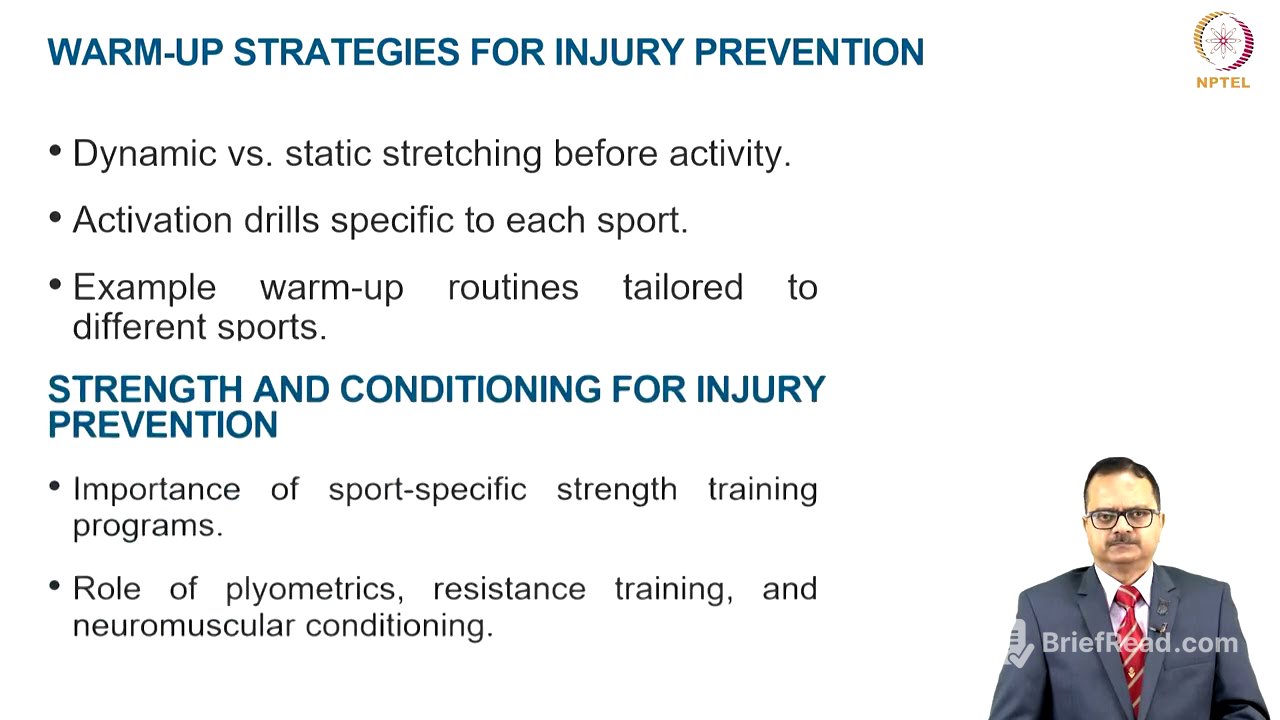
Effective design strategies include dynamic and static stretching, with dynamic stretching typically done before activity and static stretching after. Sport-specific activation drills and warm-up routines, like FIFA 11 plus for football, are important. Strength and conditioning programs, including plyometrics, resistance training, and neuromuscular conditioning, play a crucial role in injury prevention. Flexibility and mobility training are also vital for reducing strain on joints and muscles.
Load Management and Recovery [6:51]
Load management and recovery involve understanding the acute to chronic workload ratio to prevent overuse injuries. Strategies include proper periodization of training load, nutrition, recovery, and de-load weeks. Monitoring tools like GPS trackers and heart rate variability provide insights into an athlete's metabolic and psychological state.
Technique and Skill Development [7:41]
Proper technique and skills are strongly correlated with a reduction in injury risk. Sport-specific drills reinforce correct biomechanics, and coaching and feedback are essential for technique refinement.
Nutrition and Hydration [8:12]
Macronutrients and micronutrients significantly impact injury prevention and recovery. Hydration is crucial for muscle function and preventing cramps. Anti-inflammatory foods and supplements support tissue repair, and nutritional periodization helps prevent injuries.
Psychological Aspects [8:42]
Mental stress and fatigue are related to injury risk. Strategies such as mindfulness, visualization, and goal setting enhance focus and resilience. Sport psychology plays a significant role in athlete education and injury recovery.
Sleep [9:08]
Sleep deprivation increases injury risk. Practicing sleep hygiene strategies, such as limiting screen time before bed and consuming tryptophan-rich drinks, optimizes recovery. Sleep impacts reaction time, cognitive function, and muscle repair.
Protective Equipment [9:51]
Proper protective equipment, including helmets, mouth guards, shin guards, and knee braces, is essential. Tailor-made protective equipment and regular maintenance enhance injury prevention.
Playing Surfaces and Environmental Factors [10:19]
The type of playing surface (synthetic vs. natural) affects injury risk. Environmental factors like temperature, humidity, and altitude should be considered in injury prevention programs. Proper maintenance of the field or court reduces hazards.
Prevention of Overuse Injuries [10:52]
Strategies for preventing common overuse injuries like tendinitis and stress fractures include modifying training loads and recovery periods, incorporating movement variation, and cross-training.
ACL Injury Prevention Protocols [11:18]
ACL injury prevention involves understanding common injury mechanisms and risk factors. Preventive neuromuscular training programs like FIFA 11 plus and PEP program, along with strength, agility, and proprioception training, are crucial and should begin well before the season.
Concussion Prevention Strategies [11:59]
Athletes and coaches should be educated about concussion risks and symptoms. Proper techniques in contact sports reduce head injuries. Baseline concussion testing, such as SCAT 6, helps evaluate the severity of concussions. Return-to-play protocols must be strictly followed.
Recovery Modalities [12:46]
Cryotherapy, compression therapy, active recovery techniques, massage, hydrotherapy, and contrast therapy improve muscle recovery. A periodized recovery program is essential for long-term performance maintenance.
Role of Coaches and Support Staff [13:16]
Coaches and support staff must educate athletes on injury prevention and create a culture of injury awareness and safety. Prevention strategies should be integrated into training programs.
Return to Play Consideration [13:35]
Safe return-to-sport criteria following an injury should be strictly followed. Rehab programs should have gradual progression and reconditioning principles. Athletes must be psychologically ready before returning to play.
Advances in Technology [14:01]
Wearable devices track biomechanical data and injury risk. Artificial intelligence is used for predictive modeling and early injury detection. Virtual reality aids in rehabilitation and movement training.
Challenges [14:27]
Injury prevention should be a key component of long-term athlete success. A multidisciplinary approach involving biomechanics, strength and conditioning, psychology, nutrition, sports medicine, and recovery is crucial. Future innovations should focus on this teamwork approach.
Conclusion [14:58]
Injury prevention is a key component of long-term athletic success. A multidisciplinary approach incorporating biomechanics, strength training, psychology, nutrition, sports medicine, and recovery is very important, and future innovations will focus on injury prevention and athlete safety.