TLDR;
This YouTube video features an interview with Guada, who shares his insights on various topics, including the disconnect between humanity's potential for good and its often brutal reality, the importance of balance in life, the role of education in society, and the impact of technology on knowledge and learning. He also touches on political dynasties in Kenya, the need for economic fairness, and the significance of intellectual property.
- The discussion covers the balance between good and evil in humanity, emphasizing the need for rules and guidance.
- The conversation explores the impact of light, both physical and spiritual, on human behavior and energy levels.
- The interview addresses the issue of political dynasties in Kenya and the importance of economic fairness and equal opportunity.
- The guest advocates for a shift in the education system from knowledge consumption to knowledge production, emphasizing the importance of intellectual property and innovation.
- The discussion touches on the impact of technology, particularly AI, on education and the need to adapt to these changes.
Introduction and Guest's Identity [0:00]
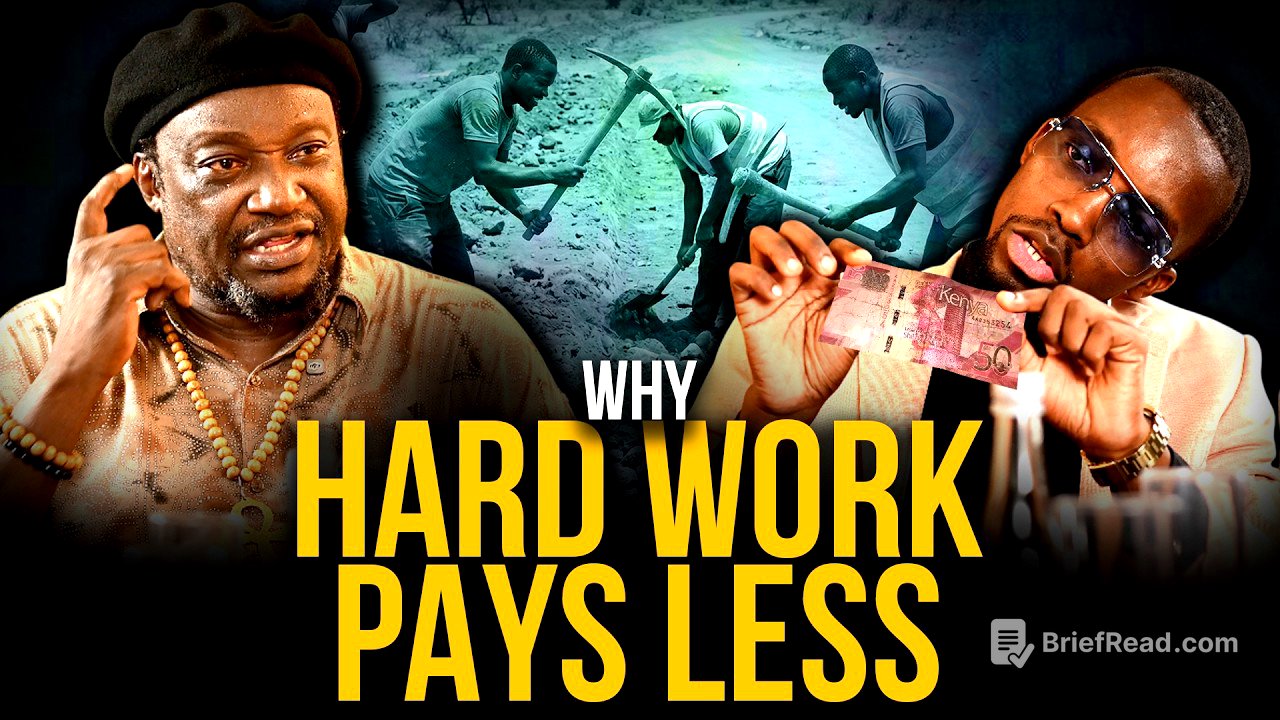
The video starts by highlighting the disparity between hardworking individuals who earn little and a smaller group that earns significantly with minimal effort. The host introduces Guada, whose extensive profile could fill an encyclopedia. Guada identifies with his faith in God, the goodness and kindness of humanity, and the pursuit of knowledge and culture.
Humanity's Duality and the Need for Moral Codes [3:21]
Guada discusses the duality of humanity, acknowledging its capacity for brutality while maintaining that humans are not inherently defective. He emphasizes the importance of moral codes, such as the Ten Commandments, as a guide for ethical behavior. He also points out that human life requires order, guidance, and a map based on values, similar to the binary features found in nature, such as light and darkness, left and right, and good and bad.
The Concept of Balance in Life [6:20]
The conversation shifts to the concept of balance in life, highlighting its importance in various aspects, from physical symmetry to the design of everyday objects like cars and chairs. Guada explains that maintaining a perfect balance is essential to avoid failure and that human beings need rules to abide by because morality is not intrinsic but acquired through interactions and experiences. He emphasizes that individuals are conditioned by their circumstances and environments.
Light and Darkness: Physical and Spiritual Contexts [9:12]
Guada explains the concept of light, distinguishing between incandescent (hot) and luminescent (cold) light, and how they affect human energy levels and behavior. He connects the return of light in the morning to the body's natural awakening processes. He also explores the spiritual context of light and darkness, associating certain animals and people with either the day or the night, suggesting that those active at night are driven by a different context of light and may be more prone to activities like theft and prostitution.
Political Exile and Commentary on Political Dynasties [16:34]
Guada recounts his experience as a political analyst and his subsequent exile in 2009 after making a statement on TV about political dynasties. He explains that he identified a policeman involved in an attempt to abduct him. He describes starting a movement called "111" to promote political consciousness and liberation, aiming to challenge the existing leadership and address the issue of political dynasties controlling access to parliament and government positions.
The Influence of Political Dynasties and the 2002 Elections [19:44]
Guada elaborates on his deduction that a few political dynasties controlled the country's problems by controlling political parties and access to government. He discusses the 2002 elections, where Mwai Kibaki, not from a prominent dynasty, became president due to a rebellion against the proposed heir, Uhuru Kenyatta. Kibaki was seen as a compromise candidate who could balance revolution and the status quo, making him acceptable across the board.
Dynasties vs. Hustlers and the Polarization of Elections [23:37]
The conversation shifts to the "dynasties versus hustlers" rhetoric used in elections, which Guada sees as a form of polarization to create a referendum within an election. He explains that elections often require a polarizing issue to mobilize voters, such as the legalization of cannabis in a recent election. He notes that the "hustlers" were meant to represent those outside the dynastic lineages, and his mentioning of these lineages was seen as a threat because it exposed the extent of their control and influence in the country.
Economic Disparities and the Need for a Balanced Society [26:56]
Guada shares his background as the son of civil servants, contrasting it with the opulence associated with political dynasties. He highlights the economic disparities in Kenya, where some people work hard for very little while others earn significantly with minimal effort. He advocates for a more balanced society where the gap between the rich and poor is bridged, and earnings are based on fairness rather than colonial-era structures. He criticizes the high salaries of parastatal MDs compared to the low wages of clerks and calls for a fairer system of remuneration.
Addressing Economic Inequality and the Role of Education [30:47]
Guada discusses how to close the economic gap without taking from others, emphasizing that leadership should provide better conditions for everyone. He points out that the equality of a society is judged by how it treats the weak and disadvantaged. He argues that the education system is faulty because it focuses on consuming processed knowledge rather than producing new knowledge. He proposes shifting the focus to knowledge production, where individuals are encouraged to create and innovate.
Shifting the Focus to Knowledge Production and Intellectual Property [35:07]
Guada advocates for changing the education system to prioritize knowledge production over consumption. He suggests that schools should focus on generating patents and copyrights, which would bring value to the community and improve the local economy. He criticizes the current system for stifling creativity and innovation, noting that many graduates struggle to find jobs because they lack practical skills. He emphasizes that anyone, regardless of their education level, can generate valuable ideas and that schools should have copyright desks to register and develop these ideas.
The Colonial Education System and the Importance of Innovation [40:18]
Guada argues that the colonial education system was designed to create people who would manage colonial enterprises, stifling the intellectual growth of Kenyans. He believes that Kenyans have a high intellect and should be encouraged to innovate. He suggests that schools should promote the production of writing and publication, so that students have reference points to their work. He also notes that the current system reinforces cultural dominance from the West, and Kenya should focus on promoting its own knowledge and culture.
The Impact of Technology and the Need for Deep Work [1:09:23]
Guada discusses the impact of technology, particularly the computer age and AI, on education. He notes that the computer network has liberalized knowledge, making it readily available, but it has also diluted the value of traditional education. He argues that AI can be a valuable tool for research and information gathering but emphasizes the importance of deep work and original thought. He suggests that there will be a distinction between AI-edited and non-AI-edited work, with value placed on handwritten and deeply researched material.
Financial Literacy, Economic Empowerment, and Bridging the Gap [1:21:57]
Guada emphasizes the importance of bridging the gap between the rich and poor in Kenya, a highly polarized society. He notes that the class divide left by colonialism still defines social life. He advocates for leadership that provides better conditions for everyone and criticizes the requirement of a university degree for leadership positions, which he sees as elitist. He commends the host for his work in promoting financial literacy and economic empowerment.
The Universal Theory of Circumcision and Challenging Convention [1:25:08]
Guada introduces his universal theory of circumcision, which posits that it is based on access to fresh water rather than tradition or transition. He argues that communities with limited access to fresh water practice circumcision as an adaptation to prevent infections, while those with abundant fresh water do not need it. He challenges the conventional understanding of circumcision and emphasizes the importance of challenging convention and placing new ideas on the table for discussion. He concludes by stating that Kenya should leverage its best minds to compete globally and interpret the world through its own eyes.