TLDR;
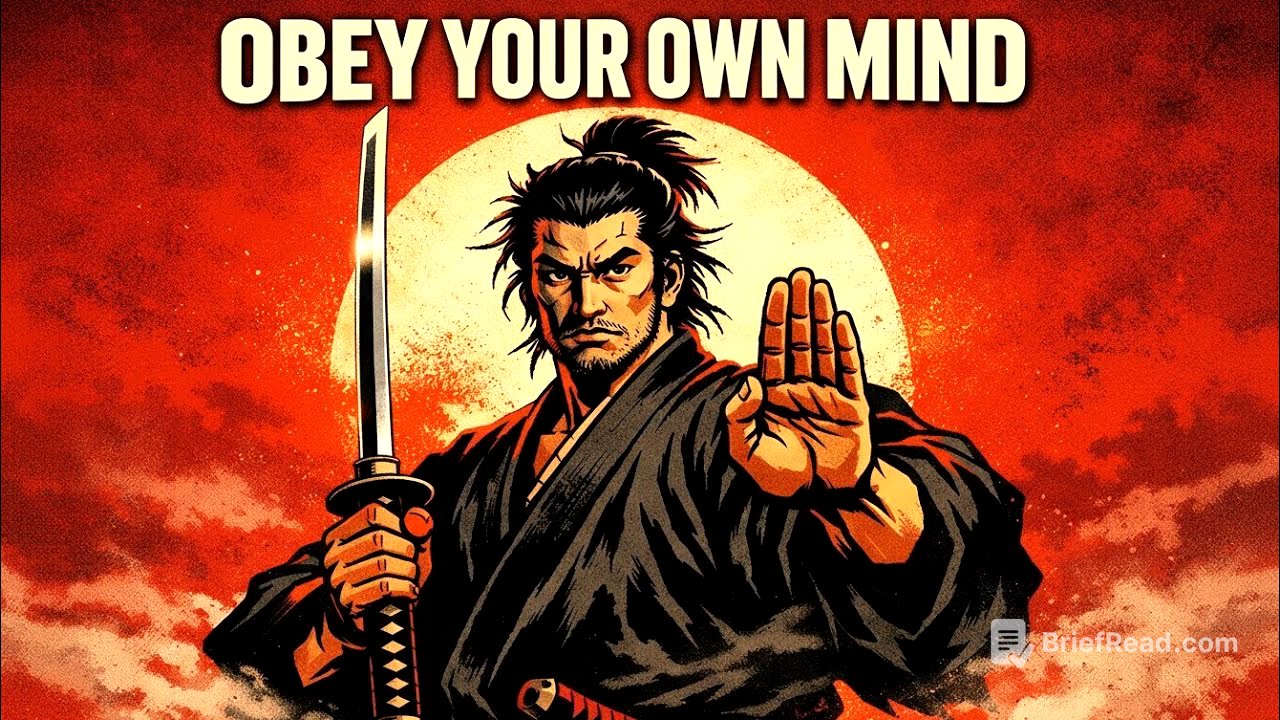
This video explores the concept of mental discipline through the lens of Miyamoto Musashi's philosophy, emphasizing the importance of training the mind to obey without hesitation. It challenges the common reliance on motivation and willpower, instead advocating for immediate action, simplicity, repetition, and emotional detachment to condition the mind for obedience. The video concludes with a call to action, urging viewers to prove their commitment by completing a task immediately and reinforcing the idea that consistent obedience leads to self-mastery and an unstoppable will.
- Train your mind to obey instantly, not eventually.
- Act the moment you decide, cutting out unnecessary thoughts.
- Condition obedience through repetition.
- Don't let emotion decide your actions.
Introduction: The War Within [0:00]
Many people struggle with a mind that doesn't obey, leading to a constant battle against themselves. They know what they should do but fail to execute, craving discipline and control yet being governed by their own thoughts and emotions. This internal conflict is not mere laziness but a deeper issue of a mind that has not been properly trained. The key is to recognize that the mind is untrained, not broken, and reconditioning it is essential for change.
The Untrained Mind [1:39]
People often start the day with intentions and goals, but something breaks down between knowing and doing, leading to hesitation and distraction. This cycle repeats, fostering the belief that discipline is unattainable and that the mind will never truly listen. The truth is that the mind is not inherently flawed but rather untrained. Every instance of hesitation or delay reinforces the mind's resistance and weakens one's authority.
Miyamoto Musashi's Philosophy [3:30]
Miyamoto Musashi, a philosopher of self-mastery, understood the importance of training the mind to obey instantly. His approach to discipline was not based on inspiration but on conditioning the mind for immediate obedience. Musashi emphasized thinking lightly of oneself and deeply of the world, acting without internal negotiation and viewing hesitation as weakness. He saw the mind as a tool, not an advisor, and believed that warriors control their fate by controlling their minds.
Principle 1: Act Immediately [6:48]
The first principle is to act the moment you decide, without delay or overthinking. The gap between decision and action is where the mind resists, throwing doubt and excuses. By acting immediately, you train obedience, teaching your mind that resistance is pointless and that action will follow regardless. This builds warriors through repetition of immediate action, not motivation.
Principle 2: Cut the Unnecessary [9:10]
The second principle involves simplifying decisions by focusing on what is necessary in the moment. Overthinking and analyzing options lead to paralysis and missed opportunities. By asking "What must be done right now?" instead of seeking the optimal or perfect solution, you remove the space for hesitation and enable decisive action. Warriors move faster than thinkers because they've trained themselves to see clearly and act decisively, focusing on what is rather than what-ifs.
Principle 3: Condition Through Repetition [11:29]
Obedience is conditioned through repetition. Miyamoto Musashi became a master swordsman by repeatedly swinging his sword until the movement became instinct. Discipline is not about forcing oneself to do hard things but about making hard things automatic through relentless repetition. Each immediate action reinforces the pattern, conditioning the mind to trust decisions and deepening obedience.
Principle 4: Do Not Let Emotion Decide [14:02]
The fourth principle emphasizes acting independently of emotion. Discipline is doing what must be done even when you feel nothing, regardless of tiredness or fear. Emotions are not consistent, and waiting for the right feeling leads to stagnation. Act based on what is necessary, not on how you feel, breaking free from emotional dependency and creating a rule where feelings are irrelevant and decisions are final.
The Striking Moment [16:26]
The moment between intention and action is the internal battlefield where discipline is either born or destroyed. Hesitation allows doubt to creep in and the mind to take control. Warriors eliminate this pause, acting without negotiation. Every day presents numerous small battles where you either train obedience or resistance. The mind is always watching, learning from each hesitation or immediate action, and adapting accordingly.
Reversing the Pattern [21:58]
To reverse the pattern of resistance, start small and immediately. Make a clear, specific decision and act on it without waiting for motivation. Collapse the time between decision and action to minimize resistance. Repeat this process daily without exception, reconditioning the mind through repetition. Focus on obedience rather than outcome, measuring success by whether you did what you said you'd do.
Discipline as Identity [25:16]
Discipline is not a skill but an identity. Stop seeing yourself as someone who struggles with consistency and start seeing yourself as someone whose mind obeys. This shift in identity changes everything, leading to immediate action and consistent follow-through.
The Final Test: Application [26:09]
The final principle emphasizes the importance of application over mere understanding. Knowing principles means nothing without action. The real test is in the moment of combat, where hesitation means death. Act immediately without hesitation to prove that your mind obeys you.
The Warrior's Task [29:22]
As a final task, viewers are challenged to decide on one simple action they've been putting off and complete it within the next 10 minutes. Then, they must return to the comments and type "I act without delay" to signify their commitment. This small act of follow-through is the first step in reconditioning the relationship with discipline.
Victory Over Self [31:09]
Miyamoto Musashi lived by the truth that today is victory over the self of yesterday. Measure success by whether you obeyed yourself, acted when you decided to act, and moved forward despite resistance. Winning the battle against yourself leads to strength, clarity, and purpose, aligning the mind and making you unstoppable.



![इतना शानदार स्टोरेज सिस्टम है हमारी याददाश्त [Memory: Our Storage System] | DW Documentary हिन्दी](https://wm-img.halpindev.com/p-briefread_c-10_b-10/urlb/aHR0cDovL2ltZy55b3V0dWJlLmNvbS92aS9RSmNyZU91SFRNNC9ocWRlZmF1bHQuanBn.jpg)