TLDR;
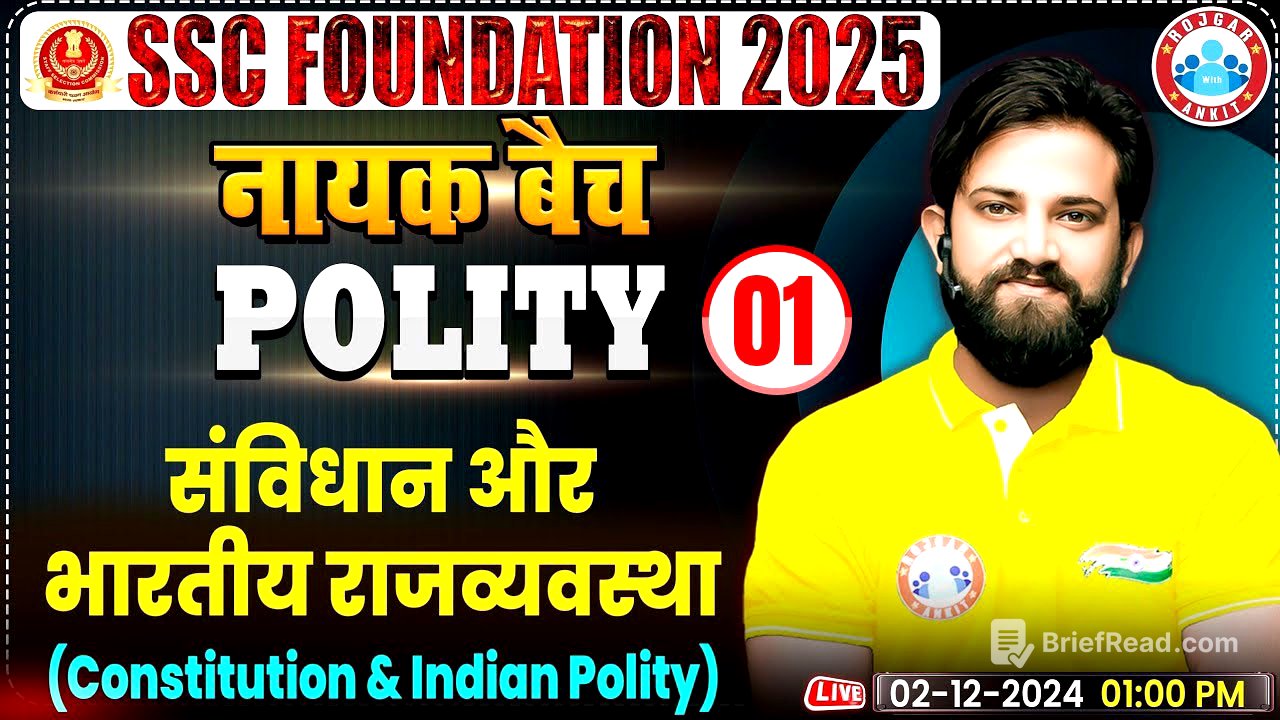
This video introduces a comprehensive polity course designed for SSC exams, outlining the topics to be covered, the approach to teaching, and the resources available for students. It emphasizes understanding the constitution and governance, the historical development of the Indian constitution, and the roles and functions of various constitutional and non-constitutional bodies. The course aims to build a clear understanding of the Indian political system, ensuring that students are well-prepared for their exams.
- Course introduction and objectives
- Detailed syllabus overview
- Explanation of constitutional and non-constitutional bodies
- Emphasis on conceptual clarity and practical application
Introduction [0:08]
The instructor welcomes the students and expresses hope for their well-being and success. He emphasizes the importance of dedication and the potential for positive change through education. The session marks the beginning of the polity subject, with a promise to make the learning experience engaging and accessible.
Course Overview and Strategy [1:37]
The instructor refers to a previous video, "GS strategy nayak foundation batch," which details how the course will be conducted, including information on note-taking and resource availability. The current class focuses on understanding the constitution and Indian governance, with future sessions planned to explore the structure of India's governance system, including whether it is unitary, federal, or quasi-federal.
Syllabus and Topics [3:42]
The polity course will cover approximately 40 topics in 35 to 45 classes. Key topics include the Constitution and Polity, the constitutional development of India from the 1600s through various reforms (such as the Charter Acts, Morley-Minto Reforms, and Montagu-Chelmsford Reforms), and the Government of India Act of 1935. The course will also cover the August Offer, Cripps Mission, Cabinet Mission, Mountbatten Plan, and the Simla Conference.
Constitution Assembly and Sources [5:39]
The course will discuss the composition of the Constituent Assembly, the individuals involved, and their specific roles. It will also explore the sources of the Indian Constitution, noting that it was developed after studying the constitutions of about 60 countries, with significant influences from about 10 major countries.
Key Constitutional Components [6:19]
The curriculum includes a detailed study of the schedules of the Constitution, the reorganization of states, citizenship (including amendments to the Citizenship Act of 1955), Directive Principles of State Policy (DPSP), Fundamental Duties, the President (including powers), the Vice President, the Prime Minister and Council of Ministers, the Attorney General, and Parliament.
Parliamentary Procedures and Federal Structure [7:17]
The course will cover parliamentary procedures, including sessions, question formats, and various types of proposals. It will also address the Consolidated Fund of India, the Comptroller and Auditor General (CAG), Governors, State Legislatures, High Courts, Public Service Commissions, official languages, and important constitutional amendments.
Classroom Etiquette and Expectations [8:33]
The instructor asks students to confirm their readiness to learn and emphasizes the importance of patience and a systematic approach to understanding the material. He advises against rushing through the content and encourages attentive listening.
Starting with Constitution and Polity [9:59]
The instructor requests students to turn off the comment section to focus and take notes. The class begins with an explanation of the terms "Constitution" and "Polity."
Understanding the Constitution [10:39]
The term "Constitution" is broken down into "Sam" (equal) and "Vidhan" (law), meaning equal laws for all citizens in a nation. The instructor uses the example of internet access to illustrate that while rights are generally equal, they can be restricted in specific circumstances, such as during riots.
Defining the Constitution [13:42]
The definition of the Constitution is presented as a collection of rules and laws necessary for governing a country. Governance is explained as the system and arrangements made by a ruler or authority to manage the state, ensuring order and functionality.
Understanding Polity [17:35]
Polity is defined as the system needed to implement the Constitution. While the Constitution exists in a book form, it requires a mechanism to be put into practice. For example, Article 17 of the Constitution abolishes untouchability, but it requires a system (the Polity) to enforce this abolition.
Article 17 and Civil Rights Protection Act [20:02]
Article 17, which abolishes untouchability, is part of the Constitution. The Civil Rights Protection Act of 1955 is an example of Polity, providing punishment for those who do not follow the constitutional provision. This act specifies imprisonment and fines for practicing untouchability, with courts responsible for administering these punishments.
Examples of Constitution and Polity [28:02]
The instructor provides additional examples, such as the right to love marriage and the right to sleep, to further illustrate the difference between the Constitution and Polity. He explains that while the Constitution grants these rights, the Polity (laws and systems) ensures they can be exercised and protected.
Components of Polity [33:04]
The instructor identifies three key components for running a Polity: lawmaking (Parliament), justice (Judiciary), and extra-constitutional bodies.
Types of Institutions [35:36]
The instructor explains that institutions in a country can be divided into three types: constitutional, non-constitutional, and extra-constitutional.
Constitutional Bodies [36:57]
Constitutional bodies are those mentioned and described in the Constitution, such as the Finance Commission (mentioned in Article 280) and the Election Commission (mentioned in Articles 324-329).
Non-Constitutional Bodies [38:46]
Non-constitutional bodies are those that violate the Constitution. Examples include terrorist organizations, Maoist organizations, and Naxalite organizations.
Terrorist and Maoist Organizations [40:20]
Terrorist organizations aim to promote terror, while Maoist organizations follow the ideology of Mao Zedong, who believed that political power comes from the barrel of a gun. Maoists advocate for the use of force to uplift depressed classes.
Naxalite Organizations and UAPA Act [44:57]
Naxalism originated in 1967 in West Bengal, led by Charu Majumdar and Kanu Sanyal. It began as a movement by farmers against landlords to protect their interests. The government uses acts like the Unlawful Activities Prevention Act (UAPA) of 1967 to curb Naxalite activities. Section 3 of the UAPA allows the government to ban organizations involved in unlawful activities.
Extra-Constitutional Bodies [52:07]
Extra-constitutional bodies are not mentioned in the Constitution but help in implementing it. These bodies are established in two ways: through executive action (by the President on the advice of the Council of Ministers) or through statutory action (by Parliament).
Executive and Statutory Bodies [54:11]
An example of an executive body is NITI Aayog, which was formed in 2015 to replace the Planning Commission. Statutory bodies are created by laws passed in Parliament.
Examples of Statutory Bodies [59:19]
Examples of statutory bodies include the National Human Rights Commission (NHRC) established in 1993, the Central Information Commission (CIC) established in 2005 under the Right to Information Act, and the National Commission for Women (NCW) established in 1990.
Need for a Constitution [1:03:00]
The instructor addresses the question of why a constitution is necessary. He explains that even after India's independence in 1947, a constitution was needed to establish rules and systems for governing the diverse population.
Importance of Rules and Laws [1:03:54]
Rules and laws are essential to ensure that diverse groups can coexist peacefully. These rules must be followed by everyone, and there must be punishments for non-compliance.
Democracy vs. Monarchy [1:06:53]
In a monarchy, the ruler makes the rules, whereas in a democracy, the people make the rules through elected representatives. These representatives are responsible for considering the interests of the public.
Functions of a Constitution [1:09:28]
The first function of a constitution is to ensure that rules are in place and followed. The second function is to specify who has the power to make decisions in society and how governments are formed. The third function is to set limits on the power of the government to protect the rights of individuals.
Limits on Government Power [1:15:20]
The constitution imposes limits on government power to prevent the violation of individual rights. Fundamental rights must be clearly defined to prevent government overreach.
Emergency Provisions and Article 20 and 21 [1:18:03]
During emergencies, certain rights can be suspended, but Article 20 (protection in respect of conviction for offenses) and Article 21 (protection of life and personal liberty) remain in effect. These provisions ensure that individuals are protected from double jeopardy and have the right to life.
Just and Fair Society [1:21:59]
The constitution aims to create a just and fair society. The instructor provides examples, such as the Indonesian constitution's provision for the care of the poor and orphans, and Indian court cases that highlight the need for justice for all.
Examples of Injustice and Court Interventions [1:22:45]
The instructor discusses the 1982 ASEAN Games case, where laborers were underpaid, and the court intervened to ensure they received fair wages. He also mentions the Machal Lalung case from Assam, where a man was unjustly imprisoned for 54 years, highlighting the practical challenges in ensuring equal justice for all, especially the poor.
Written vs. Unwritten Constitutions [1:27:08]
The instructor notes that most countries have written constitutions. The next class will discuss the characteristics of the Indian Constitution.
Conclusion and Resources [1:27:43]
The instructor concludes the session, emphasizing that the class will continue to build on these foundational concepts. He directs students to the Rojgar With Ankit application for PDF notes, including handwritten bilingual notes, and expresses gratitude for their participation.