TLDR;
This video explains blood disorders such as Thalassemia, and blood group systems, focusing on the ABO and Rh systems. It describes how blood is classified into different groups based on the presence or absence of certain antigens and antibodies. The video also touches on the importance of blood transfusions, the process of cross-matching, and the concepts of universal donors and recipients.
- Thalassemia and its causes and treatments
- ABO and Rh blood group systems
- Blood transfusions and cross-matching
- Universal donors and recipients
Introduction to Blood Disorders: Thalassemia [0:28]
The lecture discusses blood disorders, specifically focusing on Thalassemia. Thalassemia is a genetic blood disease caused by mutations in the genes responsible for producing hemoglobin. These mutations lead to the production of abnormal hemoglobin, resulting in a deficiency of oxygen in the blood and the destruction of red blood cells. This condition, also known as Cooley's anemia, was first observed by scientist Thomas Cooley. Treatment options are limited, with bone marrow transplant being the most effective. Regular blood transfusions are necessary for survival if a transplant is not possible.
ABO Blood Group System: Classification and Antigens [2:52]
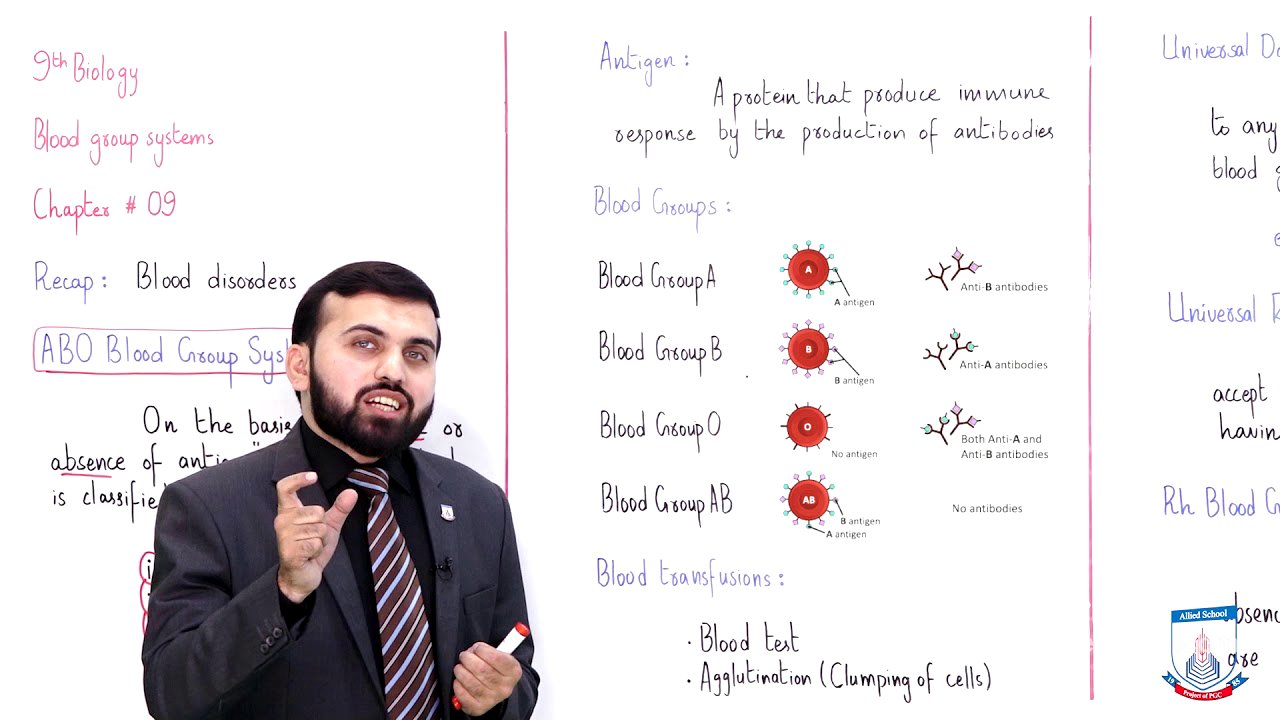
There are 29 blood group systems recognized by the International Society for Blood Transfusion. The lecture focuses on two main systems: the ABO and Rh blood group systems. The ABO system classifies blood into four groups: A, B, O, and AB, based on the presence of antigens A and B on the surface of red blood cells. Antigens are proteins that trigger an immune response, leading to the production of antibodies. Antibodies are produced by white blood cells and help fight against foreign substances.
Understanding Antigens and Blood Group Types [5:20]
Antigens are proteins that stimulate an immune response by producing antibodies. There are two types of antigens: A and B. Blood group A develops when antigen A is present on red blood cells, leading to the production of anti-B antibodies. Blood group B develops when antigen B is present, resulting in anti-A antibodies. Blood group O develops when neither antigen A nor B is present, leading to the production of both anti-A and anti-B antibodies. Blood group AB develops when both antigens A and B are present, and no antibodies are produced.
Blood Transfusion: Process and Importance [6:53]
Blood transfusion is a life-saving process where blood is donated to someone who has lost blood due to injury, surgery, or illness. Before a transfusion, a blood test is crucial to ensure the donor's blood is free from infections and compatible with the recipient's blood group. Cross-matching is performed to confirm compatibility. If blood is transfused without proper matching, the recipient's body may recognize the foreign blood as an invader, leading to the production of antibodies and agglutination (clumping) of cells.
Universal Donors and Recipients in ABO System [9:28]
Individuals with blood group A can receive blood from blood group A. Similarly, those with blood group B can receive blood from blood group B. Blood group O is considered the universal donor because it can be donated to anyone, as it lacks antigens. Blood group AB is the universal recipient because it can receive blood from any blood group, as it has no antibodies.
Rh Blood Group System: Positive and Negative Types [11:48]
The Rh blood group system, discovered by Karl Landsteiner in 1930, is based on the presence of the Rh factor (or Rh antigen) found in Rhesus monkeys. Blood is classified as Rh positive if the Rh antigen is present and Rh negative if it is absent.
Rh Factor in Blood Transfusion and Potential Risks [13:07]
Blood transfusion involves transferring blood from one person to another and is a life-saving procedure needed in cases of injury, surgery, or blood disorders like blood cancer or thalassemia. In the Rh system, Rh-positive blood can be donated to Rh-positive recipients. Rh-negative blood can be donated to Rh-negative recipients. Rh-negative blood can be transferred to Rh-positive recipients only if the donor's blood has never been exposed to the Rh antigen and does not contain any Rh antibodies. Blood must be tested for infectious diseases like AIDS and hepatitis B and C to prevent transmission to the recipient.