TLDR;
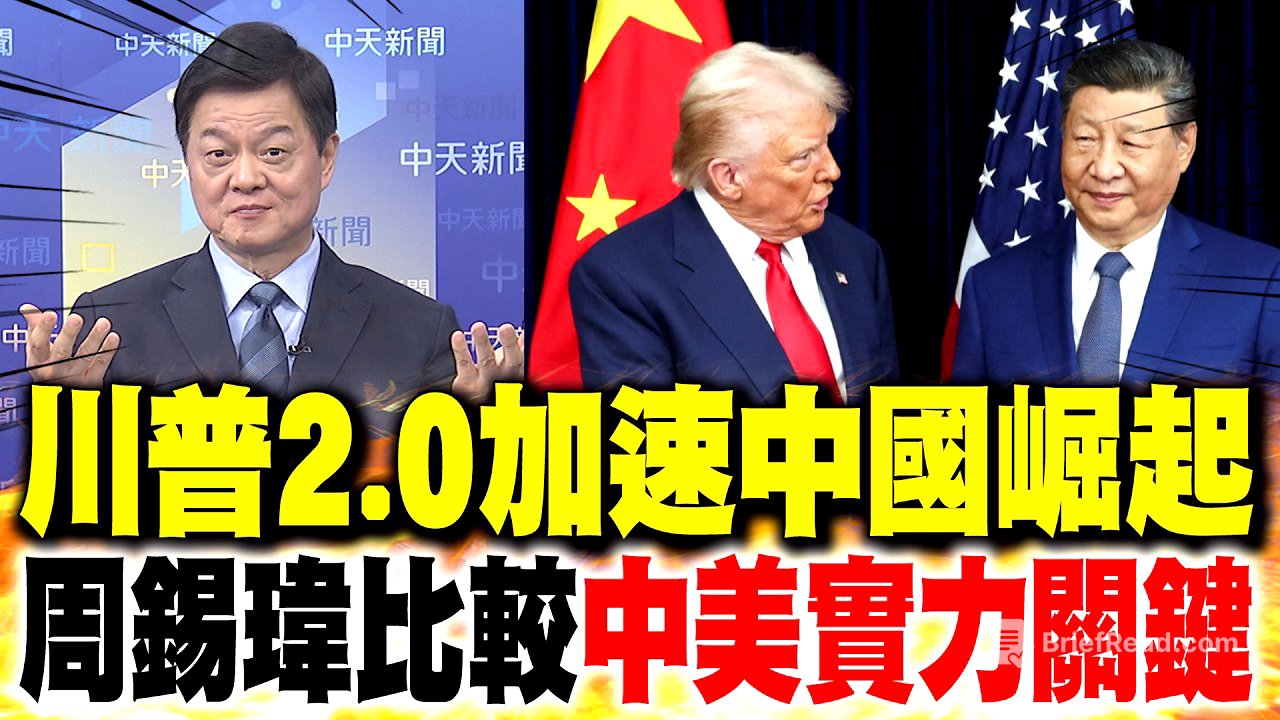
This video discusses the shifting global power dynamics, particularly focusing on the decline of U.S. hegemony and the potential rise of China. It examines the reasons behind China's growing influence, including its economic strength and strategic decisions, while also addressing the challenges and criticisms faced by both nations. The video emphasizes the importance of understanding these changes and advocating for peace and cooperation in the international arena.
- The decline of U.S. hegemony and the potential rise of China.
- China's economic strength and strategic decisions.
- The importance of peace and cooperation in the international arena.
Economic Observer's Perspective [0:00]
The Economist magazine cover suggests that when an enemy makes a mistake, one should not interrupt them. CTV created an AI animation depicting Iran's perspective on U.S. foreign policy, portraying the U.S. as a warmongering, declining power, while China is depicted as a stable, peaceful, and rising nation through the Belt and Road Initiative. A senior researcher from the International Crisis Group notes a real shift in confidence and negotiation stances between Washington and Beijing. The Trump administration overestimated the impact of tariffs on China and underestimated China's ability to retaliate.
Trump's Claims vs. Reality [0:21]
Trump claimed that China would buy large quantities of soybeans from the U.S., but data shows that as of June 2026, China had only purchased and shipped 10.8 million tons, with an additional 2.19 million tons sold to an unknown country. The trade war and tariffs have created significant problems. China has prepared for this situation by securing mineral resources like rare earths, which are crucial for U.S. military equipment such as Tomahawk missiles. Replenishing the U.S.'s stockpile of these missiles would take five years, while China controls the key rare earth mineral resources.
Reasons for China's Rise [2:04]
It's an oversimplification to attribute China's rise solely to the U.S.'s mistakes or weakening. A more accurate assessment includes the fact that China has made correct decisions and grown stronger. The discussion shifts to whether the Renminbi (RMB) will replace the U.S. dollar as the dominant global currency.
RMB as a Global Currency [2:32]
China is the world's largest trading nation, and while the U.S. currently has the largest market, China's 1.4 billion population suggests it will become the largest market as it prospers. Using RMB for trade with China would be more direct. China is also the world's largest exporter. If countries use RMB to settle trade with China, China could also use RMB for construction and assistance projects in those countries. The RMB could become as strong as the U.S. dollar.
Challengers to the U.S. Dollar [3:56]
The U.S. uses the dollar to impose economic sanctions, like those against Iran, which restricts their trade. Many countries under economic sanctions would prefer to use their own currency or the RMB, as China does not impose such sanctions. The U.S. manipulates the dollar's value, causing losses for countries holding U.S. dollar reserves. The U.S. ties the dollar to oil, requiring Middle Eastern countries to buy U.S. debt with their dollar earnings. Some countries question why they should buy U.S. debt, especially with the U.S. national debt at $39 trillion, if the U.S. cannot protect their security. The U.S. dollar faces significant challenges due to its use as a tool for control and sanctions.
Trump's Trade Policies and Global Trade [5:40]
Trump's reciprocal tariffs have made countries realize the U.S. market is unreliable. As a result, countries are signing trade agreements with each other, excluding the U.S., and using their own currencies for trade. The U.S. dollar's dominance is expected to weaken. China does not point out U.S. mistakes to take advantage, but because the U.S. has unfairly suppressed China through sanctions, intellectual property exploitation, and exclusion from technological advancements.
China's Perspective on U.S. Actions [6:20]
The U.S. has unfairly attacked and suppressed China in areas like space, aviation, and chip manufacturing. China has no obligation to advise the U.S. when it makes mistakes. China's strength is not solely due to U.S. decline; it is due to China's own efforts to avoid foreign aggression and protect its people. China aims to build a strong military for self-defense and to pursue a path of peace.
Critiques of U.S. Foreign Policy [8:58]
The U.S. often accuses China of being aggressive, but this label better applies to the U.S., which has initiated numerous wars and imposed unfair tariffs for its own economic gain. The U.S. accuses China of being an invader, but the U.S. has invaded many countries. The U.S. criticizes China for unilaterally disrupting the status quo, but the U.S. itself has disrupted the status quo through tariffs, economic sanctions, and wars. European countries are realizing that following the U.S. could make them aggressors, invaders, and rule-breakers.
Call for Peace and Clear Judgement [10:30]
The speaker emphasizes the importance of recognizing the true realities of the world and not being misled by biased narratives. As a Chinese person, it's important to maintain integrity and strive for peace rather than pursuing or participating in war. The speaker advocates for maintaining a clear mind and working towards peace.
KS Advertisement [11:50]
The video concludes with an advertisement for KS beauty products, promoting their ability to maintain optimal skin condition and radiance.