TLDR;
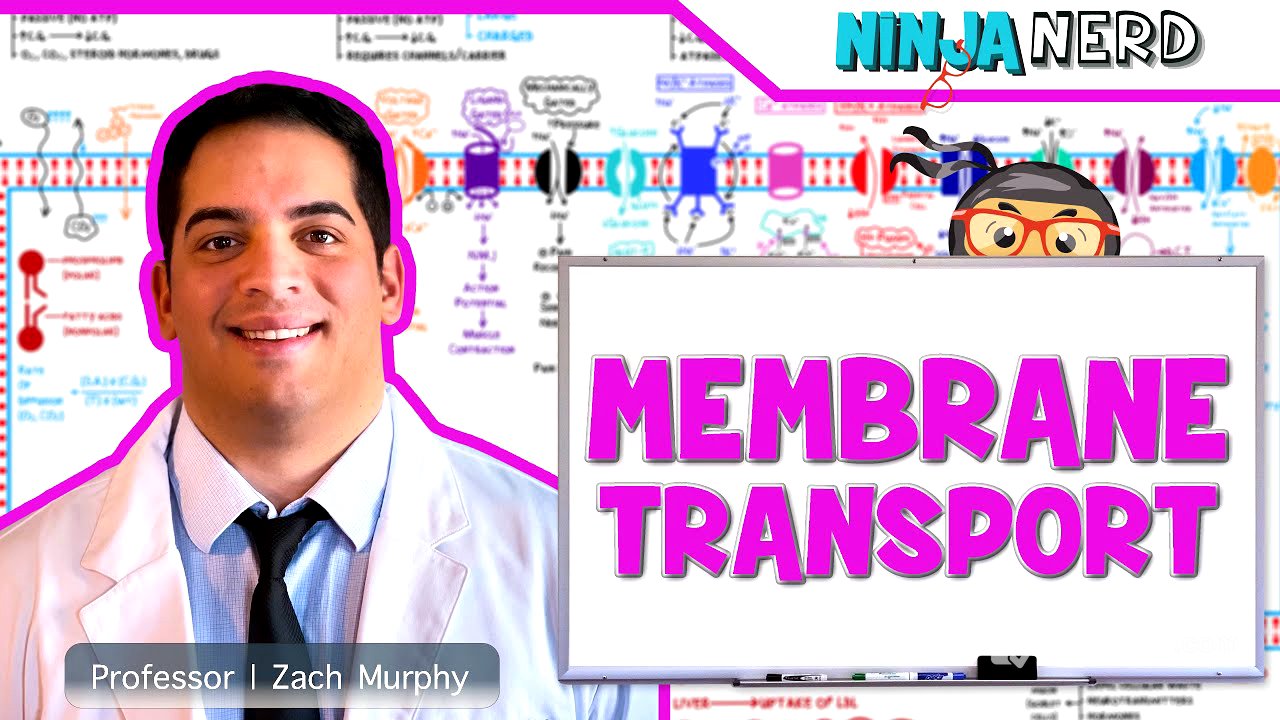
This video by Ninja Nerd provides a comprehensive overview of membrane transport mechanisms, including simple diffusion, facilitated diffusion (osmosis, channel-mediated, and carrier-mediated), primary active transport (sodium-potassium pump, calcium pump, and proton pump), secondary active transport (symport and antiport), and vesicular transport (pinocytosis, phagocytosis, and receptor-mediated endocytosis). It explains the underlying principles, requirements, and clinical relevance of each mechanism.
- Simple diffusion involves the movement of small, nonpolar molecules across the cell membrane down their concentration gradient without the need for transport proteins.
- Facilitated diffusion requires channel or carrier proteins to assist the movement of large or charged molecules across the cell membrane down their concentration gradient.
- Active transport mechanisms, including primary and secondary active transport, require energy (ATP) to move molecules against their concentration gradients.
- Vesicular transport involves the movement of large molecules or particles into or out of the cell via vesicles.
Lab [0:00]
The video introduces the topic of membrane transport, emphasizing the various mechanisms involved. It encourages viewers to like, comment, and subscribe to the channel, as well as check out the links to the channel's social media accounts in the description box.
Simple Diffusion [0:31]
Simple diffusion is a passive process that doesn't require energy (ATP). It allows molecules to move from areas of high concentration to areas of low concentration through the cell membrane. Examples of molecules that move via simple diffusion include respiratory gases (oxygen and carbon dioxide), steroid hormones (testosterone, estrogen, progesterone, aldosterone, cortisol, vitamin D), and lipid-soluble drugs. The cell membrane's phospholipid bilayer, with its polar heads and nonpolar fatty acid tails, prevents charged molecules from crossing. The rate of diffusion depends on surface area, concentration gradient, membrane thickness, and molecular weight.
Facilitated Diffusion [10:37]
Facilitated diffusion is also a passive process, generally not requiring ATP, where molecules move from high to low concentration with the help of transport proteins (channels or carriers). Osmosis, the movement of water from high to low concentration or from low to high solute concentration, is a type of facilitated diffusion mediated by aquaporins. Other types of facilitated diffusion include channel-mediated transport involving leaky channels (e.g., potassium channels in neurons), voltage-gated channels (e.g., sodium or calcium channels for action potentials), ligand-gated channels (e.g., acetylcholine receptors at the neuromuscular junction), and mechanically gated channels (e.g., pain receptors). Carrier-mediated facilitated diffusion involves carriers like GLUT4 transporters, which are regulated by insulin to transport glucose into adipose and muscle tissues.
Primary Active Transport [26:46]
Primary active transport directly uses ATP to move substances from low to high concentration, against their concentration gradient. This process involves ATPases, enzymes that break down ATP to release energy. Examples include the sodium-potassium ATPase, which pumps three sodium ions out of the cell and two potassium ions into the cell; calcium ATPases, which pump calcium ions into the sarcoplasmic reticulum during muscle relaxation; and proton pumps, which pump protons into the stomach lumen. Insulin and thyroid hormone (T3, T4) can increase the activity of the sodium-potassium ATPase, while digoxin inhibits it.
Secondary Active Transport [39:57]
Secondary active transport indirectly uses ATP, relying on the concentration gradient created by primary active transport. One molecule (e.g., sodium) moves down its concentration gradient, while another molecule (e.g., glucose) moves against its concentration gradient. Symport involves both molecules moving in the same direction, while antiport involves them moving in opposite directions. Examples include the sodium-glucose co-transporter (SGLT2) in the kidneys, which is targeted by SGLT2 inhibitors to treat diabetes; the sodium-potassium-2-chloride symporter in the loop of Henle, which is inhibited by loop diuretics like furosemide; the sodium-proton pump in the distal convoluted tubule, which is affected by aldosterone levels; and the sodium-calcium exchanger in cardiac muscle, which is influenced by digoxin.
Vesicular Transport [57:09]
Vesicular transport involves endocytosis (taking substances into the cell) and exocytosis (releasing substances out of the cell).
Pinocytosis [57:42]
Pinocytosis, or "cell drinking," involves the cell creating an invagination to take in water and dissolved solutes. The invagination buds off into the cell, forming a pinocytic vesicle, which is transported deeper into the cell by kinesins and dyneins along microtubules. This process is ATP-dependent (primary active transport) and is important in the intestines for sampling water and solutes.
Phagocytosis [1:01:15]
Phagocytosis, or "cell eating," is prominent in white blood cells like neutrophils and macrophages. The cell uses actin-powered pseudopods to engulf pathogens, forming a phagosome. The phagosome is acidified via proton pumps (ATP-dependent) and then combines with a lysosome to form a phagolysosome, where lysosomal enzymes break down the pathogen. The remaining components are expelled via exocytosis.
Receptor-Mediated Endocytosis [1:07:44]
Receptor-mediated endocytosis involves specific receptors on the cell surface binding to ligands, such as LDL receptors binding to LDL in liver cells. Clathrin proteins then coat the membrane, forming a clathrin-coated pit, which invaginates and buds off into the cell as an endosome. Protons are pumped into the endosome (ATP-dependent), weakening the bond between the receptor and ligand. The receptors are recycled back to the cell membrane, while the endosome fuses with a lysosome to break down the ligand. Disruptions in this process can lead to familial hypercholesterolemia.
Exocytosis [1:15:29]
Exocytosis is the process of expelling substances out of the cell. It is responsible for expelling cellular waste and releasing neurotransmitters, hormones, and mucin. The process involves transcription of DNA into mRNA, translation of mRNA into proteins at the rough endoplasmic reticulum, modification of proteins in the Golgi apparatus, and packaging of proteins into vesicles. The vesicles are transported to the cell membrane by kinesins and dyneins along microtubules (ATP-dependent). V-snares on the vesicle interact with t-snares on the cell membrane, causing the vesicle to fuse with the cell membrane and release its contents. This process is calcium-dependent.
Comment, Like, SUBSCRIBE! [1:22:47]
The video concludes by summarizing the membrane transport mechanisms discussed and encouraging viewers to like, comment, and subscribe.