TLDR;
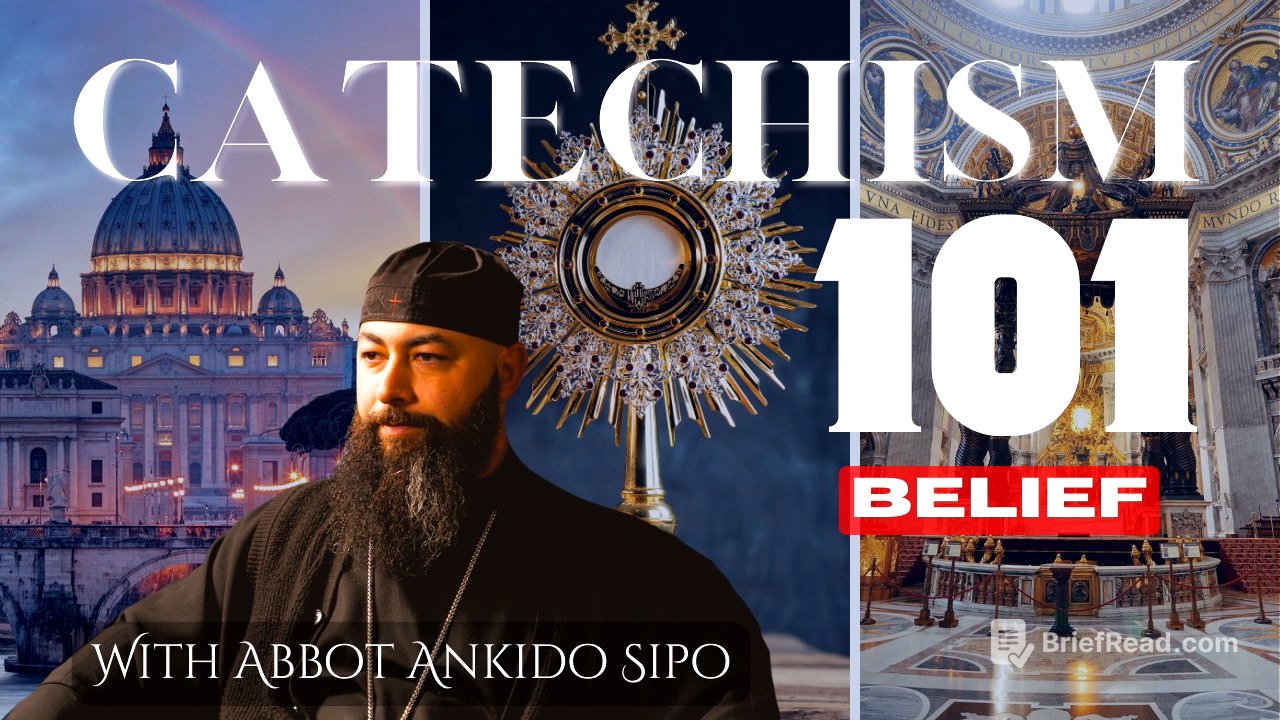
This video provides a detailed explanation of the Nicene Creed, focusing on the phrase "We believe in one God, the Father Almighty." It explores the meaning of "belief" in the context of the Creed, contrasting it with modern interpretations of personal opinion. The video also discusses how we can know God exists through the world and the human person, and how the understanding of God develops from the Old Testament to the New Testament, culminating in Jesus' revelation of God as a personal Father.
- The Nicene Creed is structured around the Trinity: Father, Son, and Holy Spirit.
- Belief in God is not merely intellectual assent but a trust in His goodness and truthfulness, born out of a relationship with Him.
- The existence of God can be known through the complexity and harmony of the world and the unique qualities of the human person.
- Jesus reveals God as a personal Father, inviting an intimate relationship with Him.
Introduction and Background of the Creed [0:11]
The speaker begins with a prayer and then provides background information on the Nicene Creed. The Creed arose in response to the Aryan heresy, which denied Jesus' divinity. In 325 AD, bishops gathered at the Council of Nicaea to address this issue, ultimately rejecting Arius's teaching and affirming Jesus' divinity, leading to the initial formulation of the Nicene Creed. The speaker also touches on the Trinity, explaining that the Creed is structured around it, with sections dedicated to the Father, Son, and Holy Spirit. The Apostles Creed is a shorter version, originating from questions asked during baptismal preparation, while the Nicene Creed expands upon these foundational beliefs.
The Meaning of "We Believe" [3:42]
The speaker addresses the phrase "We believe in one God," questioning why it doesn't express a more confident assertion of knowledge. In contemporary society, belief is often equated with personal opinion, but the Church's understanding of belief is different. Drawing upon the insights of saints like Augustine and John Henry Newman, the speaker explains that belief is a form of knowledge, distinct from empirical knowledge gained through scientific testing. It involves trust in the goodness and trustworthiness of another, similar to the belief a husband and wife have in each other's love.
Faith as a Form of Knowledge [6:14]
The speaker explains that knowledge extends beyond what can be empirically proven. People rely on faith daily, such as when driving or flying, trusting in the competence and intentions of others. This trust-based knowledge is crucial in relationships, where empirical proof of love is impossible. Belief in God involves trusting in what He has revealed and taught, stemming from a relationship with Him. This belief is not just acknowledging God's existence but trusting in His words and actions.
Belief in One God and Its Implications [12:00]
The speaker emphasizes that professing belief in one God was a radical statement in the ancient world, which was largely polytheistic. This belief necessitates rejecting other gods and affirming exclusive devotion to the one true God. While the existence of God can be known through reason, certain aspects of God, such as the Trinity, can only be known through divine revelation. The speaker underscores the importance of trusting in Jesus' teachings and seeking to understand them through faith.
Knowing God Through the World and the Human Person [12:48]
The speaker explains that the existence of God can be known through the world and the human person. The complexity, harmony, and beauty of the world point to an intelligent designer. Similarly, the unique capacities of the human person, such as abstract thought, communication, artistic expression, and the search for meaning, suggest a longing for something beyond the material world. Drawing on C.S. Lewis, the speaker argues that every desire has a corresponding fulfillment, and the human desire for immortality and union with God indicates that such fulfillment exists.
Faith, Trust, and Relationship with God [23:59]
The speaker highlights the recurring motif in the Gospels where Jesus asks individuals if they believe He can heal them before performing a miracle, emphasizing the importance of faith in receiving God's grace. Faith requires trust, which is a form of knowledge that surpasses empirical understanding because it necessitates a relationship. The speaker contrasts this with the modern notion of belief as mere personal opinion, stressing that Christian belief is a public proclamation of trust in God, the Father, Son, and Holy Spirit.
Historical Context and the Radical Proclamation of One God [30:21]
The speaker discusses the historical context of the early Christians, who were often accused of atheism because they refused to worship the Roman gods and the emperor. The speaker explains that the Gospels present Jesus as the true counterpart to Caesar, offering genuine salvation rather than the emperor's empty promises. The speaker emphasizes that the Christian proclamation of one God was a radical challenge to the polytheistic societies of the ancient world, rejecting idolatry and the attempt to control the divine.
The Development of Understanding God in Scripture [37:34]
The speaker explains that the understanding of God develops throughout the Old and New Testaments. In the Old Testament, God is revealed as the one creator God, distinct from the violent and chaotic deities of ancient mythologies. In the New Testament, Jesus reveals God as a personal Father, inviting an intimate relationship with humanity. This revelation is a major development, as the Old Testament rarely refers to God as Father in a personal sense.
God as a Personal Father [41:15]
The speaker concludes by emphasizing that Christians believe in a personal God who is intimately involved in their lives and loves them with the love of a father. This understanding of God as a personal Father is central to the Christian faith and is reflected in the Nicene Creed's affirmation of belief in "one God, the Father Almighty." The speaker ends with a prayer, promising to continue the discussion in the next session.