TLDR;
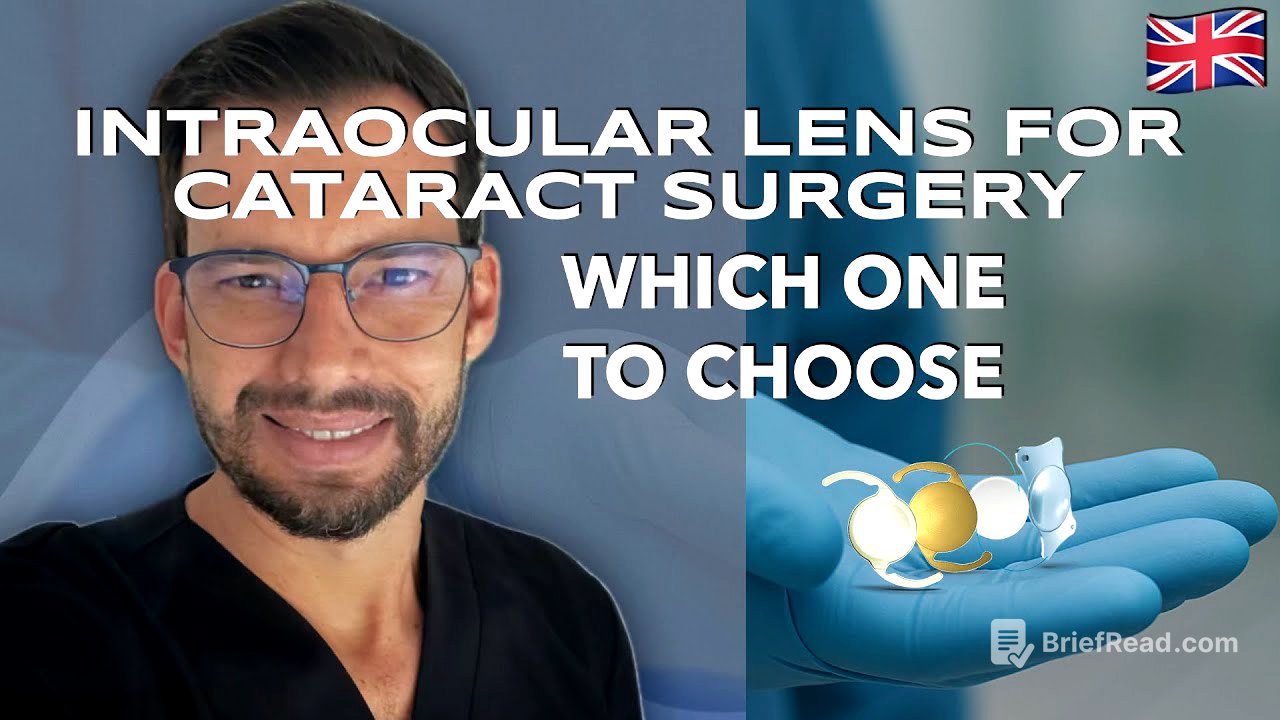
This video explains the different types of intraocular lenses (IOLs) available for cataract surgery, helping viewers understand their options and make informed decisions. It covers monofocal, bifocal, trifocal, advanced monofocal (monofocal plus), and EDOF lenses, discussing their advantages, limitations, and suitability for various visual needs and eye conditions. The video also touches on insurance coverage and the importance of considering individual lifestyles and activities when choosing a lens.
- Early cataract surgery is becoming more common due to advancements in technology and safety.
- Premium lenses aim to reduce dependence on glasses and improve overall quality of life.
- Different lenses cater to different visual needs (distance, intermediate, near) and eye conditions.
Introduction [0:00]
Dr. Filipe Lucatto introduces a discussion on intraocular lenses (IOLs) for cataract surgery, addressing common uncertainties patients face regarding lens options and costs. The video aims to provide clarity on the different types of lenses available, helping viewers and their families understand whether investing in a premium lens is worthwhile based on individual needs and quality of life.
Cataracts today: earlier diagnosis and surgery [0:53]
Cataract surgery is now performed on younger patients due to advancements in technology, diagnosis, and surgical safety. It's no longer necessary to wait until the cataract becomes very hard, which reduces the risk of complications during surgery. The goal has evolved from simply restoring transparency to improving the patient's quality of life by reducing dependence on glasses.
Differences between eyes and visual needs [1:20]
Cataract surgery isn't a one-size-fits-all procedure. Each eye has unique anatomical features, and individual habits and daily activities influence the choice of intraocular lens. While the primary goal used to be restoring transparency, modern technology allows for precise correction of refractive errors for distance, intermediate, and near vision, leading to earlier and safer surgeries aimed at improving overall quality of life. Premium lenses are designed to reduce dependence on glasses, offering benefits such as increased autonomy, safety, and the ability to engage in activities without the hindrance of glasses. This is particularly important for the elderly, where improved vision can help prevent falls and enhance their overall well-being.
“Insurance lens” vs. premium lens [2:49]
The video outlines the different types of lenses available, including monofocal, advanced monofocal (plus), bifocal, EDOF (extended depth of focus), and trifocal lenses, with options for toric lenses to correct astigmatism. Health insurance plans typically cover a basic type of lens but not the more advanced or expensive ones. The lenses covered by insurance are usually simpler monofocal lenses without advanced technology.
Monofocal spherical and aspheric lenses & monovision strategies [5:05]
Insurance plans usually cover spherical monofocal IOLs, which have a single focus and correct vision at a specific distance. Biometry, a crucial pre-surgery exam, determines the lens power needed to achieve the desired prescription. A common strategy involves correcting one eye for distance vision and the other for near vision, known as monovision. Monovision can improve independence from glasses, but it may compromise binocular vision and depth perception, making it less suitable for professional drivers. Spherical monofocal lenses may have distortions at the edge, while aspheric lenses correct this, offering better visual quality but at a higher cost. Toric monofocal lenses are used to correct astigmatism, further increasing the cost, which may not be fully covered by insurance.
Bifocal lenses: advantages and limitations [9:33]
Bifocal lenses provide two focal points for vision: one for distance and one for near. However, they have a significant limitation: poor intermediate vision, which is needed for tasks like using a computer or cooking. These lenses are of the diffractive type, featuring rings that split light to focus at different points. Not all patients are suitable for diffractive lenses; contraindications include dry eye, blepharitis, ocular surface changes, pupil size, and retinal changes. If these factors are not carefully considered, patients may be dissatisfied with the visual outcome. Diffractive lenses can also cause halos and glare, especially in low-light conditions, although the brain can adapt over time. These lenses work best in bright environments due to the way they split light. While bifocal lenses offer good distance and near vision, they may not be the best choice for those who heavily rely on intermediate vision.
Trifocal lenses: near, intermediate, and distance vision [14:03]
Trifocal lenses are also diffractive lenses with rings and require perfect ocular health, a good ocular surface, and a healthy retina. Like bifocal lenses, they split light and perform better in well-lit environments, and can cause halos and glare. However, for those without contraindications, trifocal lenses are excellent for achieving independence from glasses, providing good vision at all three distances: distance, intermediate, and near. Despite being the most expensive option, they are not suitable for everyone, especially those with conditions like epiretinal membrane, macular degeneration, or severe dry eye, as these conditions can compromise the visual results.
Advanced monofocal lenses (monofocal plus) [15:43]
Advanced monofocal lenses, or monofocal plus lenses, are a preferred option, especially for patients with retinal issues who cannot have diffractive lenses. These lenses do not have rings, thus avoiding halos and glare. They feature a small adjustment in the center that provides excellent intermediate vision without affecting distance vision. While they do not offer excellent near vision, they significantly aid with intermediate tasks like cooking and computer use. A mini-monovision strategy can be employed by adjusting the vision in the second eye to improve near vision, typically leaving a small amount of myopia (e.g., 0.75 to 1 diopter). This approach often allows patients to be free from glasses for distance, intermediate, and near vision. The indications for monofocal plus lenses are more straightforward, making them suitable for cases with mild retinal changes, such as dry macular degeneration, mild epiretinal membrane, or diabetic retinopathy.
EDOF lenses (extended depth of focus) [18:55]
EDOF (extended depth of focus) IOLs are designed to provide good vision for both distance and intermediate ranges. Some EDOF lenses are diffractive and have rings, while newer options are non-diffractive, avoiding halo and glare issues. These lenses offer excellent distance and intermediate vision and provide a significant amount of near vision. EDOF lenses can be recommended in many cases where diffractive lenses were previously not suitable, achieving excellent results and increasing the patient's independence from glasses.
Conclusion and final advice [19:44]
Dr. Lucatto concludes by expressing hope that the video has clarified questions about intraocular lenses. He encourages viewers to leave comments with further questions and emphasizes the importance of being well-informed about their condition, options, and limitations before undergoing surgery. He believes that understanding these aspects is a crucial part of the treatment process, leading to better surgical outcomes.