TLDR;
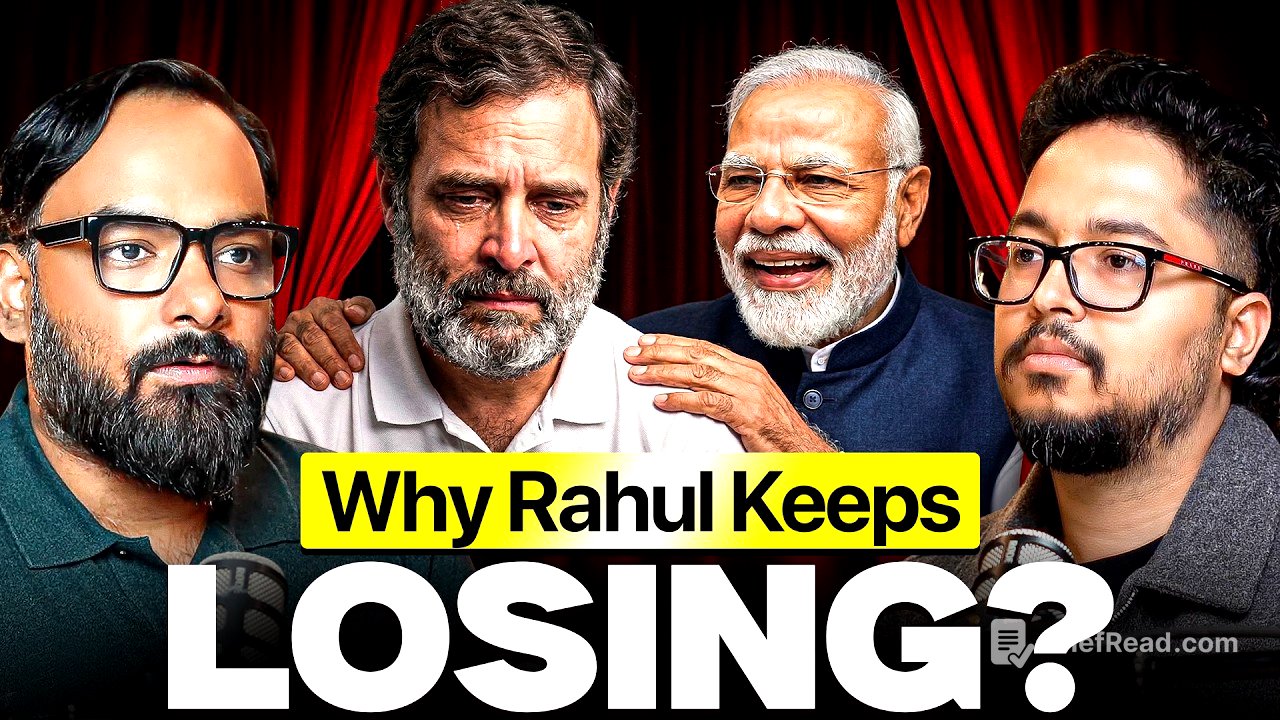
This podcast episode features a discussion about the Indian political landscape, focusing on the Congress party's challenges, the BJP's strengths, and the role of morality and economics in politics. The conversation explores Rahul Gandhi's leadership, the influence of social media, the importance of grassroots connections, and the need for a uniform civil code.
- Rahul Gandhi's leadership struggles and lack of resonance with voters.
- The Congress party's shift towards leftist ideologies and its disconnect from the ground reality.
- The BJP's success is attributed to a fusion of Hindutva, development, and welfare policies, along with effective communication.
- The limitations of social media in influencing elections and the importance of ground-level connections.
- The necessity of a uniform civil code for national unity and the role of economic development in improving citizens' lives.
Intro [0:00]
The host introduces the guest and sets the stage for a discussion about the core issues facing the Congress party. The conversation aims to the challenges and strategies within Indian politics, particularly concerning leadership and party dynamics.
Rahul Gandhi - Vision Problem or Strategy Failure [1:10]
The core crisis of the Congress party is that they are not addressing the "elephant in the room," which is Rahul Gandhi's inability to win elections for the party at the state level. After 20 years in active politics, Rahul Gandhi still cannot define a region that can loyally back him. There is no resonance for Rahul Gandhi with the younger, more dynamic population, and he often tries too hard to connect with them. There is a lack of communication between the top leadership of the Congress and the "Karkarta" (worker) on the ground, unlike the BJP or Aam Aadmi Party. People see Rahul Gandhi as an arrogant, angry man who mocks the BJP instead of working harder to understand the aspirations of the people. The Congress forgot that winning 99 seats in the 2024 election wasn't a victory, and 240 seats wasn't a defeat for the BJP.
Is Rahul Fighting The Wrong Battles [8:20]
Rahul Gandhi selectively quoted from an article that itself selectively quoted from an unpublished book, claiming that the Prime Minister and Defense Minister abdicated their responsibility during operations on the LAC (Line of Actual Control). The word "abdicate" was not in the excerpt, but the author's conclusion, which Rahul Gandhi presented as the general's opinion. This is seen as dishonesty and fraud, especially considering the Prime Minister's stance on bombing a nuclear neighbor. Rahul Gandhi needs to understand that people do their checks in the age of the internet, and this kind of manipulation is not expected from the leader of an opposition. This has been a Congress strategy of manipulation and misinformation since the emergency, which explains why they are having a hard time with social media.
No Merit Within Congress Party [12:50]
The rot inside the Congress party is that it doesn't elevate eligible or capable leaders because Rahul Gandhi believes that the prime minister within the Congress has to come from the family. There is no opposition to this idea within the party, and people who suggest change are eventually pushed out. It's not that the workers of the Congress don't want to work, but people are not impressed with the central leadership, Rahul Gandhi and Priyanka Gandhi. The inability to acknowledge that people do not resonate with Rahul Gandhi is a problem within the Congress.
Why No Strong Opposition to BJP [17:00]
One-party domination is defined by the BJP winning seats and forming the government, but the voter base of other parties still exists on the ground. The Congress is conducting an AI summit while the BJP is sending in semi-naked protesters, showing a lack of humility and understanding of what the people want. The responsibility of having a healthy opposition is not the BJP's or the government's. The incapacity of the Congress needs to be quantified, and this quantification will differ from region to region. There are potential contenders to replicate Modi's central command structure style of leadership at a state level, but unfortunately, none from the Congress.
Kolkata Elections and Mamta Banerjee [21:15]
Mamta Banerjee starts with a significant vote share of 35 to 40%. The BJP's best vote share has been 40 to 41%. The difference in West Bengal would be that last 10%. If the BJP has to win West Bengal, they'll have to flip that gap of 5 to 7 percentage points, which is going to be very difficult. Mab Banerjee has the benefit of identity and continuity, but the undercurrents in West Bengal are against her right now. If the BJP cannot win this election, it gets really difficult for them. The BJP has not lost a lot of ground in terms of vote share, so can they bridge that gap? West Bengal also has its problems, as surrounding states are progressing ahead.
Congress is the New Communist [25:15]
There are two categories or spectrums in the country: the extreme left and the center-right. The Congress is now on the left, and its manifesto resembles that of the communists. The communists are now the fringe left. The Congress talks about wealth redistribution, affirmative action, and religion-based reservation, which are regressive policies. The mindset of the Congress is now actually left. There is a strong overlap between what the left thinks and what the Congress thinks in Bengal. Nationally, the relevance of the left is increasing because the Congress is now the new communist. The entire economic and social agenda of the Congress now resembles that of the left.
Social Media Cant win elections [29:00]
Social media can't win elections. Even if all the influencers on social media who say they are honest BJP voters were gathered, they wouldn't be able to swing an assembly. People overestimate their importance on social media and underestimate the size of the electorate on the ground. Even if Dhuvati has 40 million followers, his majority audience is in the urban parts of India, which have been swept by the BJP. One good election, people tend to look for a lot of reasons and then attribute those reasons to people who don't even deserve credit for it.
JNU & Campus Politics [31:18]
The left has historically dominated JNU (Jawaharlal Nehru University) because of the institution's legacy and the kind of projection it has with its arts and humanities department. But the left in Delhi is constrained to JNU. Congress has secured three consecutive ducks in the assembly elections of Delhi. Campus politics should be banned. There are scores of private universities in every state with no such nonsense. Political parties do not need to use campuses to prove a point. What is wanted in campuses is genuine innovation, not time squandered on elections. A subsidized university needs to be useful and give some tangible return to the taxpayer.
BJP’s Strongest Weapon [34:18]
The visible weapon of the BJP is the fusion of Hindutwa with development, but to the voter, it's very different. A voter's decision is not based on a single factor. It depends on how safe their family feels, how safe their business is, and whether they are getting better infrastructure. To an MSME (Micro, Small & Medium Enterprises) owner, the continuity and stability of their business are important. To someone who's 22, 23 years old, they are thinking about what the country can offer them when they start a family. The strongest card of the BJP is the fusion of Hindutwa and development, along with a welfare model.
How will GenZs Vote in future? [39:50]
One thing the BJP can still do better is pushing the state governments to do more and bridging the gap between their intent and communication. They need to communicate their ideas far better, especially when those ideas are from a long-run perspective. They need to work harder in areas where they're not very strong, like Punjab or Tamil Nadu. The BJP should strengthen its communication because the news cycle moves too fast, and people process too much information. A White House model or a press secretary kind of model can really work. The BJP is unable to communicate their achievements and the projects that are ongoing.
The Banking Crisis and Adani Fiasco [44:30]
A person who's going to vote for the first time in 2029 was three years old when Narendra Modi became the prime minister. They have absolutely no understanding of the UPA years, the cost, the opportunity cost, and the terrorist attacks. How many people can tell you about the banking crisis of 2015-16 and how it originated? Congress talks about Adani but never talks about the banking crisis. How many people know that the dedicated freight corridor we talk about today was planned during the UPA years but not a single kilometer was built?
Does Rahul Understand Economics? [49:00]
If Rahul Gandhi were to be advised, his economic agenda would be changed. His economic agenda is flawed, and his understanding of India is flawed. He thinks we are still the Roti Kaparamakan kind of polity, but we are not. Rahul Gandhi needs to understand he's not the most competent person in the Congress party. He mocks the idea of people earning money. Narendra Modi says they want to enable women to earn 1 lakh rupees every year through self-help groups, while Rahul Gandhi says they'll give away 1 lakh rupees for free. Rahul Gandhi's economic agenda is flawed, and people feel threatened.
Delhi’s Pollution and Urban Planning Failure [55:50]
The BJP has genuinely failed to communicate the problem of Delhi's air pollution. There are two things going on in Delhi: stubble burning and temperature inversion. What Delhi needs is decongestion and more infrastructure. Bypass roads that take away traffic out of Delhi need to be created. Satellite suburbs need to be built and connected. Delhi has a severe problem of illegal encroachment. The state government will have to act on this. Delhi has too many layers of public transport. Some degree of reorganization needs to happen, and that has to be the job of the state government, which is not happening.
How Elections are Really Won in India [1:00:00]
The only litmus test for a policy being good or bad is elections. If there is a threshold of people who hate the policy enough to vote the government out, that is the only way. Otherwise, it's your opinion against mine. On the ground, what the voter is thinking changes every 5 km. A leader has to be on the ground. There is no substitute for ground work and hard work. The process of voting is where everyone is a direct or indirect stakeholder in an economy. Election doesn't happen on social media or in a parliamentary constituency; it happens on a booth. Election management is the job of the party. A political party only exists to fight elections.
Can Morality and Politics Co Exist? [1:07:04]
Politicians need to be constitutionally moral and efficient. Efficiency is more important than morality in a politician. Every politician since a certain threshold have voters have elected them to, they've passed the morality test. It's now about the efficiency. Morality is a trap. Constitutionally moral is the basic requirement through law. Beyond that, it's all about efficiency. The media shouldn't make that moral compass. The society has a will of its own.
Society has a will of its own [1:14:20]
The society has a will of its own. The electorate has a will of its own. People overestimate their abilities with a mic and a camera. They need to retain that humility. The people on the ground actually have a better shot at defining where the country is moving.
Urgency with UCC & Why its important [1:15:20]
A uniform civil code (UCC) needs to come in. If a country does not have a uniform set of laws, then it is creating a ground for a lot of micro partitions. In a country where the constitution is secular and the polity is secular, the laws also need to be secular. Religion-based personal laws do not have a space in this country.
Wrap Up [1:19:00]
The guest wants the current prime minister to contest for a fourth term in 2029 and become the longest-serving prime minister of India. There are a lot of names that come up for potential successors, but it's hard to put a name right now. The Home Minister has the best shot. The guest has always been vocal about liking the current prime minister and voting for him for a particular reason, focusing on the economic aspect rather than religion or RSS. The guest judges any leader based on what they are doing to make the life of a citizen better and improve the economy of the state.