TLDR;
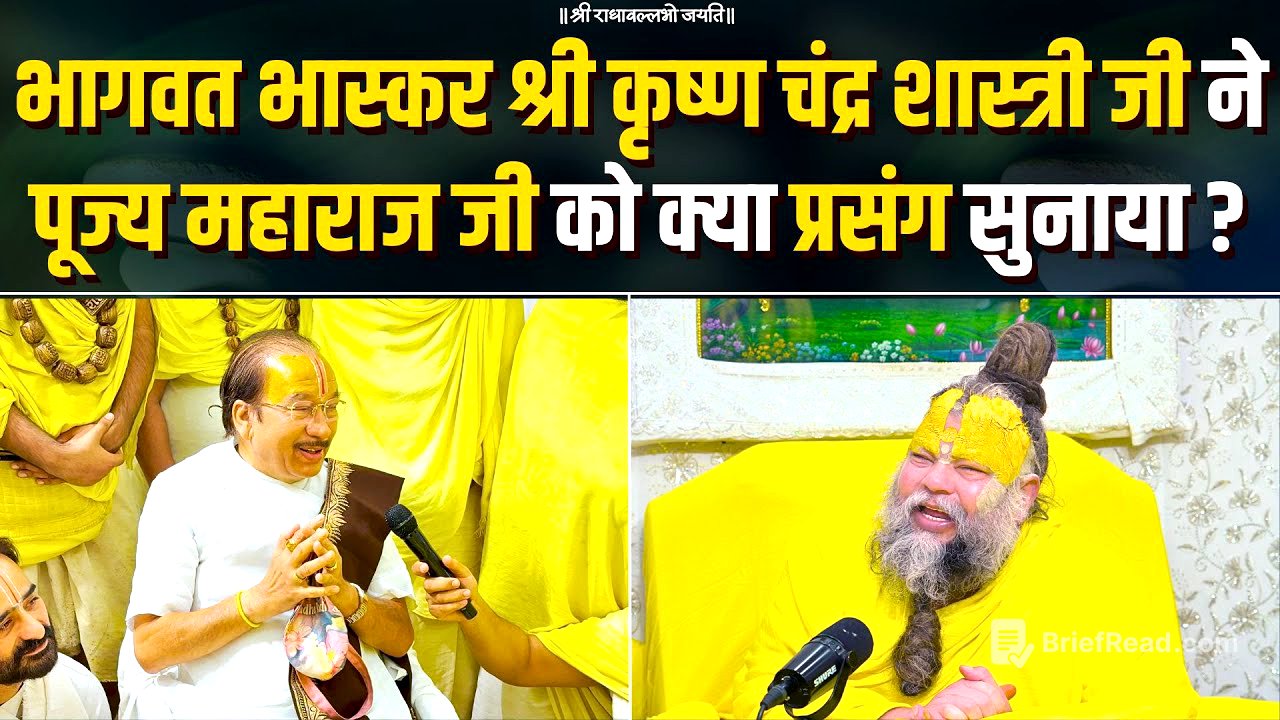
This video features a discourse on spirituality, drawing from Hindu scriptures like the Bhagavad Gita and Srimad Bhagavatam. It emphasizes the importance of devotion, the nature of the soul, and the significance of a Guru's guidance in overcoming worldly illusions. The speaker also touches on the concept of "atma-hatya" (spiritual suicide) and the value of human life as a means to attain divine realization.
- Importance of devotion and spiritual practice for overcoming worldly illusions.
- The role of a Guru in guiding individuals towards divine realization.
- The concept of "spiritual suicide" as neglecting the opportunity for spiritual growth in human life.
Introduction [0:34]
The speaker expresses gratitude for the opportunity to share insights and mentions his regular visits to Vrindavan, where he frequently encountered revered figures. He acknowledges the importance of social media in staying connected and listening to spiritual discourses. He praises Lala Indresh as being dear to all Vaishnavs, highlighting his captivating nature and the divine quality of his speech, which effortlessly focuses the mind on Bhagavan.
The Story of Yamalarjuna [2:12]
The speaker narrates the story of Yamalarjuna, the two sons of Kubera who were cursed to become trees. They were eventually liberated by Krishna when he crawled between them, causing them to fall. The speaker emphasizes a prayer where one seeks that their speech always sings the praises of the Lord, their ears always listen to His stories, their hands engage in His service, their mind dwells on His feet, their head bows in reverence, and their eyes behold the saints as embodiments of the Lord.
The Nature of the Soul and Body [7:12]
The speaker explains the distinction between the body and the soul, referencing a conversation between Vasudeva and Kamsa. He states that death is inherent to the body, which is born and eventually dies, but the soul is eternal and unchanging. He quotes the Yogeshwaras, who told King Janaka that the soul neither takes birth nor dies; these processes belong to the body, which undergoes changes like birth, growth, and decay. The speaker also touches on the roles of the mind, intellect, and senses in experiencing emotions and perceptions, contrasting them with the soul's eternal nature.
The Dialogue Between Sukadeva and Parikshit [9:59]
The speaker recounts the story of Sukadeva and King Parikshit, who had only seven days to live. Sukadeva answers Parikshit's question about liberation for one who is about to die. On the final day, Sukadeva asks Parikshit if he will die, to which Parikshit replies that he was never born, so how can he die? Sukadeva explains that the thought of "I will die" is a sign of ignorance. He uses the analogy of a clay pot containing space to illustrate that when the pot breaks, the space merges back into the larger space. Similarly, the enlightened soul merges back with the divine.
The Illusion of Dreams [14:44]
The speaker uses the analogy of a dream to explain the nature of reality. In a dream, one might experience vivid events, such as being chased by a lion, but upon waking, one realizes it was all an illusion. Similarly, the world we perceive is a kind of dream created by the mind. The ultimate realization is to understand that "I belong to God, and God belongs to me." This understanding leads to a state of bliss and detachment, as described in the Bhagavad Gita.
The Significance of Human Life [18:29]
The speaker emphasizes the rarity and importance of human life as a means to attain divine realization. Quoting from the Srimad Bhagavatam, he explains that human life is a boat that can carry one across the ocean of samsara (the cycle of birth and death). He contrasts this with the idea of "atma-hatya," or spiritual suicide, which occurs when one wastes this precious opportunity for spiritual growth.
The Role of the Guru and Divine Grace [23:36]
The speaker explains that while human life is a sturdy boat, the ocean of samsara is vast and difficult to cross due to the power of Maya (illusion). To navigate this ocean, one needs a Guru, who acts as the helmsman of the boat. Furthermore, divine grace is like a favorable wind that propels the boat forward. The speaker concludes by emphasizing that those who fail to take advantage of these opportunities are committing spiritual suicide.
Conclusion [26:31]
The speaker concludes by affirming the good health and spiritual state. He expresses joy at the opportunity to have this discussion and mentions his practice of secretly visiting and paying respects. He also invites everyone to the upcoming Baikunthotsav, an event featuring various saints and spiritual discourses. The speaker emphasizes that Bhagavat Katha is essentially the stories of devotees, highlighting their devotion and experiences.