TLDR;
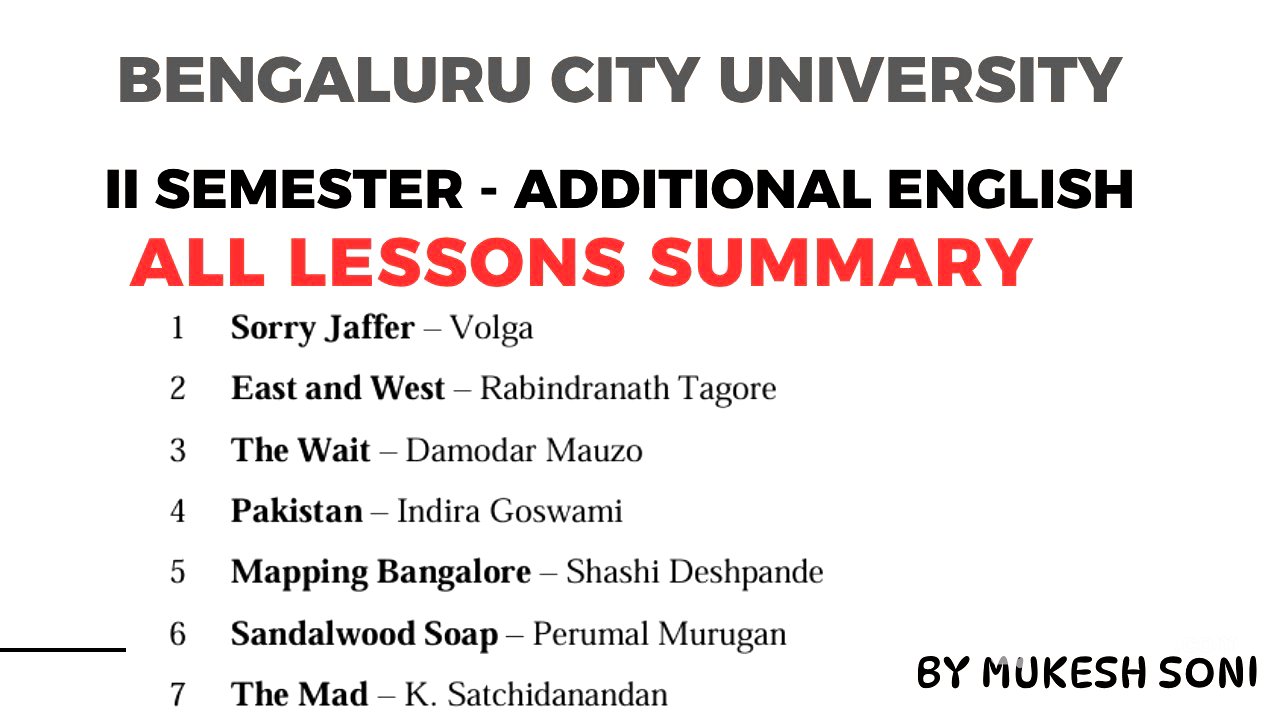
This video provides comprehensive summaries of the additional English curriculum for second-semester students at Bengaluru City University. It covers seven chapters, including stories, essays, and poems that address themes of communal harmony, cultural exchange, misunderstandings, and identity.
- Summaries of seven chapters catered for BCU second semester students
- Focus on themes like communal harmony, cultural exchange, and identity
Sorry Jaffer [1:37]
"Sorry Jaffer" by P. Alita Kumari explores communal harmony and cultural conflict set in 1990s India. The story focuses on Ramar Rao, a middle-class Hindu, and his friendship with Jaffer Ali, a Muslim bookseller. While initially close, prejudices grow as Ramar's son, Vinn, exhibits hostility towards Jaffer’s daughter, Nazima. The story reveals the impact of internal familial tensions on interfaith relationships and ends with Ramar's feelings of guilt and helplessness as his friend feels unwelcome in his home.
East and West [6:21]
Rabindranath Tagore's essay "East and West" critiques the superficialities in the interactions between Eastern and Western civilizations. He argues for mutual respect and spiritual exchange over domination, emphasizing how colonialism has severed human connections. Tagore calls for an understanding that transcends collective ideologies, pointing out the need for an emotional bond and true empathy to forge a harmonious future.
The Weight [10:43]
"The Weight" by Damodar Mauzo delves into themes of miscommunication and the consequences of family interference in relationships. The protagonist, Viraj, struggles with feelings for his love interest, Si, after his sister harshly judges her past. The narrative shows how assumptions and societal norms can strain relationships, emphasizing the importance of open communication and empathy. Ultimately, it reveals that true love requires patience and understanding.
Pakistan [15:33]
Indra Gowda's poem "Pakistan" expresses longing and emotional connection between India and Pakistan. The poet reminisces about shared histories and mutual experiences before partition, addressing the pain caused by division. Despite the separation, the poem conveys a hope for reconciliation and unity, urging for emotional bonds to transcend borders and advocating for peace and understanding.
Mapping Bangalore [24:44]
Shashi Deshpande's essay "Mapping Bangalore" is a personal reflection on her evolving relationship with the city. She recounts her family's move to Bangalore in 1956, contrasting its past peacefulness with its modern bustling character. Deshpande explores themes of memory, belonging, and identity shaped by her experiences in various neighborhoods, illustrating how Bangalore remains an integral part of her identity as it continues to transform.
Sandalwood Soap [33:54]
"Sandalwood Soap" by Perumal Murugan tells the story of a young boy working at a bus station toilet. His encounter with a man from his hometown highlights themes of child labor and human suffering. The boy laments his situation but shows resilience, eventually using a bar of sandalwood soap gifted by the man as a symbol of comfort amidst his hardships, emphasizing the significance of small acts of kindness.
The Mad [36:32]
K. Sachidanandan's poem "The Mad" challenges conventional notions of madness by portraying those labeled as 'mad' as possessing unique insights and a deeper understanding of life. The poem emphasizes their freedom from societal constraints, suggesting that they exist in a realm filled with imagination and purity. It invites respect for their perspective and highlights the beauty in their alternate reality, urging society to reevaluate its perception of sanity.