TLDR;
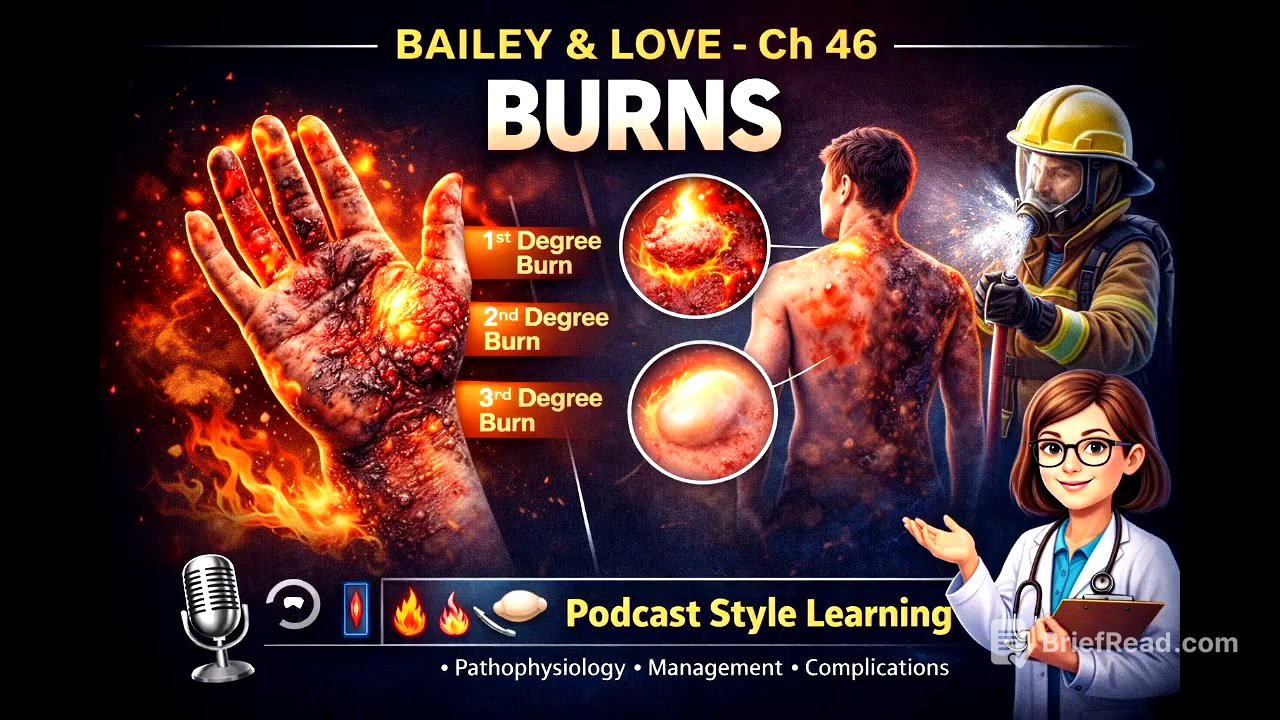
This video provides a comprehensive overview of burn injuries, from initial assessment and pathophysiology to acute and long-term management. It emphasizes the importance of understanding the mechanisms of injury, the systemic inflammatory response, and the critical steps in immediate care and surgical intervention. The video also highlights the significance of multidisciplinary treatment and rehabilitation for improving patient outcomes.
- Burn injuries are a major clinical problem with high incidence, especially in children.
- Immediate care focuses on cooling the burn and preventing hypothermia.
- Early intubation is crucial for suspected airway burns.
- Fluid resuscitation is vital, guided by the Parkland formula and urine output monitoring.
- Surgical intervention includes escharotomy, excision, and skin grafting.
- Post-acute care involves pain management, nutritional support, infection control, and rehabilitation.
Introduction to Burn Injuries [0:00]
The video introduces the topic of burn injuries, emphasizing that they are a life-threatening multi-system trauma, not just a skin problem. The goal is to provide a thorough understanding of the pathophysiology, acute assessment, and multidisciplinary treatment required for burn injuries. This knowledge is crucial due to the high incidence of burns, with a significant portion of victims being children under 16. Structured immediate care is essential for managing burn injuries effectively.
Clinical Context and Mechanisms of Injury [1:22]
The clinical context of burn injuries varies significantly based on the patient's age. In children, the majority of burns are scalds from hot drinks or bath water, typically domestic accidents causing superficial to deep partial thickness injuries. Adolescents often experience higher energy injuries due to risk-taking behavior involving flammable liquids. Adults, especially the elderly, are more prone to flame and contact burns, often linked to underlying frailty or inability to self-care.
Safeguarding and Underlying Co-morbidities [2:27]
Clinicians have an ethical and legal duty to screen for non-accidental injury (NAI), especially in vulnerable groups like the very young and the very old. Warning signs include delayed presentation, lack of appropriate concern from caregivers, inconsistencies between the history and burn pattern, unexplained injuries, and frequent hospital attendances. In the general adult population, burns often reveal underlying co-morbidities such as mental health issues, epilepsy, or substance abuse, which increase the risk of burn injuries. Occupational injuries, particularly electrical and chemical burns, are also common in working-age adults.
Public Health Successes in Prevention [4:26]
Public health measures have significantly reduced the incidence of burn injuries. Legislation mandating flame-retardant clothes and furniture, along with product design changes like cordless kettles, have been effective. Public education campaigns emphasizing setting water thermostats to no more than 60°C and using slogans like "Hot water burns like fire" have also been successful in preventing scalds.
Pathophysiology of Burn Injuries [5:18]
Burn injuries are multi-system injuries driven by a massive inflammatory cascade. The skin's vital functions, including waterproofing, UV protection, immune response, and thermoregulation, are immediately lost when destroyed by heat. Inhalation injury is a critical factor dictating immediate airway management, described as a triple threat: upper airway injury from hot gases, lower airway injury from smoke particles and steam, and metabolic poisoning from gases like carbon monoxide and cyanide.
Inhalation Injury: Upper vs. Lower Airway [6:52]
Upper airway injury is primarily thermal, caused by inhaling superheated air or steam, leading to superglottic airway burns and laryngeal edema. Lower airway injury is predominantly chemical, involving toxic steam and smoke particles, causing subglottic burns, sloughing, and acute respiratory failure. Metabolic poisoning from carbon monoxide (CO) and hydrogen cyanide (HCN) is a significant threat. CO binds to hemoglobin, preventing oxygen transport, while HCN inhibits cellular respiration.
Mechanical Block and Systemic Response [9:13]
Full thickness burns can cause a mechanical block if the eschar extends around the chest wall, restricting rib expansion. The systemic response to burns involves a massive inflammatory cascade, leading to increased vascular permeability and fluid shifts. This results in generalized edema and hypovolemic shock. Fluid loss sufficient to cause burn shock requiring intravenous resuscitation occurs when the burn exceeds 15% of the total body surface area (TBSA) in adults or 10% TBSA in the elderly and children.
Hidden Dangers: GI Tract and Immune System [11:15]
Large burns cause a profound reduction in cell-mediated immunity, making patients highly susceptible to infections. The systemic inflammatory response and shock can lead to microvascular damage and ischemia in the gut mucosa, reducing gut motility and impairing nutrient absorption. Damaged mucosal barrier increases the translocation of gut bacteria into the systemic circulation, causing sepsis. Abdominal compartment syndrome can develop due to gut mucosal swelling and peritoneal edema, compromising ventilation.
Limb-Threatening Tourniquet Effect [12:40]
Circumferential burns can create a limb-threatening tourniquet effect. The rigid, non-elastic eschar restricts underlying tissues, and as edema progresses, it compromises arterial and venous flow, causing ischemia. Immediate surgical intervention is required to relieve the pressure.
Immediate Care: First Responder Actions [13:11]
The most frequently missed step in immediate burn care is effective cooling coupled with prevention of hypothermia. The sequence of care includes rescuer safety, stopping the burning process, performing a rapid primary survey (ABCs), cooling the burn for at least 20 minutes with tepid water (15°C), giving oxygen, elevating burned limbs, and providing analgesia with opiates.
Hospital Management: ATLS Approach [15:07]
In the hospital, management follows the Advanced Trauma Life Support (ATLS) structure: Airway, Breathing, Circulation, Disability, Exposure, and Fluid resuscitation. The severity of the burn is determined by the percentage of total body surface area (TBSA) involved, the depth of the burns, the presence of inhalational injury, and the patient's age and co-morbidities. Patients meeting specific criteria, such as suspected airway injury, burns exceeding fluid resuscitation thresholds, or burns to critical areas, must be admitted to a specialist burns unit.
Airway Management: Early Intubation [16:44]
Early elective intubation (ET) is the treatment of choice for any suspected airway burn, especially with deep facial burns or a history of being trapped. Classic symptoms like hoarseness and stridor are late signs of laryngeal edema. Intubation should be performed by an experienced anesthetist, and equipment for emergency cricothyroidotomy must be readily available.
Breathing Management: Lower Airway Injury [17:43]
Initial suspicion of lower airway inhalational injury is based on history and physical signs like soot in the nose or oropharynx. Management is primarily supportive, including maintaining a secure airway, chest physiotherapy, and nebulizers with warm humidified oxygen. Advanced strategies in the ICU involve nebulized heparin and acetylcysteine to break up fibrin casts and clear thickened mucus.
Poison Management: CO and HCN [19:03]
Carbon monoxide (CO) poisoning is confirmed by measuring carboxyhemoglobin levels, with treatment involving high inspired oxygen. Hydrogen cyanide (HCN) poisoning, suspected with severe metabolic acidosis, is treated with hydroxycobalamin, which binds with cyanide to form a non-toxic complex excreted in the urine.
Mechanical Block and Burn Size Estimation [19:50]
For a circumferential full thickness burn restricting lung movement, immediate escharotomy is performed to allow the chest wall to expand. Burn size estimation is crucial for fluid planning and surgical strategy, measured as the percentage of total body surface area (TBSA). Quick estimate tools include the patient's hand (approximately 1% TBSA) and the Wallace rule of nines for adults. The London Browder chart is the gold standard, especially for children, as it accounts for changing body proportions.
Burn Depth Assessment [22:20]
Burn depth is determined by the time-temperature relationship. Superficial partial thickness burns (Group A) are pink, moist, and highly painful, with visible capillary refill. Deep partial thickness burns (Group B) are less moist, often white or red, with fixed capillary staining and reduced sensation. Full thickness burns (Group B) are hard, rigid, and leathery, with no capillary return and no sensation. The distinction between Group A and Group B is critical for treatment planning.
Fluid Resuscitation [25:01]
IV fluids are required for adults with burns greater than 15% TBSA and children with burns greater than 10%. The Parkland formula, using isotonic crystalloids like Hartmann's solution, is commonly used. Half of the total fluid volume is administered in the first 8 hours post-burn, and the remaining half over the subsequent 16 hours. Pediatric patients also require additional maintenance fluid. Urine output is the primary index for monitoring resuscitation, targeting 0.5 to 1.0 ml/kg/hour.
Temperature Control and Wound Care [28:38]
Hypothermia is dangerous and must be prevented by infusing warmed fluids and maintaining a high ambient room temperature. For superficial dermal burns (Group A), the goal of wound care is protective, preventing progression to a Group B injury and managing pain. Simple dressings, Vaseline-impregnated gauze, or antibacterial films like Acticoat or BioBrain are used.
Surgical Management: Group B Burns [30:07]
Deep dermal and full thickness burns (Group B) require active surgical management. Circumferential full thickness burns to the limbs or torso are surgical emergencies requiring escharotomy. Early excision of the eschar within the first few days is preferred to exploit anesthetic, hemodynamic, and bacterial windows. Staged excision involves serial debridement over several shorter operating sessions. Silver-based dressings are used for temporizing deep burns.
Surgical Techniques: Skin Grafting and Substitutes [33:38]
Split-skin grafts are thin sheets of skin harvested using a dermatome. Meshing is used to expand the graft, maximizing coverage. When donor site availability is exhausted, techniques like harvesting very thin grafts, wide meshing, or the Meek wall technique are used. Skin substitutes serve as temporizing measures, with dermal matrix strategies like biodegradable temporizing matrix (BTM) encouraging the ingrowth of the patient's own tissue.
Post-Acute Care: Pain, Nutrition, and Infection Control [36:11]
Post-acute care includes pain management, nutritional support, and infection control. Major burns are profoundly catabolic, requiring high-calorie, high-protein tube feeding. Infection control relies on strict institutional policies, handwashing, and regular bacteriological surveillance. Rehabilitation, both physical and psychological, must start immediately.
Rehabilitation and Scar Management [37:54]
Physiotherapy and occupational therapy are vital from day one, emphasizing elevation and splinting to prevent contractures. Early psychological intervention is important to address post-traumatic reactions. Delayed reconstruction and scar management focus on maximizing function and appearance, with early focus on the eyes. Techniques include Z-plasty, local flaps, tissue expansion, and vascularized tissue replacement. Pressure garments, silicone patches, and intralesional steroid injections help manage scar hypertrophy.
Non-Thermal Burn Injuries: Electrical and Chemical [40:06]
Electrical injuries are divided into low and high voltage. High tension injuries cause massive subcutaneous tissue and muscle damage, requiring urgent fasciotomies and aggressive fluid resuscitation to prevent acute renal dysfunction. Chemical injuries require rescuer safety and copious sustained lavage with water. Hydrofluoric acid requires specific management with calcium gluconate gel or regional anesthesia blocks.
Radiation and Cold Injuries [42:56]
Localized radiation damage requires conservative management, with excision and coverage for deep ulceration. Cold injuries like frostbite require rapid rewarming. Surgery is delayed until absolute demarcation is visible.
Conclusion and Future Directions [43:27]
The video concludes by summarizing the key aspects of burn care, emphasizing the importance of early intubation, calculation tools like the London Browder chart, and the distinction between Group A and Group B management. Future advancements focus on sophisticated skin substitutes and cultured autologous skin to improve long-term outcomes. The most significant factor in reversing the patient's hypermetabolic state is rapid excision and stable wound coverage. Future research may focus on pharmaceutical interventions targeting the hormonal cascade to further improve recovery.