TLDR;
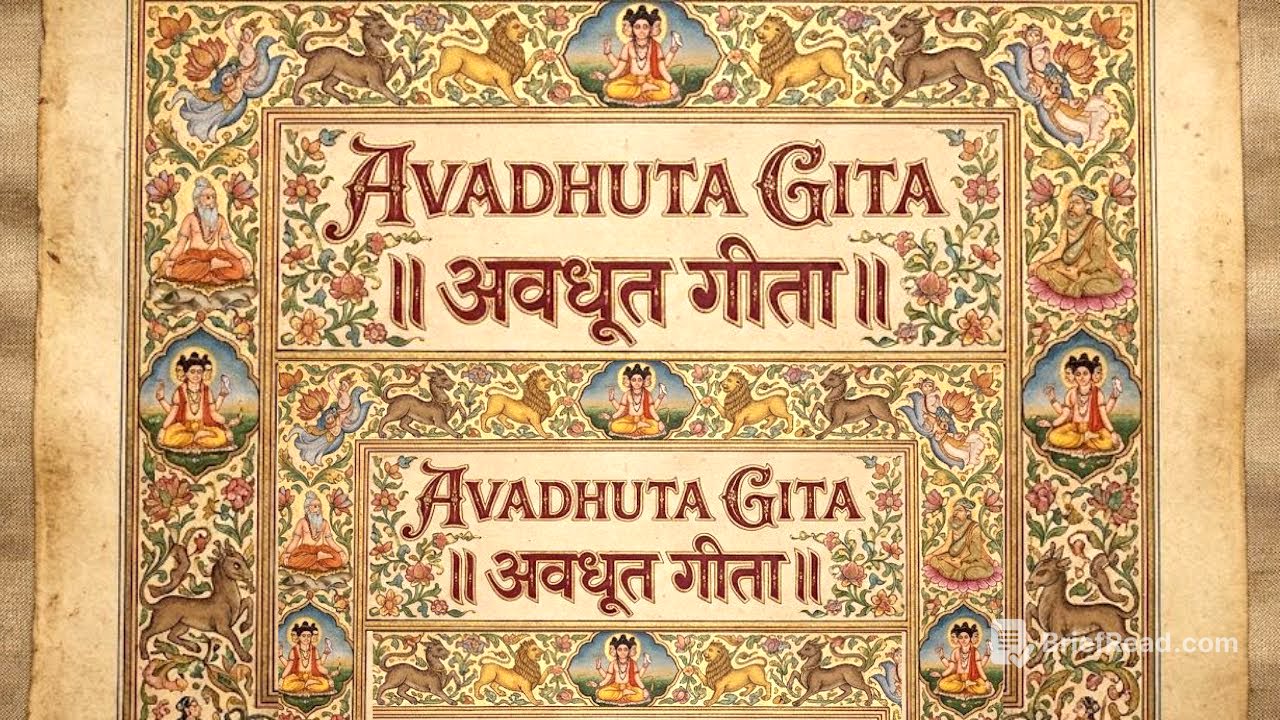
This video summarizes the Avadhuta Gita, a sacred Hindu text attributed to Rishi Dattatreya, who is considered by many as the ultimate incarnation of Brahma, Vishnu, and Shiva. The Gita explores Advaita Vedanta, emphasizing non-duality and the realization of the self as identical to the all-pervading Brahman. The text delves into the nature of reality, illusion, and the path to liberation, advocating for detachment, self-awareness, and the transcendence of worldly desires and dualities.
- Dattatreya's teachings emphasize non-duality and self-realization.
- The Avadhuta Gita advocates for detachment and transcendence of worldly desires.
- The text explores the nature of reality, illusion, and liberation.
Introduction to Avadhuta Gita and Dattatreya [0:04]
The Avadhuta Gita is attributed to Rishi Dattatreya, considered by many to be the greatest incarnation, embodying the combined aspects of Brahma, Vishnu, and Shiva. His teachings were documented by his disciples, Swami and Kartika, establishing the Gita as an ancient Hindu scripture. Dattatreya is believed to predate the Ramayana era, having imparted knowledge of Sri Vidya to Parashurama and Ashtanga Yoga to Patanjali, who later composed the Yoga Sutras. The Avadhuta Gita is highly regarded by sages and saints as a key text in Advaita Vedanta, with some attributing the origin of Tantra Vidya to Dattatreya. While the specifics of his birth are varied and his death remains unknown, he is believed to have been born on the 14th day of the full moon in the month of Margashirsha, potentially as early as 5000 BCE.
Dattatreya's Stories and Teachings [1:12]
Various Puranas recount stories of Dattatreya, including one from the Markandeya Purana involving a Brahmin named Kausika and his devoted wife, Shandili. Anusuya, the wife of Rishi Atri, intervened to help Shandili, leading to boons from the gods and the birth of Dattatreya as an incarnation of the divine trinity. Dattatreya, meaning "son of Atri," is also associated with a tale where he was born with three heads after Atri Rishi transformed Brahma, Vishnu, and Shiva into a single child. From a young age, Dattatreya renounced worldly possessions, living as a free and unconcerned saint, initiating disciples without discrimination and wandering through regions from North Mysore to Gujarat. He is said to have attained enlightenment near present-day Gangapur, leading a life that transitioned from a warrior to a yogi, and engaging in unconventional practices to demonstrate detachment to his followers.
Dattatreya's Literary Contributions and Significance [6:18]
Besides the Avadhuta Gita, Dattatreya authored the Jivanmukta Gita, a concise text of 23 verses on the characteristics of an enlightened being, as well as the Haritayana Samhita, a tantric text, and the Dattatreya Tantra. References to Dattatreya appear in various Upanishads and the Mahabharata, with Vaishnavites considering him an incarnation of Vishnu. He imparted the knowledge of Tripura Rahasya to Parashurama to resolve his questions about liberation. Dattatreya is often depicted with four dogs symbolizing the Vedas, a cow representing Vishnu, a trident symbolizing Shiva, and three heads representing Brahma.
Verse 1-10: Seeking Non-Duality and Salutations to the Self [7:50]
The first verses of the Avadhuta Gita emphasize that the desire for non-duality arises through divine grace, enabling individuals to overcome great fear. The verses express salutations to the formless, unbroken, auspicious, and unchanging Supreme Self, which pervades all places and resides within the soul. The universe, composed of the five elements, is likened to an illusion, questioning to whom one should offer salutations when the self is pure and alone. The verses assert that everything is truly the Supreme Self, negating distinctions and expressing wonder at how to define what is and is not, highlighting that the ultimate knowledge lies in realizing the self as the all-pervading, formless soul.
Verse 11-20: The Nature of the Self and Transcendence of Duality [9:11]
These verses affirm the speaker's identity as the divine, the soul of all, pure, unbroken, and vast like the sky, unwavering and infinite, embodying pure knowledge. The speaker expresses ignorance of who or how experiences pleasure or pain, devoid of good or bad thoughts, actions, or speech. The verses describe the self as beyond the senses, an elixir of knowledge, and absolutely pure. The mind is likened to the sky, all-encompassing and the essence of everything, yet ultimately unreal. The speaker identifies as one, all-encompassing, beyond space, and continuous, questioning how to perceive the self as hidden or revealed when the self is all there is.
Verse 21-30: Realizing Oneness and Freedom from Illusion [10:39]
The verses urge understanding of the unchanging oneness that is equally present everywhere, questioning why one contemplates day and night when always shining and free. The soul should be recognized as one, continuous, and all-pervading, with the speaker identifying as the seeker, meditator, and ultimate goal of meditation, questioning why one divides the unique. The verses assert that one is never born, never dies, and has no body, with scriptures clearly stating that everything is Brahman. The verses emphasize being the inner and outer, the ever-present auspicious soul, questioning why one wanders in delusion like a lost soul.
Verse 31-40: The Illusion of Separation and the Nature of Reality [12:12]
These verses state that there is no meeting or separation, no "you" or "I," and no universe, only the soul. One is not of the five senses, nor are they of you; therefore, why suffer? There is no birth, death, mind, bondage, liberation, good, or bad, so why weep? There is no name or form, so why wander in delusion? The verses urge seeing the indivisible self, abandoning delusion, and rejoicing in the unchanging, peaceful, and free truth. There is no attachment or opposition, so why be saddened by chasing desires?
Verse 41-50: The Nature of Truth and the Illusion of Duality [13:45]
The verses state that scriptures describe truth as without qualities, pure, unchanging, without a body, and equally present everywhere, urging the listener to understand this and recognize that anything with form is false, while the formless is eternal. Knowing this, one transcends birth and death. Saints say that the true reality is one, and when delusion is abandoned, the mind, which is both one and many, ceases to exist. The verses question the nature of samadhi (a state of intense concentration) if something is not the soul, if it is the soul, or if it both is and is not. If everything is one and free, what is the point of samadhi?
Verse 51-60: The True Self and the Futility of External Practices [15:05]
The verses affirm that one is pure, uniform truth without a body, never born or changing, questioning why one thinks "I know" or "I don't know." The true form is described as that which is false and made of the five elements, with scriptures negating it with "not this, not this." Just as the soul fills the soul, one is continuously filled in everything. There is no seeker, no practice, no meditator, and no meditation, so why does the mind meditate? If one does not know the Supreme Self, how can one speak of it or worship it? If one is the highest, most true, and all-pervading, how can one speak of or worship oneself?
Verse 61-70: Transcendence of Ego and the Nature of Reality [16:32]
The verses question how one can see oneself if one is the highest, asking if the eye can see itself. Ego is described as not the true reality, which is uniform, unmixed, and free from discrimination. How can ego be that which knows itself? There is nothing in the mind that is limitless, and nothing that is true; the soul is the highest truth, in which there is neither harming nor being harmed. One is uniform truth, pure, without a body, beyond birth and death, and indestructible. Why then hold illusions about the soul, and why be deluded?
Verse 71-80: The Merging of Self and the Nature of Brahman [17:52]
The verses explain that when a pot breaks, the space inside merges with the infinite sky, and the difference disappears. When the mind is purified, there is no difference between the mind and the Supreme Self. There is no pot, no space inside it, no soul, and no form of the soul. Know the true Brahman, in which there is neither the knower nor the known. Know the self as that which is everything, everywhere, and always, which always exists, is stable, and is everything, both visible and invisible. Have no doubt about this.
Verse 81-90: The Nature of Brahman and the Illusion of Duality [18:58]
The verses state that there are no Vedas, no world, no gods, no yajnas (sacrifices), no caste, no stages of life, no family, no birth, no path of smoke, and no path of light, only the highest truth, the uniform Brahman. If one is free from that which encompasses everything, if one is whole, how can one speak of knowing oneself through the senses or being beyond the senses? Some seek non-duality, some duality, but they do not know the true reality, which is always the same, neither duality nor non-duality. How can that truth be described which is beyond mind and words, in which there is no color, sound, or quality?
Verse 91-100: Realizing the Truth and the Nature of the Self [20:22]
The verses state that when everything appears false, when the body seems like the sky, then one truly knows Brahman. Then there is no duality. Now, one's true identity does not seem separate from the Supreme Self. Everything appears like the sky, so where are the seeker and the practice, the meditator and the meditation? Whatever one does, eats, sacrifices, or gives, is not one's own; one is pure, beyond birth and death, and never decaying. This entire creation is formless, never changing, pure, and the absolute Brahman.
Verse 101-110: The Nature of Maya and the Boundless Self [21:50]
The verses affirm that one is the truth, without doubt, but question why one considers the soul, which knows itself, to be invisible. The verses question the nature of Maya (illusion) and the absence of Maya, shadow and shadowless, stating that everything is the same truth, clear like the sky. One is free in the beginning, middle, and end, never bound. One is certain that one is always pure and clear. This entire universe, starting from the first intellect, does not manifest to the speaker at all; everything is only Brahman.
Verse 111-120: Transcendence of Identity and the Nature of the Soul [23:10]
The verses state that caste or stages of life have no meaning. The speaker knows that everything, from every direction, is the one self, complete in itself, while the five elements, starting with the sky, are essentially empty. The soul is neither male, female, nor hermaphrodite; it is neither a thought nor an imagination. How can one consider the soul to be full of happiness or without happiness? The soul is never purified by the six-limbed yoga, by destroying the mind, or by the teachings of a guru. The soul is itself the truth and the light.
Verse 121-130: The Nature of Reality and the Illusion of Duality [24:25]
The verses state that there is no body made of the five elements, nor is there one without a body; everything is only the soul. What are the three states (wakefulness, dream, deep sleep) and the fourth (transcendental state)? One is neither bound nor free, nor separate from Brahman; one is neither the doer nor the enjoyer; there is no difference. Just as water mixes with water without any difference, Purusha (the cosmic man) and Prakriti (nature) do not seem separate. If one was never bound or free, how can one think of oneself as having form or being formless?
Verse 131-140: The Formless Self and the Absence of Boundaries [25:39]
The verses state that the speaker sees the true form without any difference, like the sky. The small form is like the water of a mirage. There is no guru, no teaching, no limit, and no work. Know that one is pure by nature, uniform, without a body, like the sky. One is pure, without a body, and the mind is not above. One should not hesitate to say that one is the soul, the greatest truth.
Verse 141-150: The Nature of the Soul and the Transcendence of Duality [26:35]
The verses ask why the mind weeps, stating that it is the soul. Know the soul through the soul. Drink the best nectar of non-duality and rise above all discrimination. There is no knowledge, no ignorance, and no mixture of knowledge and ignorance. One who always knows this is knowledge itself. There is no need for knowledge, logic, time, space, learning from a guru, or attaining samadhi. One is complete knowledge and truth in oneself, as easy and stable as the sky.
Verse 151-160: The Nature of Brahman and the Illusion of the World [27:34]
The verses state that there is no birth or death, no work, neither good nor bad; one is Brahman, completely clear and without any qualities. There is no bondage or liberation. If God is all-pervading, unmoving, complete, and indivisible, the speaker sees no difference. How can there be an outside or inside? The entire universe shines unbroken; this Maya is a great deception. Duality and non-duality are mere thoughts. Always "not this, not this." Whether formless or formed, only that highest truth is beyond all difference.
Verse 161-170: The Nature of Reality and the Transcendence of Sorrow [29:06]
The verses state that there is no father, mother, wife, son, relative, or friend. There is no love or hate, so why is there sorrow in the mind? There is no day or night, no rising or setting. How can one think of having a body for that which is without a body? The soul is neither divided nor undivided, neither has feelings of sorrow or happiness, nor is it everything or the least. Know the soul as unchanging.
Verse 171-180: The Nature of the Self and the Transcendence of Duality [29:59]
The verses state that one is neither the doer nor the enjoyer, neither a "doer" nor "enjoyer." There is no work, neither now nor before; there is no body, nor is one without a body. How can there be "mine" or "not mine"? There is no fault, such as desire, and no sorrow that comes from the body. Know the self as the one soul, as vast and open as the sky.
Verse 181-190: The Nature of Truth and the Dissolution of the Self [30:53]
The verses question the benefit of many words, stating that everything is just speculation. The speaker has told the true thing: one is truth, like the sky. Wherever and in whatever condition yogis die, they disappear like the space of a pot merging into the sky. Whether the body is left in a holy place or in the house of an outcaste, even if the yogi is unconscious, upon being freed from the body, one becomes one with the ultimate truth.
Verse 191-200: The Nature of the Avadhuta and the Ultimate Truth [31:48]
The verses state that yogis consider the duties of life, the desire for wealth, the pleasure of love, liberation, and all moving and unmoving things as a mirage. The speaker is certain that one does no old work, no new work, and no present work, only the Avadhuta, who is pure in every state, lives happily in empty space, and wanders naked, having abandoned everything, seeing the Supreme Self within. Where there are no three states and no fourth, one merges into the ultimate truth in the soul. Where there is neither good nor bad, how can there be bondage or liberation?
Verse 201-210: The Nature of the Guru and the Essence of Truth [32:56]
The verses state that the Avadhuta knows no Vedic mantras or tantras. This is the highest teaching of the Avadhuta, which, purified by meditation, has merged into infinite sameness. There is neither complete void nor non-void, neither scriptural truth nor falsehood; the Avadhuta has spoken all these things from his own nature. It does not matter if the guru is small, uneducated, immersed in sensual pleasures, a servant, or a householder. Just as one does not throw away a precious gem even if it falls in a dirty place, in such a state, it is not necessary to look at his education.
Verse 211-220: The Nature of Consciousness and the Supreme Self [34:07]
The verses state that a wise man should recognize the true thing, just as an unadorned boat carries people across. One who is always peaceful, who has everything without effort, both moving and unmoving, is the true consciousness, like the sky. One who is everywhere, who runs everything without effort, in the moving and the still, how can there be any difference? For the speaker, that is non-duality. The speaker is truly the highest because he is the real Supreme Self, more real than every real thing, because he is free from birth and death, peaceful, and uniform.
Verse 221-230: The Nature of the Self and the Illusion of Duality [35:26]
The verses state that the speaker is free from all kinds of parts. The gods worship him, but he is complete and perfect in himself; therefore, he sees no difference between the gods and everything else. Ignorance does not create any doubt. What should the speaker do when thoughts come to him? They come and go like bubbles in water. The speaker always pervades everything, from the highest intellect to the soft, hard, sweet, and bitter.
Verse 231-240: The Nature of Reality and the Transcendence of Duality [36:18]
The verses state that just as bitterness, coldness, or softness are not separate from water, nature does not seem separate from the soul. The speaker feels this way. The owner of this universe has no name; he is the subtlest, the highest, absolutely clear, beyond the senses, mind, and intellect. Where there is such a real nature, how can there be "I," "you," or the world? That which is described as like the sky is truly so; it is consciousness, absolutely clear, all-knowing, and perfect. It neither walks on the ground, nor lives in fire, nor flies with the wind, nor is covered by water.
Verse 241-250: The Path to Liberation and the Nature of the Self [37:32]
The verses state that space is contained in it, but nothing is contained in it. It is inside and outside, uniform and continuous. Yogis should adopt the things that have been told for meditation, according to their subtlety, invisibility, and qualitylessness. When, through continuous practice, meditation becomes without anything, then a person is freed from good and bad. The subject of meditation ends, and then a person completely merges into the ultimate truth, but not before.
Verse 251-260: The Nature of Reality and the Illusion of Form [38:31]
The verses state that there is only one true way to erase this poisonous universe, which gives delusion and unconsciousness: the nectar of one's own ease. That which has form is seen by the eyes; that which is formless is understood by the mind. The soul is beyond both of these; it is called the middle. The existence outside is the universe; that inside is called nature. But try to know that which is even inside, like the water inside a coconut.
Verse 261-270: The Nature of Knowledge and the Path to Liberation [39:26]
The verses state that the knowledge connected to external things is false; true knowledge is from internal things. But know that which is even inside, like the water inside a coconut. Just as there is only one clear moon in the sky on a full moon night, the soul should be seen in the same way. If two moons are seen, it is an illusion. Similarly, when the intellect is divided, it cannot see everything together. One who abandons everything attains knowledge and is known by many names.
Verse 271-280: The Nature of the Liberated and the Path to Union [40:19]
The verses state that any person, whether uneducated or learned, if he completely knows the true truth through the understanding of the guru, rises above the ocean of this world. A person who is दूर (dura) from attachment and hatred, engaged in the welfare of all, steadfast in knowledge, and stable, attains the highest state. Just as the space of a pot merges into the larger space upon breaking, a yogi merges into his true soul upon the body ceasing to exist.
Verse 281-290: The Yogi's Path and the Nature of Liberation [41:10]
The verses state that it has been said that the future of those engaged in karma (action) is determined according to their last thought, but nothing has been said for those who are stable in yoga. It can be said what will happen to those who perform karma, but it can never be said what will happen to yogis because they are above everything. Knowing this, no one says that yogis have a specific path; for them, abandoning every kind of duality is everything, and the highest state is attained automatically.
Verse 291-300: The Nature of the Liberated Soul and the Ultimate Truth [42:09]
The verses state that wherever a yogi dies, in a holy place or in an untouchable place, he never has to see the womb of a mother again; he directly merges into the Supreme Brahman. One who has seen his true soul, which is in himself, beyond birth and death, and beyond understanding, even if any desired thing happens to him, no stain is attached to him. Because of being free from stains, he never performs any karma.
Verse 301-310: The Characteristics of the Highest Soul [42:55]
The verses state that such a person, who can restrain himself or is an ascetic, is never bound. He attains the highest soul, which is eternal, absolutely pure, fearless, formless, without any support, without a body, without desire, beyond dualities like happiness and sorrow, दूर (dura) from Maya, and always powerful. He attains the highest, ever-lasting soul, in which there are no Vedas, no initiation, no tonsure, no guru, no disciple, no yantra, no mudra, and nothing else.
Verse 311-320: The Nature of the Supreme Soul and the Illusion of the World [43:50]
The verses state that he attains the highest, ever-lasting soul, in which there is no possible desire, no power, no previous desire, no sphere, no idol, no feet, no beginning or end, no pot, nothing at all. He attains the highest, ever-lasting soul, from whose real form this entire universe, moving and immovable, is born, in which it stays, and into which it merges again, just as foam and bubbles are formed from water and then merge back into the water.
Verse 321-330: The Nature of the Supreme Soul and the Transcendence of Duality [44:45]
The verses state that he attains the highest, ever-lasting soul, in which there is no practice of stopping the breath, no fixing the eyes, no asana, no knowledge, no flow of nerves. He attains the highest, ever-lasting soul, in which there is no difference, no unity, no one in many, no separation, no smallness, no length, no bigness, no emptiness, no knowledge, nothing worth knowing, no equality. He attains the highest, ever-lasting soul, whether he has complete restraint or not, whether he has restrained the senses or not, whether he is beyond karma or performs karma.
Verse 331-340: The Nature of the Supreme Soul and the Dissolution of the Mind [45:56]
The verses state that he attains the highest, ever-lasting soul, which is not the mind, intellect, body, senses, or ego, which is neither the form of subtle elements nor of the five gross elements, nor of space. When all rules end and the yogi attains the highest soul, his mind becomes completely empty of discrimination. Then there is neither purity nor impurity in him. His meditation is without any qualities, and the things that are generally forbidden become right for him.
Verse 341-350: The Nature of the Guru and the Essence of Truth [46:53]
The verses state that where the mind and words cannot say anything, what is the teaching of the guru? In those who are always connected to Brahman and who have spoken these things, a uniform truth is reflected. There is no difference between qualities and the lack of qualities. How can the speaker worship Shiva, who is beyond attachment and detachment, who is like the sky, in every form, beyond Maya, and all-pervading? Shiva can be called like the sky or void, but he is beyond both.
Verse 351-360: The Nature of Shiva and the Pure Consciousness [47:57]
The verses state that there is no whiteness or any other color in Shiva. Whatever is cause and effect is also that Supreme Shiva. The speaker is also that pure Shiva, without any doubt. The speaker questions how to salute the soul within, because in reality, the speaker does not exist. The speaker has no soul of his own, yet there is awareness of the soul. The speaker is just pure consciousness.
Verse 361-370: The Nature of Consciousness and the Illusion of the World [48:41]
The verses state that as there is awareness, so there is existence. The speaker's being is not known until there is consciousness. This entire creation is actually nothing, but when the speaker knows consciousness, then creation also appears in awareness. The speaker is beyond both जड़ (jada) and non-जड़ (ajada), and is always manifest. The speaker is beyond both smoke and non-smoke, and is always manifest. The speaker is beyond both light and non-light, and is always manifest. The speaker is the nectar of knowledge, a uniform existence, like the sky.
Verse 371-380: The Nature of Awareness and the Source of Existence [49:41]
The verses state that because the speaker exists, things worth knowing are known. Knowing only happens when consciousness meets awareness. This does not mean that the knower is separate; rather, awareness itself knows consciousness and also knows the knower along with it. That which is known is only known through consciousness in awareness; otherwise, it has no existence. Therefore, everything depends on awareness, which makes the mind conscious.
Verse 381-390: The Nature of the Self and the Transcendence of Duality [50:36]
The verses question how the speaker can speak about desirelessness and desire, attachment and non-attachment. How can the speaker say that there is reality or non-reality in it? The speaker is the nectar of knowledge, a uniform existence, like the sky, because everything depends on knowing it. That which is present before consciousness, therefore, the speaker is the source of existence, but there is no form within.
Verse 391-400: The Nature of the Supreme Self and the Illusion of the World [51:22]
The verses state that all creation comes from the speaker, just like the existence of consciousness. How can the speaker say about the पूर्ण (purna) which is non-dual? How can the speaker say about the पूर्ण (purna) which is dual? How can the speaker say about the पूर्ण (purna) which always exists and which does not always exist? The speaker is the nectar of knowledge, a uniform existence, like the sky. It is neither gross nor subtle, neither has it come nor gone, neither has it a beginning, middle, or end, it is neither high nor low.
Verse 401-410: The Nature of Reality and the Transcendence of Duality [52:17]
The verses state that the speaker is truly telling the highest reality. The speaker is the nectar of knowledge, a uniform existence, like the sky. Know all the means of knowing as like the sky. Know all knowing as like the sky. Do not consider this pure to be bound or free. The speaker is the nectar of knowledge, a uniform existence, like the sky.
Verse 411-420: The Nature of the Self and the Illusion of the World [52:55]
The verses state that it is not difficult to understand the speaker; he is not hidden in consciousness. It is not difficult to see the speaker; he is not hidden in the things that are seen. The speaker is not hidden in the forms near him. The speaker is the nectar of knowledge, a uniform existence, like the sky. The speaker is that fire which burns the karma of that person who is beyond every karma. The speaker is that fire which burns the sorrow of that person who is beyond every sorrow.
Verse 421-430: The Nature of the Self and the Transcendence of Duality [53:37]
The verses state that the speaker has no body. The speaker is the nectar of knowledge, a uniform existence, like the sky. The speaker is that fire which burns the sin of that person who is beyond sin. The speaker is that fire which burns the qualities of that person who is beyond qualities. The speaker is that fire which burns the bondage of that person who is beyond bondage. The speaker is the nectar of knowledge, a uniform existence, like the sky.
Verse 431-440: The Nature of the Self and the Illusion of Duality [54:24]
The verses state that the speaker is neither beyond existence nor beyond non-existence. The speaker is neither beyond unity nor beyond the absence of unity. The speaker is neither beyond the mind nor without the mind. The speaker is the nectar of knowledge, a uniform existence, like the sky. If someone is beyond Maya and yet appears in Maya, there is no ignorance in the speaker. If someone is beyond sorrow and yet appears in sorrow, there is no ignorance in the speaker.