TLDR;
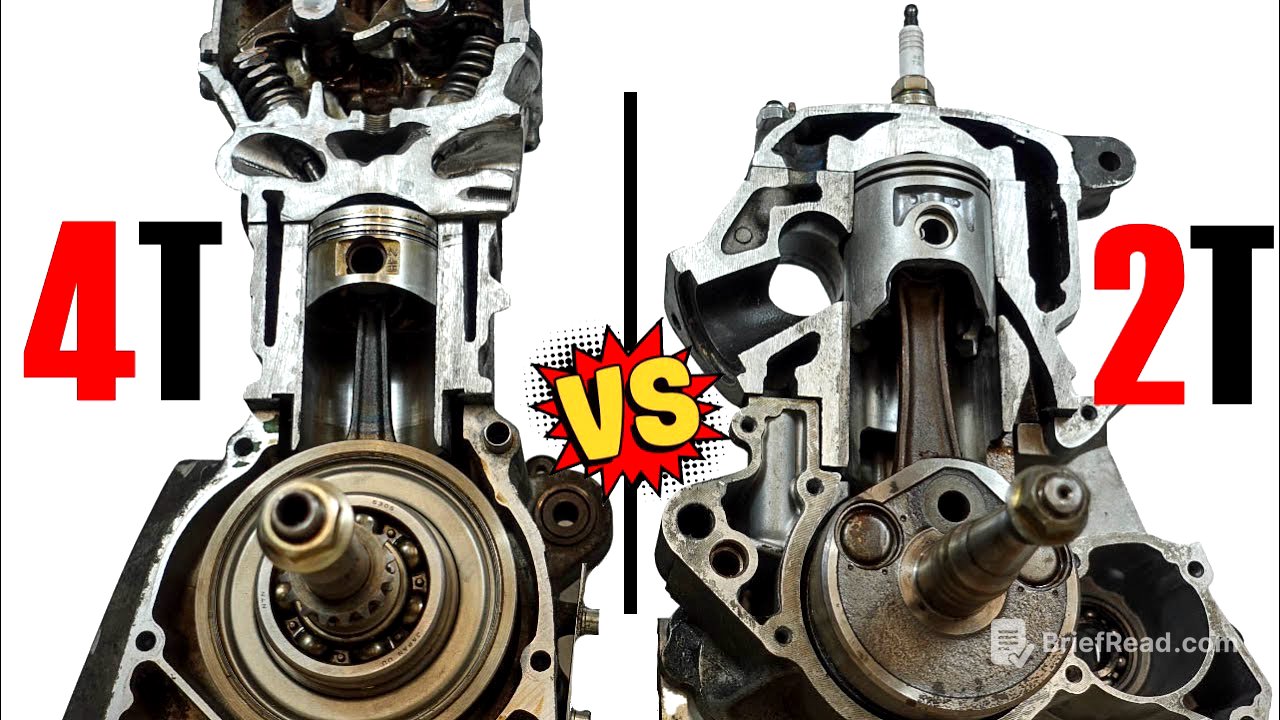
This video explains the operation and differences between four-stroke and two-stroke engines. It discusses various aspects such as combustion cycles, lubrication, compression ratios, and features like reed valves and direct injection, comparing the efficiency, complexity, and performance of both engine types.
- Four-stroke engines use a four-phase cycle: intake, compression, combustion, and exhaust.
- Two-stroke engines complete a cycle in two phases, allowing for twice the number of power strokes compared to four-stroke engines but resulting in higher emissions and potentially shorter lifespan.
Ciclo de combustión de los 4 tiempos [0:00]
The four-stroke engine operates through four phases: intake, compression, combustion, and exhaust. During the intake phase, the piston moves down, creating a vacuum that draws in a mixture of air and fuel. Next, the piston compresses this mixture. The spark plug ignites it, causing combustion, which pushes the piston down for power. Finally, during the exhaust phase, the piston pushes out the combustion gases. The video emphasizes how valves, operated by a camshaft, control these phases to optimize performance and prevent loss of pressure or energy during the cycle.
Ciclo de combustión de los 2 tiempos [8:02]
In contrast, the two-stroke engine cycle involves both phases occurring in a single movement of the piston, allowing for quicker combustion. The combustion phase pushes the piston down while simultaneously compressing a new fuel-air mixture located below the piston. This design leads to more frequent power strokes, producing theoretically double the power for the same displacement compared to four-stroke engines. However, the overlapping phases can lead to inefficiencies, such as unburned fuel escaping through the exhaust.
Válvula de láminas o pétalos [13:24]
Two-stroke engines often utilize a reed valve, which operates as a one-way valve to control the intake of the air-fuel mixture. As the piston descends, it creates a vacuum that opens the reed valve, allowing the mixture to enter the upper crankcase. When the piston rises, and the pressure increases, the reed valve closes, preventing the mixture from escaping. This mechanism helps maintain pressure and ensures efficiency in the combustion process despite the lack of traditional valves.
Lubricación [15:02]
Lubrication is crucial for preventing metal-to-metal contact in engines. In four-stroke engines, oil circulates to lubricate all moving parts continuously. However, in two-stroke engines, oil is mixed with fuel due to the need for constant lubrication under different conditions. This "total loss lubrication" system is less reliable, leading to shorter engine life and higher emissions, as unburned oil is expelled into the combustion chamber and eventually the atmosphere.
Relación de compresión [21:12]
The compression ratio is an important factor influencing engine efficiency. Four-stroke engines can achieve higher compression ratios since the compression occurs within a completely sealed cylinder, whereas two-stroke engines struggle due to their design, where compression begins before the exhaust port is closed. This results in lower efficiency and power performance in two-stroke engines.
Distribución mediante válvulas & válvulas de potencia [23:41]
The complexity of four-stroke engines allows for variable valve timing through the camshaft. This adaptability enhances performance across various RPMs. In two-stroke engines, modifications are limited, but they may include a power valve system to optimize exhaust port size for better performance across RPM ranges, although their overall design remains fixed compared to four-stroke engines.
Inyección directa [27:18]
Direct injection technology represents a significant advancement for both engine types, allowing fuel to be injected directly into the combustion chamber. This method improves efficiency, reduces emissions, and enhances lubrication issues typically faced in two-stroke engines. Although promising, direct injection technology is still in development and may improve the viability of two-stroke engines in future production.