TLDR;
This lesson introduces Venoba Bobby and his Buddhan movement, a land gift initiative aimed at helping landless people in India. It covers Venoba's background, the movement's origins, and its impact. Additionally, the lesson explains the concept of point of view in storytelling, detailing the differences between first-person and third-person perspectives (limited omniscient, omniscient, and dramatic/objective). The lesson concludes with an assignment involving the exploration of works by ancient Indian poets.
- Introduction to Venoba Bobby and the Buddhan Movement
- Explanation of the different types of Point of View
- Assignment: Exploring works of three famous ancient poets
Introduction to Venoba Bobby [0:44]
The lesson introduces Venoba Bobby, a key figure known for the Buddhan movement, also called the land gift movement or bloodless revolution, which was a voluntary land reform movement in India that started in 1951. The movement encouraged landowners to share their land with landless, poor farmers. Venoba was born on September 11, 1895, and died on November 15, 1982. He lived a simple, disciplined, vegetarian life, dedicating himself to studying and prayer. He became a follower of Mahatma Gandhi and was later arrested for protesting British rules. After India's independence, he focused on inspiring individuals through religion and selfless service, leading to some people calling him the new Gandhi.
The Story of a Saint: The Buddhan Movement [4:05]
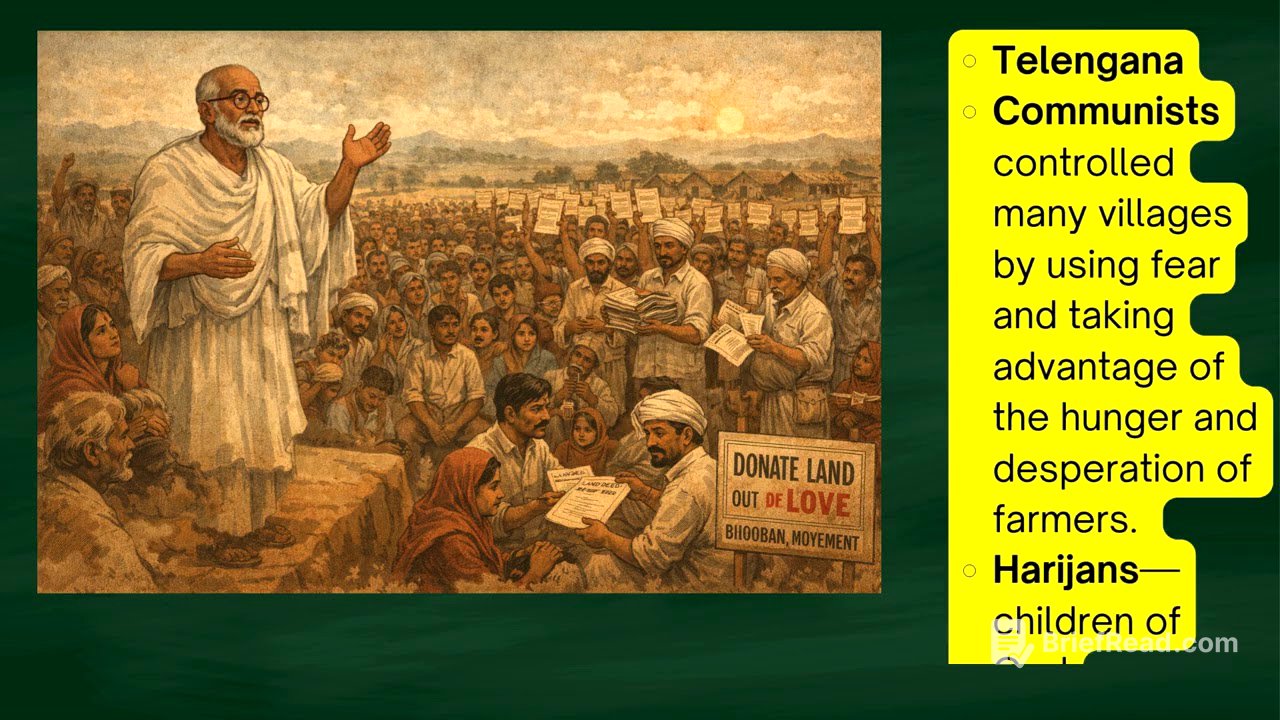
The Buddhan movement began on April 18, 1951, in Pochampelli, South India, where many were landless and hungry. Venoba initiated the Buddhan movement, advocating for landowners to voluntarily give land to the landless out of love. Thousands were inspired by Venoba's words, and many villagers donated land. The movement started when Venoba was walking through Telangana, a communist activity center, where landless people, referred to as "Harigians" or children of God, were promised land by communists. A wealthy man, Ramchandra, offered 50 hectares of land, marking the start of the Buddhan movement. Over 50 days, 6,000 hectares were donated, reducing the communist threat. The movement spread across India, with leaders praising it and people donating land even from places Venoba had not visited.
Venoba's Practices and Impact [9:58]
Venoba and his followers maintained a disciplined routine, waking up at 3:20 AM for prayer and walking silently. Villagers showed respect by touching their foreheads to his sandals. Venoba emphasized that India should be built on villages, with people taking action themselves. He believed in unity, stating that a village should have "one heart." While almost every village gave land to Buddhan, some critics pointed out that 30% of the donated land was not good and that Buddhan could not provide land for everyone. Venoba responded that any land could be used for community purposes. He inspired people to share and believe in a better life through love, discipline, and selfless giving. Venoba's quote emphasizes that giving away land is a significant sacrifice, like sharing a part of oneself, teaching that true generosity requires sacrifice and comes from the heart.
Point of View in Storytelling [14:46]
Point of view is the perspective through which a story is told. The first type is first person, where the writer uses "I" to narrate, providing insights into the character's thoughts and feelings. Key clues include the use of "I," "me," "my," and "we." The second type is third person, where the narrator is an observer using "he," "she," "it," or "they." Third-person perspective has three types: limited omniscient, which reveals the thoughts and feelings of only one character; omniscient, which reveals the thoughts and feelings of all characters; and dramatic or objective, which only relates the events and words of the characters without revealing their thoughts or feelings.
Assignment: Exploring Ancient Indian Poets [20:34]
The assignment involves exploring the works of three famous ancient Indian poets. Students are to read selected poems from each poet and reflect on their meanings, messages, and relevance to real life. The goal is to understand the emotions, ideas, and lessons expressed in the poems, which will help appreciate poetry and deepen understanding of different perspectives. Students can refer to pages 73 to 78 in their module for this task.